
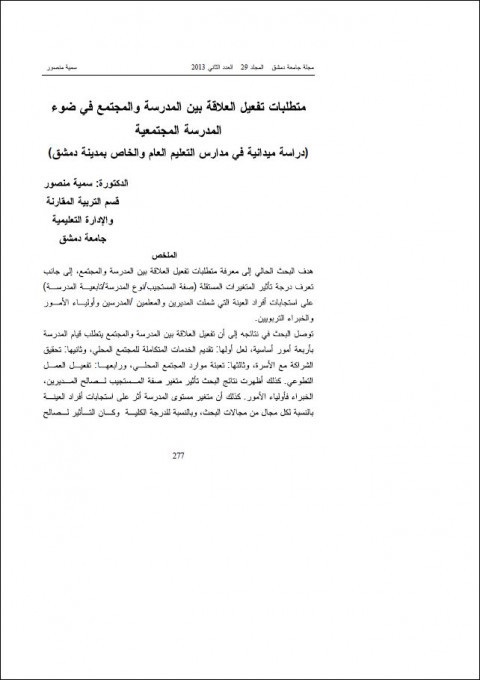
Requirement for Activating the Relationship between the School and the Society in the light of School Community : A Field Research in the Public and Private teaching schools in Damascus
- Auteur
- منصور، سمية
- Auteur institutionnel
- Damascus University
- ISBN
- ISSN 1818-5029
- Collation
- p. 277-325
- Langue de la ressource
- Arabe
- Année de publication
- 2013
- Type de ressource
- Research papers / journal articles
- Niveau d’éducation
- Enseignement primaireEnseignement secondaire
- Région
- États arabes
- Lieu de publication
- دمشق
This research aimed to identify: the requirement for activating the relationship between the school and the society, the degree of independent variables effect (the status of the respondent, the school level and the belonging of the school) on the sample’s responses (from the principals, teachers, parents and educational experts) to the questions of the research tool.
The research has reached the following findings: firstly, in order to make the relationship between school and society more effective, the school should satisfy the following four fundamental matters: Providing integrated services to the local society, achieving the partnership with the family, mobilizing the resources of the local society and enforcing voluntary work. Secondly, the effect of respondent's position variable was in favor of the managers, the teachers, the educational experts and parents respectively. Thirdly, the type of the school or its level has influenced the responses of the sample members at the general or total level as well as at the particular level for each sector of the field sectors, and this influence was in favor of basic education schools. Fourthly, there was no influence of belonging to the school variable on the sample responses whether on general or particular levels.
The research introduced some suggestions and proposals, for the partnership between school and society such as, the agreement of Syrian Ministry of education to legalize and implement the approach of effecting the relationship between school and society on the one hand, and to encourage parents, local community and schools to participate and cooperate.
Ressources associées
-
 IIEP-UNESCO 12th Medium-Term Strategy: 2026–2029
 -
 Advancing Intergenerational Learning: Identifying Challenges and Opportunities for Older Adults; Integrated Case Study Report
 -
 Digital Empowerment for Lifelong Learning and Transformative Andragogy (DELTA) for Adult Educators: Introduction to the DELTA Framework and Resources
 -
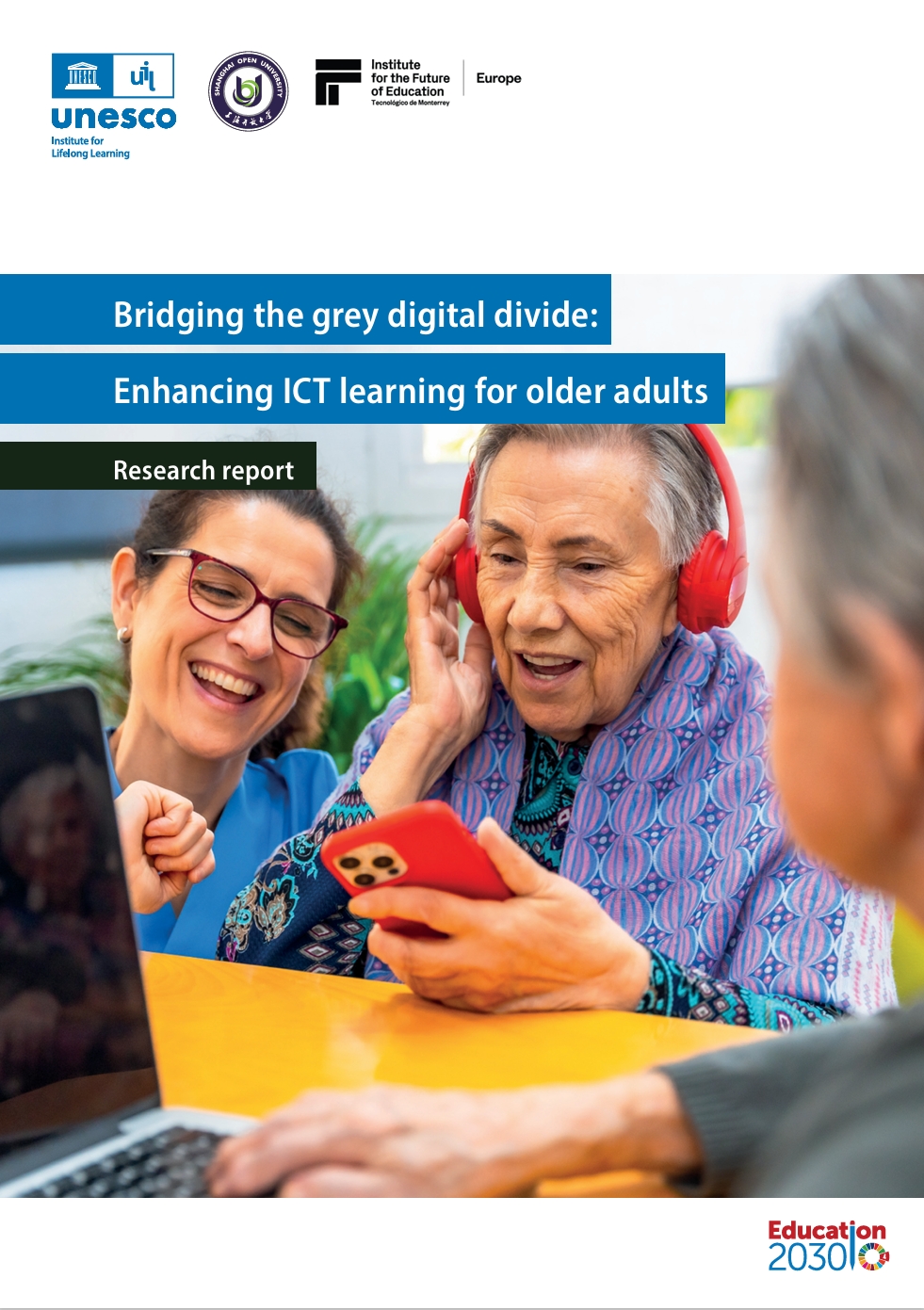 Bridging the Grey Digital Divide: Enhancing ICT Learning for Older Adults; Research Report