
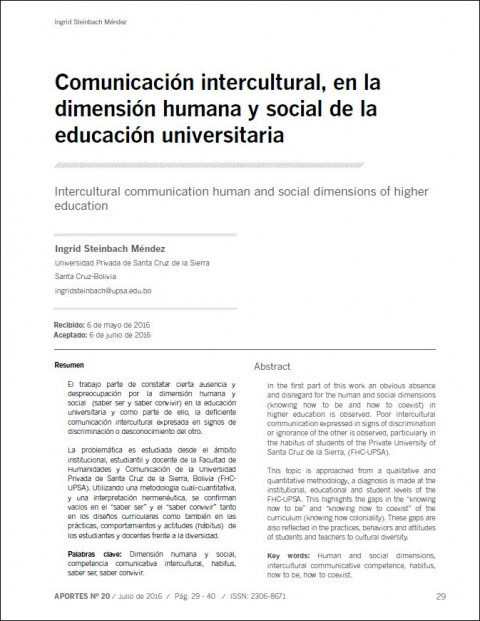
Intercultural Communication Human and Social Dimensions of Higher Education
- Author
- Ingrid Steinbach Méndez
- Corporate Author
- Universidad Privada de Santa Cruz de la Sierra
- ISBN
- ISSN 2306-8671
- Collation
- p. 29-40
- Resource Language
- Spanish
- Year of publication
- 2016
- Topic
- Civic / Citizenship / DemocracyDiversity / Cultural literacy / InclusivenessGlobalisation and social justice / International understandingTransformative initiatives / Transformative pedagogies
- Resource Type
- Research papers / journal articles
- Level of education
- Higher education
- Place of publication
- Santa Cruz de la Sierra
The starting point of this work is verifying the absence of and disregard for the human and social dimensions (knowing how to be and knowing how to coexist) in university education, including deficient intercultural communication manifested in discrimination ora lack of acknowledgement of the other. The problem is studied from the standpoints of the institution, the students and the faculty of the Faculty of Humanities and Communication of the Universidad Privada de Santa Cruz de la Sierra, Bolivia (FHC-UPSA). Using a qualitative quantitative methodology and a hermeneutic interpretation, voids are confirmed in the areas of "knowing how to be" and "knowing how to coexist" in the curricular designs as well as in the practices, behaviors and attitudes (habitus) of the students and faculty when faced with diversity.
Related Resources
-
 Study on the Historical Impact of the 1974 Recommendation concerning Education for International Understanding, Cooperation and Peace and Education relating to Human Rights and Fundamental Freedoms
 -
 IIEP-UNESCO 12th Medium-Term Strategy: 2026–2029
 -
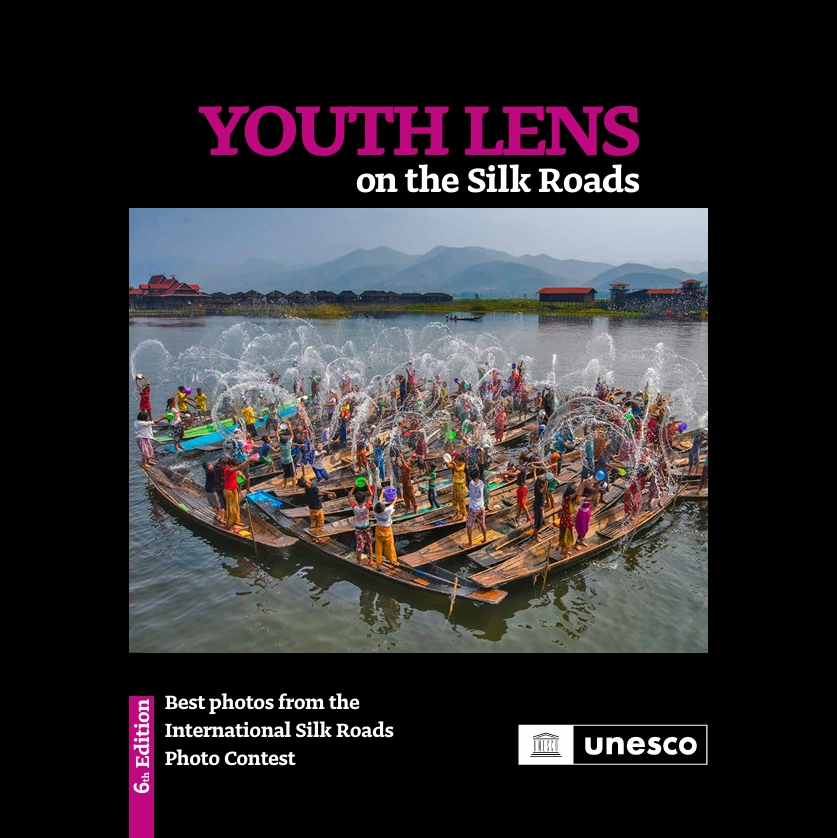 Youth Lens on the Silk Roads: Best Photos from the International Silk Roads Photo Contest; 6th Edition
 -
 More than Welcome: Intercultural Integration of Migrants in and Through Higher Education