
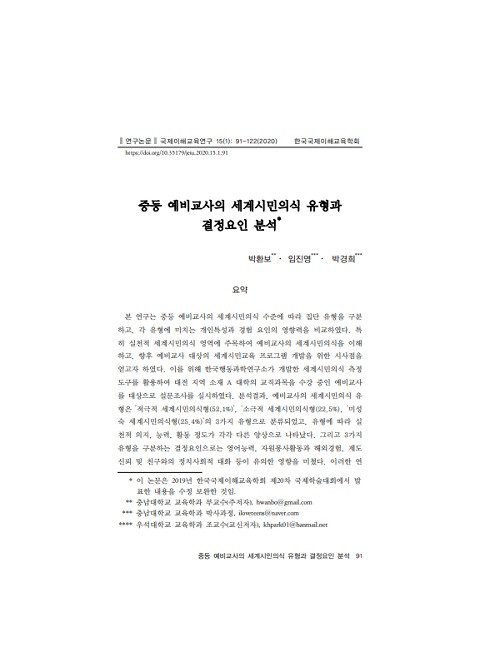
An Analysis on the Types of Global Citizenship Among the Pre-Service Secondary Teachers and the Determinant Factors (Journal of Education for International Understanding; Vol. 15, No. 1)
- Corporate Author
- Korean Society of Education for International Understanding (KOSEIU)
- ISBN
- ISSN 2005-3665
- Collation
- p. 91-122
- Resource Language
- Korean
- Year of publication
- 2020
- Resource Type
- Research papers / journal articles
- Level of education
- Higher education
- Region
- Asia and the Pacific
- Place of publication
- Seoul
This study aims to investigate the types of global citizenship among pre-service teachers based on the level of global citizenship and to explore the factors effect on each types. Especially, this study focus on the action area among the three dimension of global citizenship. For this purpose, 180 students were surveyed A university in Daejeon metro city with measurement tool developed by Korea Institute for Research in the Behavioral Sciences (KIRBS). The results show that the types of pre-service teachers divided into 3 group, ‘active global citizenship (52.1%)’, ‘passive global citizenship (22.5%)’, and ‘immature global citizenship (25.4%)’. fluency of English language, experience of volunteer and overseas, institutional trust, and communication with friends about political issues were significant factor effect on the practical type of global citizenship. The findings suggest that it is necessary to provide global citizenship education based on the characteristics of the pre-service teachers.
Related Resources
-
 Voices Against Violence: Middle Years
 -
 Study on the Historical Impact of the 1974 Recommendation concerning Education for International Understanding, Cooperation and Peace and Education relating to Human Rights and Fundamental Freedoms
 -
 IIEP-UNESCO 12th Medium-Term Strategy: 2026–2029
 -
 More than Welcome: Intercultural Integration of Migrants in and Through Higher Education