
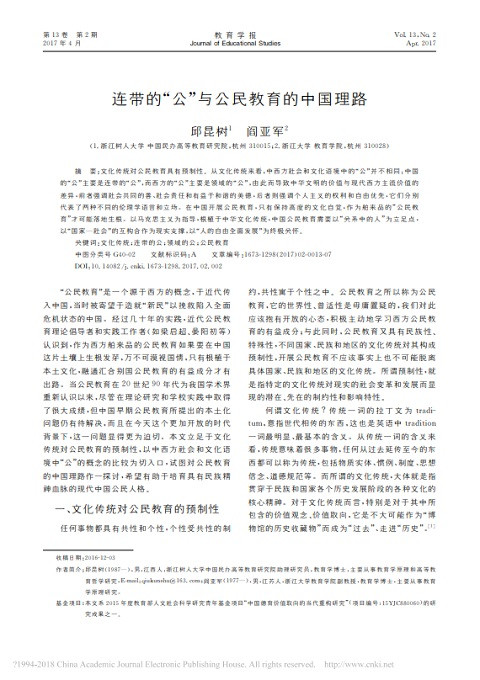
The Connective “Public” and the Chinese Logic of Citizenship Education (Journal of Educational Studies; Vol. 13, No. 2)
- Author
- Qiu KunshuYan Yajun
- Corporate Author
- Beijing Normal University
- ISBN
- ISSN 1673-1298
- Collation
- p. 13-19
- Resource Language
- Chinese
- Year of publication
- 2017
- Resource Type
- Research papers / journal articles
- Level of education
- Non-formal educationOthers
- Region
- Asia and the Pacific
- Place of publication
- Beijing
Cultural tradition has pre-conditionality on citizenship education. From the point of view of cultural tradition, the “public” in citizenship education has different meaning in China and the West: Chinese “public” is mainly a kind of connective “public”, while the western “public” mainly means domanial “public”. This lead to the difference in Chinese and modern western main stream values. The former emphasizes the common goodness of the whole society, social responsibility and virtue which is favorable to harmony, while the later emphasizes individualist rights and priority of freedom. They represent two kinds of ethics language and position. It is essential to maintain high cultural awareness for the implementation of citizenship education in China and the localization of exotic “citizenship education”. Guided by Marxism and rooted in Chinese cultural tradition, Chinese citizenship education should be based on “people in relation”, use the actual support of “state-society” cooperation, and offer ultimate concern to “the free and comprehensive development of human”.
Related Resources
-
 Addressing Violent Pasts Through Education: A Policy Guide
 -
 Where Learners Meet History: Reaffirming the Role of History Education in the 21st Century
 -
 Study on the Historical Impact of the 1974 Recommendation concerning Education for International Understanding, Cooperation and Peace and Education relating to Human Rights and Fundamental Freedoms
 -
 IIEP-UNESCO 12th Medium-Term Strategy: 2026–2029