
Resources
Explore a wide range of valuable resources on GCED to deepen your understanding and enhance your research, advocacy, teaching, and learning.
8,362 Results found
 5th UNESCO Forum on Transformative Education for Sustainable Development, Global Citizenship, Health and Well-being (Strand 1) Year of publication: 2021 Author: Shadreck Majwabe | Thomas Greiner | Taka Horio | Niveen Jouhar | Arjen Wals | Lynndina Essack | Didier Jourdan | James O’Higgins Norman | Bolorchimeg Dagva Corporate author: UNESCO | APCEIU Plenary session 1In this first plenary, countries shared their vision, practice and progress underpinning their understanding of “transformative education”. The impact of current practices related to learners’ behavior and the educational system was discussed, highlighting success indicators.Moderator: Ms Krista Pikkat, Director, UNESCO Almaty OfficeMr Shadreck Majwabe, Director of the Department of Curriculum Development and Evaluation, Ministry of Basic Education, BotswanaMr Thomas Greiner, Head of Subdivision, Lifelong Learning, Federal Ministry of Education and Research, GermanyMs Taka Horio, Assistant Secretary-General, the Japanese National Commission for UNESCO & ASP National Coordinator, Ministry of Education, Culture, Sports, Science and Technology, JapanMs Niveen Jouhar, Member of Directorate of Curricula, Ministry of Education, Jordan Concurrent sessions 1Following the plenary session, the concurrent sessions discussed the different components that need to be transformed in the education system, and how to bring about these changes and further advance. Session 1.1 – PolicyModerator: Ms Akpezi Ogbuigwe, Founder, Anpez Centre for Environment and Development, Nigeria Mr Arjen Wals, UNESCO Chair, Social Learning and Sustainable Development, University of Wageningen, Netherlands Ms Anna-Karin Johansson, Swedish National Commission for UNESCO, Ministry of Education, Sweden Mr Felipe de Souza Costa, São Paulo Municipal Secretariat of Education, Brazil Mr El Hadji Gueye, Founder, Banlieu UP, Senegal Session 1.2 – Curricula, pedagogy and assessmentModerator: Mr Yao Ydo, Director, UNESCO International Bureau of Education (IBE)Dr Esther Care, Professor, University of Melbourne, AustraliaMs Lynndina Essack, Senior Education Officer, Department of Education Services, Ministry of Education, SeychellesMr Daehoon Jho, Professor, Sungshin Women's University, Republic of KoreaDr Jinan Karameh Chaya, Principal, Al Manar Modern School (UNESCO Associated Schools Network member), Lebanon Session 1.3 – Learning environmentModerator: Mr Chris Castle, Chief of Section of Education for Health and Well-being, UNESCOProf Didier Jourdan, UNESCO Chair and Head of the World Health Organization (WHO) Collaborating Center "Global Health & Education"Prof James O’Higgins Norman, Director of the National Anti-Bullying Centre, the Dublin City University, Ireland & UNESCO Chair on Tackling Bullying in Schools and CyberspaceMs Bolorchimeg Dagva, Adolescents and HIV Specialist, UNICEF, Mongolia Links to Strand 2 & Special session / Strand 3 / Strand 4
  Peace Education in Northeast Asia: A Situational Analysis Year of publication: 2021 Author: Soonwon Kang | Cheng Liu | Ketei Matsui | Batbaatar Monkhooroi | Boyoung Park | Muyu Huang | Oyuntsetseg Dugarsuren Corporate author: APCEIU Being central to education for international understanding and global citizenship, peace education has always been an important theme in UNESCO. For effective delivery of peace education, it is critical to examine and understand the relevance of peace education and its key issues and approaches at a given juncture. With this in mind, in 2020, APCEIU conducted a study on peace education in South Korea to review its current state and suggest some policy recommendations. Following up on this study, APCEIU initiated in 2021 a research project on peace education in Northeast Asia in order to identify how peace education is interpreted and practised in the countries of the region and explore possibilities of cooperation among peace educators, researchers, and practitioners in the region. Building on this research, APCEIU hopes to develop and carry out joint projects for peace education in the region.
  Policy Review Report: Early Childhood Care and Education in Kazakhstan Year of publication: 2005 Corporate author: UNESCO UNESCO launched a joint UNESCO/OECD Early Childhood Policy Review Project as a component of the 2004-2005 plan. The purpose is to provide selected countries with an opportunity to review their early childhood policies and identify concrete options and strategies for improvement. Four countries were chosen based on their expressed interest - Brazil, Indonesia, Kazakhstan and Kenya. This review was conducted as part of Kazakhstan's participation in the project, which is being implemented in collaboration with the OECD.
  Strengthening the Gender Journalism Curriculum in the Republic of Kazakhstan Year of publication: 2018 Author: Sergey Karpov | Nazgul Shyngysova This program focuses on how strategic gender analysis might be incorporated into journalistic production. It describes and analyzes how inequalities between men and women occur culturally and are reproduced in the media, enabling students to critically examine and reconsider their own stereotypes.
 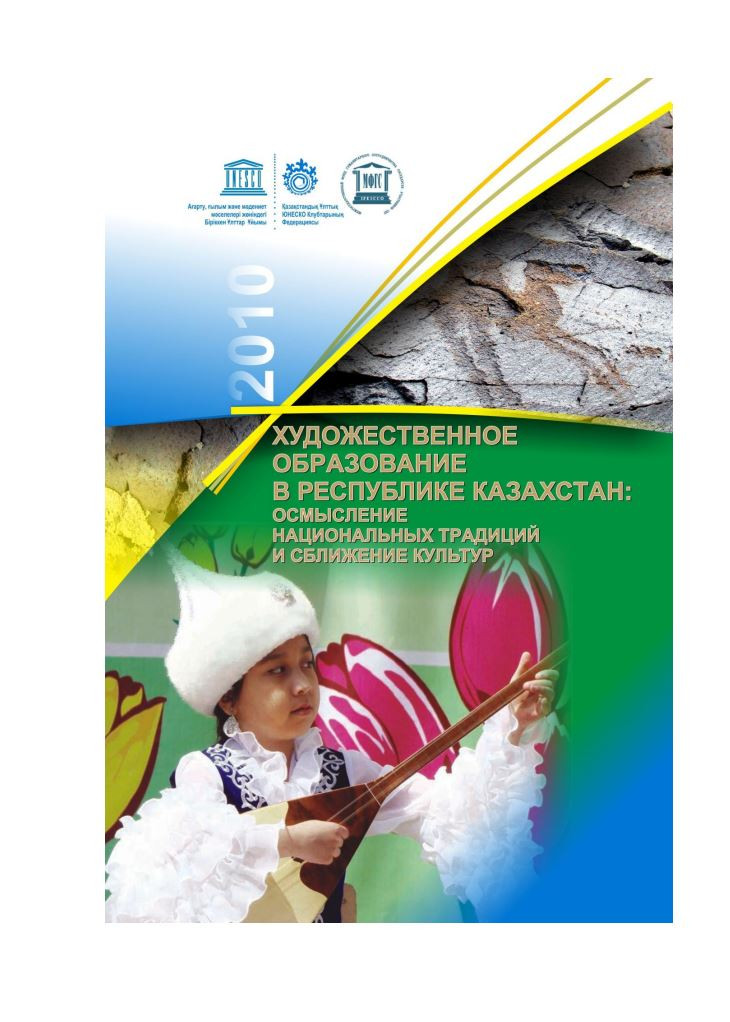 Art Education in the Republic of Kazakhstan: Perception of the National Traditions and Rapprochement of the Cultures; Research Paper Year of publication: 2010 Author: Rustam Muzafarov Kazakhstan has the unique feature of ethno-cultural diversity that appeared historically due to multi-ethnic and multi-confessional population's development. Such an environment urges the state to facilitate the revival and development of ethnic cultures and cross-cultural interaction for the benefit of national unity. The adoption of the concept of ethno-cultural education means that the creation of national education system would enhance the idea of cultural and linguistic pluralism, combining the advanced education techniques and information facilities with traditional cultural values. In fact, the educated personality feels real belonging to the historical and cultural traditions of the country.
  The Ratio of the National and Universal in the Sphere of Spirituality (on the example of Central Asia) Year of publication: 2015 Author: Ranokhon Tursunova The ratio national and universal in the sphere (Central Asia)» on the spiritual revival in the region, the place of human values in the reforms. The transformation of national and universal values in Central Asia, which is represented by a wide range of multiculturalism, ethnic groups, religions, languages traditions and customs.
  Central Asian States in the International Rankings of Democracy Development Year of publication: 2021 Author: E.G. Garbuzarova Each Central Asian state has its own features and dynamics/statics of democratic transit, but they are all united by the personification of power and loyalty to the autocrat rather than to the political institutions. The author attempts to trace the current state of the political systems of Central Asian states, highlighting the positive and negative trends in their democratization.
  Manuscript Heritage of Uzbekistan and Its Current State Year of publication: 2021 Author: Asror Abdukhakimov The study of the cultural and educational heritage of past centuries, developed by the entire history of mankind, is one of the main tasks in the construction of a new society and its culture, because only accurate knowledge of culture and science created by the entire development of mankind, and their processing can build a progressive culture. Of particular importance in this is the study of medieval written sources, which are one of the main sources of information about the historical past of people.
 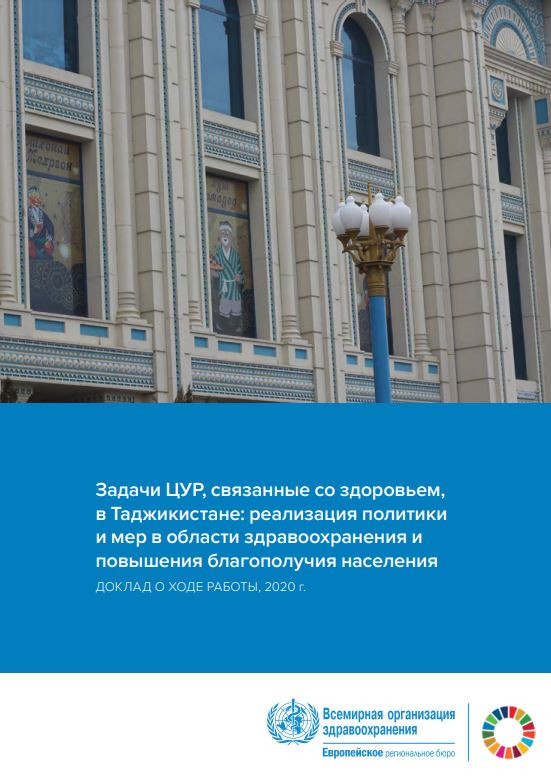 Health-related SDG Targets in Tajikistan: Implementation of Policies and Measures for Health and Well-being Year of publication: 2020 Corporate author: World Health Organization (WHO) This report reviews and assesses the achievements towards SDG 3 and its targets as well as health-related targets of other SDGs to date in Tajikistan. This is the first step of the GAP process (engage, assess, align, accelerate and account) and will clarify priorities for action to accelerate the achievement of SDG 3 in Tajikistan and alignment of development partners’ support.
 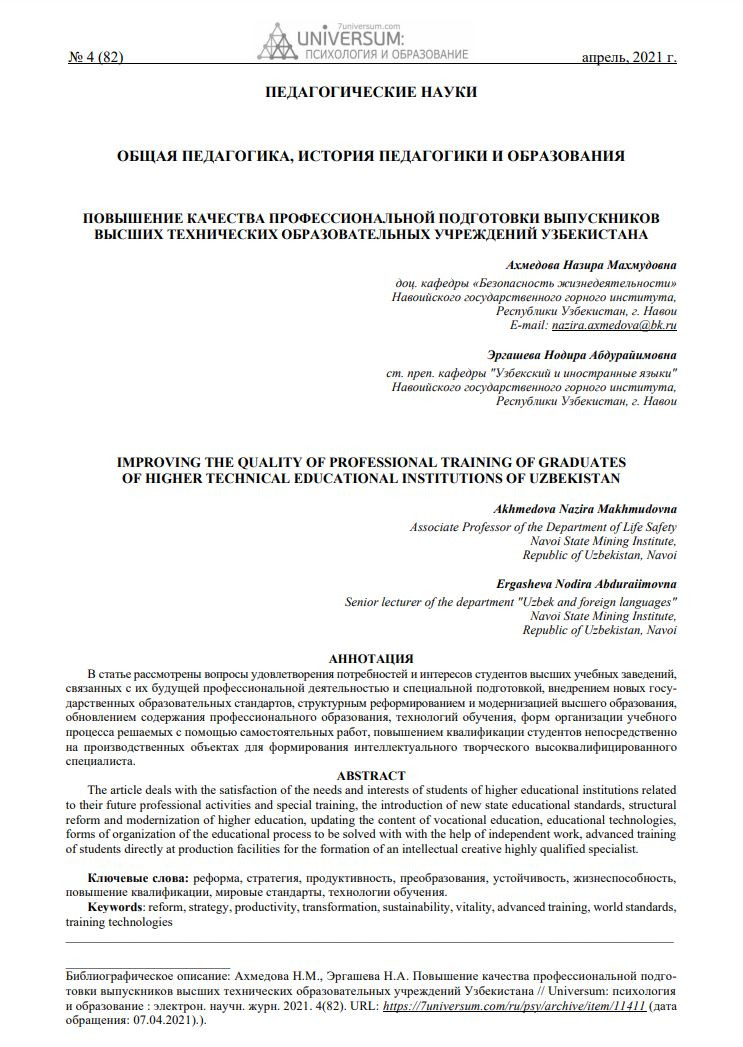 Improving the Quality of Professional Training of Graduates of Higher Technical Educational Institutions of Uzbekistan Year of publication: 2021 Author: Nazira Akhmedova | Nodira Ergasheva The article deals with the satisfaction of the needs and interests of students of higher educational institutions related to their future professional activities and special training, the introduction of new state educational standards, structural reform and modernization of higher education, updating the content of vocational education, educational technologies, forms of organization of the educational process to be solved with with the help of independent work, and advanced training of students.