
Resources
Explore a wide range of valuable resources on GCED to deepen your understanding and enhance your research, advocacy, teaching, and learning.
8,376 Results found
 Countering Terrorism through Education of Populations: The Case of African Countries Year of publication: 2011 Author: Simon M. Lelo Terrorism has become a major concern of current governments. African countries are also involved in counter- terrorism but, due to several internal security and development problems, their effective participation in the combat against terrorism is very limited. They need capacity and skills in order to participate actively in countering terrorism. Education is one of the most appropriate ways for preparing African countries to prevent terrorism. Education provides not only knowledge but also capacity to make informed decisions, strategies and policies. The international community should help African countries to strengthen their education through specialized and general training programmes. Impact of Radical Islamisation of Education on Pakistani Society Year of publication: 2012 Author: Muhammad Safeer Awan This article traces the history, rather briefly, of how the national educational policies and curricula in social sciences and humanities have been changed to serve the jihadist ideology in Pakistani society. The crumbling social order in Pakistan is not only an indication of the bad governance but also the systemic inculcation of ideologies of hatred and extremism among a whole generation of schoolchildren and college graduates. It is a society where extremism, not only of the radical Islamists but also of the average person, is on the rise.
  Education and Conflict: Complexity and Chaos Year of publication: 2003 Author: Lynn Davies Based on the author's extensive research and experience of education in several areas afflicted by conflict, the book explores the relationship between schooling and social conflict and looks at conflict internal to schools. It posits a direct link between the ethos of a school and the attitudes of future citizens towards 'others'. It also looks at the nature and purpose of peace education and war education, and addresses the role of gender and masculinity.
  Resilience, violent extremism and religious education Year of publication: 2013 Author: Joyce Miller This article is an attempt to provide an educational justification for the British Government-funded project REsilience, on addressing contentious issues through religious education (RE), which was carried out by the RE Council of England and Wales. A number of issues relating to the inclusion of religiously inspired violent extremism in the curriculum are raised – definitional, political and educational.
 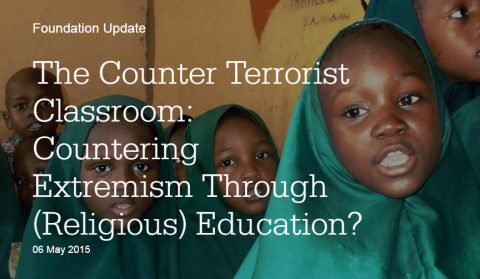 The Counter Terrorist Classroom: Countering Extremism Through (Religious) Education? Year of publication: 2015 Author: Liam Gearon The article identifies international cases– from the United States, Europe, and the United Nations– of an emergent interface of religion, education and security. This is manifest in the uses of religion in education to counter religious extremism, the notional “counter terrorist classroom”. To avoid an over-association of extremism with religion, the article provides some historical reminders that the post-Enlightenment centuries were marked by political extremism, particularly in the phenomenon that came to be known as totalitarianism.
  Preventing violent extremism through education Year of publication: 2016 Corporate author: Tim Parry Jonathan Ball Foundation for Peace This UNESCO video illustrates the importance of preventing violent extremism through education. It is based on excerpts from “My Former Life”, produced by the Tim Parry Johnathan Ball Foundation for Peace, based on testimonies of people once engaged in promoting or perpetrating extreme violence. This video also draws attention to some of the drivers of violent extremism, to the role of education in preventing violent extremism and to educational approaches recommended by UNESCO.
  Education, Extremism and Terrorism: What should be Taught in Citizenship Education and Why Year of publication: 2012 Author: Dianne Gereluk Should educators be exploring terrorism and extremism within their classrooms? If so, what should they be teaching, and how? Dianne Gereluk draws together the diverging opinions surrounding these debates, exploring and critiquing the justifications used for why these issues should be addressed in schools. She goes on to consider the ways in which educators should teach these topics, providing practical suggestions.
  Education and Security - a global literature review on the role of education in countering violent religious extremism Year of publication: 2016 Author: Ratna Ghosh | Ashley Manuel | W.Y. Alice Chan | Maihemuti Dilimulati | Mehdi Babaei This review demonstrates that the impact of the worldwide proliferation of violent attacks motivated by religious extremism threatens both national and personal security irrespective of location or faith. Education has been particularly damaged by direct attacks on institutions, by the removal of educational opportunity, and by the use of education to indoctrinate and recruit young people. This review suggests that more young people today are being radicalized through soft power – extremist ideas, ideology, narratives and propaganda. It questions whether this can be met adequately by hard power responses, as these methods appeal directly to the psychological, intellectual and emotional states of young people.
  Global Citizenship Education and the Crises of Multiculturalism: Comparative Perspectives Year of publication: 2016 Author: Massimiliano Tarozzi, Carlos Alberto Torres The notion of global citizenship education (GCE) has emerged in the international education discourse in the context of the United Nations Education First Initiative that cites developing global citizens as one of its goals. In this book, the authors argue that GCE offers a new educational perspective for making sense of the existing dilemmas of multiculturalism and national citizenship deficits in diverse societies, taking into account equality, human rights and social justice.The authors explore how teaching and research may be implemented relating to the notion of global citizenship and discuss the intersections between the framework of GCE and multiculturalism. They address the three main topics which affect education in multicultural societies and in a globalized world, and which represent unsolved dilemmas: the issue of diversity in relation to creating citizens, the issue of equality and social justice in democratic societies, and the tension between the global and the local in a globalized world.Through a comparative study of the two prevailing approaches – intercultural education within the European Union and multicultural education in the United States – the authors seek what can be learned from each model. Global Citizenship Education and the Crises of Multiculturalism offers not only a unifying theoretical framework but also a set of policy recommendations aiming to link the two approaches. Preface 1. The Priority of Global Citizenship EducationPart One Defference and Citizenship 2. Theoretical Conceptualization: The Challenge of Diversity 3. Multiculturalism: The US Perspective 4. Interculturalism: The European Union Perspective 5. Comparing Intercultural and Multicultural EducationPart Two Justice in Democracies 6. Theoretical Conceptualization: The Challenge of Equlaity 7. From Multiculturalism to Global Citizenship Education 8. ConclusionBibliographyIndex
  Educating Against Extremism: Towards a Critical Politicisation of Young People Year of publication: 2009 Author: Lynn Davis The paper examines the nature of extremism; identity formation and radicalization; religious belief, faith schools and the myth of equal value; justice, revenge and honour; and free speech, humour and satire. It argues that religious fundamentalism, as well as state terrorism, needs to be addressed in schools. Specific forms of citizenship education are needed, which provide skills to analyse the media and political or religious messages, but also enable critical idealism to be fostered.