
Resources
Explore a wide range of valuable resources on GCED to deepen your understanding and enhance your research, advocacy, teaching, and learning.
8,376 Results found
 The Presentation of the Holocaust in German and English School History Textbooks: A Comparative Study As textbooks are one way of teaching and influencing pupils’ learning, this paper aims to examine critically and compare the presentation of the Holocaust in English and German textbooks. To set the scene, the paper investigates the theoretical and methodological background of textbook analysis. This is followed by a description of the sample and method chosen for this study. The analysis concentrates upon the question of culpability for the Holocaust in German and English textbooks and reasons for this. The paper concludes by exploring the possible effects the presentation of ‘blame’ for the Holocaust has upon the pupils who read textbooks. (by the author)
  The Holocaust by Bullets - A study guide for educators Year of publication: 2015 Author: Urszula Szczepinska This guide released by Yahad in Unum is the result of several years of research on mass shootings of Jews and Roma in the ex-Soviet Union. Using this guide, teachers can educate about the genocide in the eastern parts of Europe by killing squads, a part of istory that was long obscured.
  Lessons learned from the Holocaust blogging to teach critical multicultural literacy This qualitative dual-case study addresses two 21st century teacher education imperatives, technology infusion and critical multicultural literacy instruction. We researched the integration of a blog as a tool to promote technology use in a graduate course on literacy and technology with a thematic focus on the Holocaust. Using a grounded theory approach (Corbin & Strauss, 2008), we analyzed data sources, including interviews, blog postings and surveys. We conducted a second analysis using a priori coding schemes to further analyze students’ blog posts. Findings suggest that blogging has the potential to enhance knowledge of the ways technology can be harnessed to promote critical multicultural literacy instruction. From an action research stance, we also discuss implications for our future practice. (By the author)
  Holocaust education in the primary school: Some reflections on an emergent debate Recent years have witnessed the beginnings of a debate over whether the Holocaust should be taught in primary schools. In this article the claims advanced in favour of the proposal are shown to be plausible but lacking in empirical support, while the counter-claims are considered either peripheral, contentious or contrary to established research. It is argued that some key omissions in the debate, such as the way primary school pupils conceptualize Jewish culture and identity, significantly strengthen the case against introducing young children to the Holocaust. (By the author)
  Confronting the Holocaust in Religious Education Studies of Holocaust education in secondary schools have tended to focus on how the subject is taught as part of the history curriculum. Comparatively little work of either a theoretical or an empirical nature has looked at how the subject is handled in other curricular areas. Religious education is a case in point, for the field is marked both by a dearth of literature on appropriate content and by a virtual absence of research on teachers' practices. The need to address these lacunae provides the rationale for the article. In relation to content, two concerns dominate the discussion. The first is that the Holocaust may be portrayed as an act of religious intolerance; the second is that students may be offered a diluted or distorted account of the part played by Christianity. The empirical core of the article surveys the practices of 28 teachers of religious education in connection with both concerns. It also contains a content analysis of how textbooks used by the teachers treat the attempted annihilation of European Jewry. The article concludes with a discussion of the policy implications of the findings. (By the author)
  Holocaust Education in Ontario High Schools: An antidote to racism? The premise underpinning this article is that if the Holocaust is taught well, it can help to promote anti-racist goals. The need to realize the Holocaust's anti-racist potential is self-evident, but is arguably greatest where conventional anti-racism (aimed at enhancing the life chances of visible minorities) is under threat. Such a situation currently exists in Ontario, where the right wing Progressive Conservative party was elected to office in June 1995. The uncertain future of anti-racism in the province provides the background to this article. It examines the teaching of the Holocaust in Ontario high schools and reports the findings of a survey carried out among history staff in May 1998. Various ways are suggested in which the teachers involved (and others elsewhere) might alter their approach to the Holocaust in order to strengthen its contribution to anti-racist education. (By the author)
 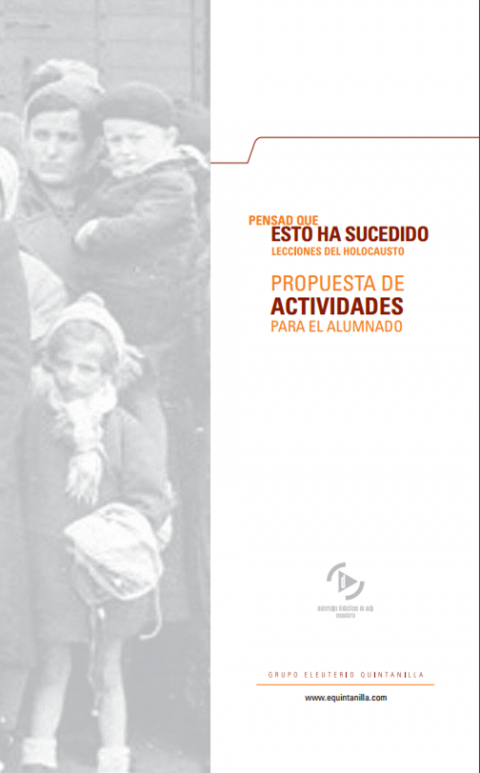 Pensad que esto ha sucedido : lecciones del Holocausto : Propuesta de actividades para el alumnado Year of publication: 2007 Corporate author: Grupo Eleuterio Quintanilla This resource guide published by the Spanish anti-racist association "Grupo Eleuterio quintanilla" was developed for teachers to broach the Holocaust by examining the historical process and its circumstances through legal and historiographical documents.
  The role of the Holocaust in antiracist education: A view from the United Kingdom The failure of antiracist educators in the United Kingdom to engage seriously with the issue of anti‐Semitism provides the background to this article. With specific reference to the Holocaust, it argues that a lack of interest among antiracists in how the subject is taught has had a number of adverse consequences. These include the forfeiture of a potent vehicle for reinforcing and advancing the aims of antiracism and the loss of the unique contribution that a study of the Holocaust can make to an understanding of racism. Lack of interest in the Holocaust has also meant that inadequate consideration has been given to the consequences for antiracist education of the subject being taught badly. To obviate these drawbacks, the article advocates a definition of racism that can embrace anti‐Semitism and thereby facilitate the involvement of antiracists in teaching about the attempted annihilation of European Jewry. (By the author)
  Teaching the Holocaust: The relevance of children's perceptions of Jewish culture and identity The Holocaust is now part of the history curriculum for all 11-14-year olds in maintained schools in England and Wales. In this paper it is argued that for the Holocaust to be taught effectively, teachers will need to have some idea of how children within this age group perceive Jewish culture and identity. The empirical core of the paper attempts to go some way towards meeting this need. Seventy-two children aged between 12 and 14 were interviewed in order to explore their knowledge of Judaism, the nature of any misconceptions they may have about the faith, the extent to which they appreciate the commonalities between Judaism and Christianity and their awareness of anti-Semitism. The paper concludes with a discussion of the policy implications of the findings. (By the author) Arab Teachers and Holocaust Education: Arab Teachers Study Holocaust Education in Israel This paper examined whether change occurred in the attitudes of Arab teachers in Israel toward Holocaust education following an in-service study course. Survey and interview data indicated that after the course, teachers had a better understanding of what occurred during the Holocaust, and their willingness to know about its effects on Jewish people increased. However, the Israeli-Palestinian conflict impacted participants' views. (By the author)