
Resources
Explore a wide range of valuable resources on GCED to deepen your understanding and enhance your research, advocacy, teaching, and learning.
8,376 Results found
 Anti-Semitism in Europe up to 1945 (Vol 1) Corporate author: Anne Frank House | OSCE. Office for Democratic Institutions and Human Rights (ODIHR) These teaching materials were developed by ODIHR and the Anne Frank House in Amsterdam, in co-operation with experts from several OSCE participating States. Part 1 examines the history of anti-Semitism. The version available here is an English translation of the Lithuanian version.
  Using social media in Holocaust Education Corporate author: International Holocaust Remembrance Alliance (IHRA) Social media is a rapidly expanding form of communication and community in our world and in education more specifically. Holocaust educators are tasked with determining how best to use this tool in their programming without compromising programme or subject integrity. These guidelines outline considerations and practices in deploying social media in the Holocaust educational environment. Ensinando sobre o Holocausto na Escola : Informações e Propostas para Professores dos Ensinos Fundamental e Médio Year of publication: 2014 Author: Nilton Mullet Pereira | Ilton Gitz Corporate author: UNESCO This textbook aims at helping teachers of primary and secondary education to address the Holocaust theme in their classes. This book contains suggested activities, lists of books and films references to help pupils to make connections between the Holocaust and others genocides but also to develop critical thinking and respect for human rights.
  Living with Controversy: Teaching Controversial Issues through Education for Democratic Citizenship and Human Rights (EDC/HRE); Training Pack for Teachers Year of publication: 2015 Corporate author: Council of Europe Learning how to engage in dialogue with people whose values are different from one’s own and to respect them is central to the democratic process and essential for the protection and strengthening of democracy and fostering a culture of human rights. Yet in Europe young people do not often have an opportunity to discuss controversial issues in school because they are seen as too challenging to teach, e.g., issues to do with extremism, gender violence, child abuse, or sexual orientation. Unable to voice their concerns, unaware of how others feel or left to rely on friends and social media for their information, young people can be frustrated or confused about some of the major issues which affect their communities and European society today. In the absence of help from school, they might have no reliable means of dealing with these issues constructively and no one to guide them. The idea for this Pack came out of a call from policy-makers and practitioners in a number of European countries for more effective training for teachers in the teaching of controversial issues.
  Global Citizenship Education: Preparing Learners for the Challenges of the 21st Century Year of publication: 2014 Corporate author: UNESCO The United Nations Secretary-General’s Global Education First Initiative (GEFI) has established education as a means to ‘foster global citizenship’ – one of its three priority areas. To support this, UNESCO organized two landmark meetings on GCE in 2013. This publication aims to define the parameters of GCE by using the collective expertise, experience and wisdom of those participants who gathered at these landmark events, and to plan for future action in line with emerging thinking and other ongoing work. The review establishes that GCE has a critical role to play in equipping learners with competencies to deal with the dynamic and interdependent world of the twenty-first century. While GCE has been applied in different ways in different contexts, regions and communities, it has a number of common elements, which include fostering in learners. In formal settings, GCE can be delivered as an integral part of an existing subject (such as civic or citizenship education, social studies, environmental studies, geography or culture), or as an independent subject area. Integrated models appear to be more common. Some less traditional, but at least as effective, pathways for GCE have included the following: the use of information and communication technologies and social media, sport competitions and the use of art and music, and youth-led initiatives employing a wide variety of approaches. Both traditional and new horizons for GCE are profiled in this review. This publication also explores a number of enabling conditions for the promotion and implementation of GCE. These include: the existence of an open environment for universal values, the implementation of transformative pedagogy and support for youth-led initiatives.The review acknowledges that there are a number of ongoing tensions with the concepts of global citizenship and global citizenship education. While these tensions vary, they all point to the fundamental question of how to promote universality (e.g. common and collective identity, interest, participation, duty), while respecting singularity (e.g. individual rights, self-improvement). Some ways forward to resolve these tensions are suggested, whilst maintaining that challenges around theoretical elements of GCE should not undermine its practice. The processes documented in this publication have strengthened partnerships, built coalitions and contributed to improving the evidence base on the theory and practice of global citizenship education. While there are tasks that remain, this foundation bodes well for improving the enabling conditions and the practices highlighted in this review. By preparing learners to fulfil their potential in an increasingly globalized world, we are promoting transformed societies that are also better equipped to deal with the twenty-first century challenges and to seize twenty-first century opportunities.
  [Video] Learning to live together in peace through Global Citizenship Education Year of publication: 2016 Corporate author: UNESCO The UNESCO video on “Learning to live together in peace through Global Citizenship Education” explains the importance of Global Citizenship Education (GCED) in a globalized and increasingly interconnected and interdependent world. GCED is key to understand the interconnections between the local and the global and nurture a sense of belonging to a common humanity. It builds motivation to assume active roles to contribute to a more just, peaceful, tolerant and sustainable world. The video also illustrates how GCED can be delivered in and outside of schools.
 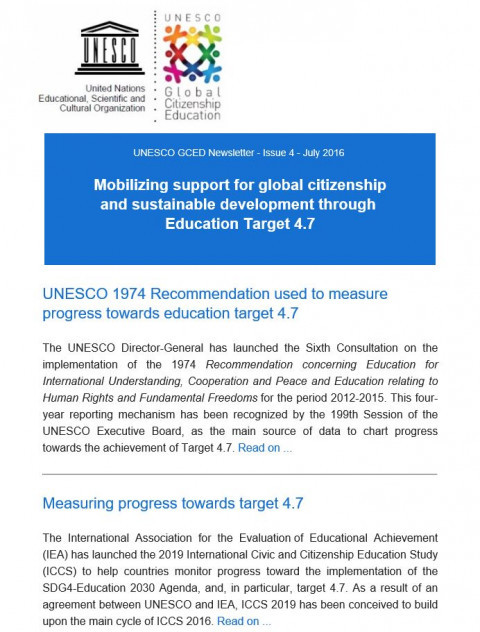 UNESCO GCED eNewsletter Issue 4 Year of publication: 2016 Corporate author: UNESCO Feature: Mobilizing support for global citizenship and sustainable development through Education Target 4.7 UNESCO 1974 Recommendation used to measure progress towards education target 4.7 Measuring progress towards 4.7 Gyeongju Action Plan: NGOs join UNESCO Global capacity-building workshop on GCED organized by APCEIU Southern Africa Regional Meeting on GCED convened in Johannesburg, South Africa UNESCO launches Teacher's Guide on the Prevention of Violent Extremism Expert meeting on the Prevention of Violent Extremism through Education European ministers back education for democracy to counter extremism and racaism UN discusses innovative solutions to prevent violent extremism through education UNESCO's YESPeace Network taps the power of youth worldwide to change the future GCED Topics and Learning Objectives available in seven languages. Address by Irina Bokova, Director-General of UNESCO on the occasion of the Geneva Conference on Preventing Violent Extremism – The Way Forward Year of publication: 2016 Corporate author: UNESCO. Director-General, 2009-2017 (Bokova, I.G.) This address presented by Irina Bokova, Director-General of UNESCO, on the occasion of the Geneva Conference on Preventing Violent Extremism - The Way Forward. Values Education through Sport Year of publication: 2016 Corporate author: UNESCO Innovative education for developmentEducation in the 21st century increasingly recognizes the role of values and social skills in tackling global challenges, such as inactivity, obesity, unemployment, and conflict. This approach is at the core of the Sustainable Development Goal 4 on quality education, which advocates for inclusive lifelong learning opportunities and innovative content delivery. Dynamic forms of values-based education using sport can be introduced in schools to support teachers deliver curricula actively and cooperatively.What are sport values?Sport can teach values such as fairness, teambuilding, equality, discipline, inclusion, perseverance and respect. Sport has the power to provide a universal framework for learning values, thus contributing to the development of soft skills needed for responsible citizenship.What can Values Education through Sport offer?Values Education through Sport (VETS) programmes support active learning, complement cognitive skills and give students increasing amounts of responsibility, and enhance their level of concentration and participation. VETS programmes are flexible and have a strong cross-curricular potential: they can reinforce existing curricula and can be streamed across different subjects, including physical education, civic and moral education, nutrition, biology, arts. Ultimately, these programmes help students to transfer and put values into action outside the school environment, by getting engaged in their communities, making informed decisions, being sensitive and respecting the others and the environment. VETS contributes to the development of self-confidence, active and healthy lifestyle choices, and an understanding of rights, supporting the delicate transition to the independence of adulthood.
 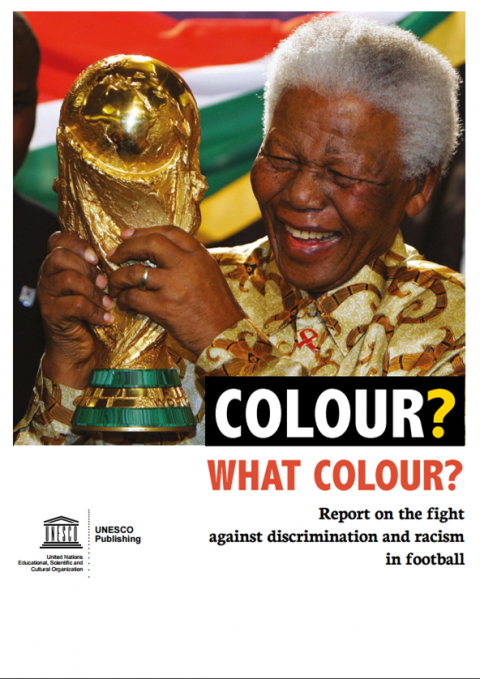 Colour? What colour? Relazione sulla lotta contro la discriminazione e il razzismo nel calcio Year of publication: 2015 Author: Albrecht Sonntag | David Ranc Football has been shown to be a mirror of society, it may also be viewed as providing a temporary suspension of reality for an interlude of high emotion and idealized hopes and dreams. Football’s public transcends differences of age, gender, culture, religion, and socioeconomic status to unite in support of their team. The broad diversity of backgrounds of football players represents tangible evidence of equal opportunity and meritocracy. The sport itself has team solidarity, fair play and mutual respect among members and for opponents ingrained within its rules and practices. Yet, the ‘beautiful game’ is one with an imbedded paradox. Football is also a game that may in many vaguely resemble war, where opponents face each other in a struggle to win over the other side, with the noisy and emphatic support of the spectators. An ‘us’ and ‘them’ mentality is an integral part of trying to help a team reach the objective, which is to win the game. This setting naturally produces a desire by supporters to intimidate the other side by encouraging their team and expressing both confidence and superiority through their words and actions. When the ‘us’ and ‘them’ mentality turns into symbolic exclusion of others, language of disparagement and insult based on racism or discrimination, or physical confrontation, the ‘beautiful game’ is debased. The existence of racism and discrimination in football is not a secret, but it is a shame on the game. Although much is already being done, both observers and experts feel too many problems persist and measures to tackle them have not been effective enough. This report was commissioned by UNESCO within the framework of UNESCO’s partnership with Juventus. It focuses on discrimination and racism in professional football and to some extent the amateur clubs that funnel into the leagues. It provides an overview of the historic and theoretical background. It reports on the state of affairs on the ground. It summarizes what has been done and is being done to mitigate racism and discrimination in domestic and international football, how the effects of these actions may be evaluated, and which new avenues for further, complementary action are promising. The report is based on a literature review, desk research, regional reports from the Unesco network and a field survey among a purposive sample of experts and actors in a number of countries. The report has a somewhat European focus, in its sources and examples. Europe has a unique position Executive Summary in the world of football, with its leading competitions, championships and clubs. It is the region where racism and discrimination in football has been most intensively researched. A number of civil society organisations from Europe have played a pioneering role in the fight against racism and discrimination in football. Moreover, the pressure that comes with the money invested in and generated by western European football, as well as its exposure in the media, has also made clubs, federations and UEFA particularly sensitive to the negative impact that discrimination can have on the game and its image, within Europe and worldwide. Europe must therefore occupy a central role in a study of the fight against discrimination in professional football and in determined policies to mitigate racism and discrimination related to football wherever they occur. The examples of incidents of discrimination and racism, as well as of existing measures to combat them have been selected to be as wide-ranging as possible. The authors do not, however, claim the report to be a comprehensive listing. Similarly, the examples of best practice have been collected through extensive reading and contacts, but must be looked at as an overview rather than as a directory. They are chosen by the authors to illustrate types of actions and institutions with the potential for greatest impact. The report also does not deal with the methods of allocation of resources to football, with issues of employment, or with womens’ football. While these are significant topics on which concerns can be expressed, the necessary focus of a report of this type means that they are alluded to without being treated in depth.