
Resources
Explore a wide range of valuable resources on GCED to deepen your understanding and enhance your research, advocacy, teaching, and learning.
8,376 Results found
 Education for citizenship in the Arab World: key to the future Year of publication: 2011 Author: Muhamman Faour | Marwan Muasher Corporate author: Carnegie Middle East Center Reforming education to foster citizenship is urgently needed if democracy is to take hold in the Arab world. Under authoritarian rule, students were primarily taught to be docile subjects of the state—creative thinking was discouraged and information was treated as indisputable. Instead, students must learn from a very early age what it means to be citizens who seek and produce knowledge, question, and innovate. Only by teaching youth to think critically and respect different points of view will Arab countries become economically competitive and reliably democratic.
 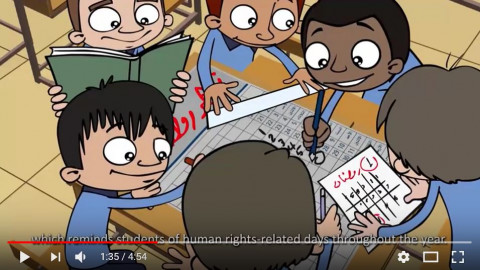 [Video] Equal rights between girls and boys Year of publication: 2015 Corporate author: United Nations Relief and Works Agency for Palestine Refugees in the Near East (UNRWA) Palestine refugee students of all ages learn about human rights in their everyday lives through the Human Rights, Conflict Resolution and Tolerance Education Programme, funded by the United States. In this short animation, young boys and girls learn to respect each other’s rights regardless of gender.
  Rethinking Education: Towards a Global Common Good? Year of publication: 2015 Corporate author: UNESCO The changes in the world today are characterized by new levels of complexity and contradiction. These changes generate tensions for which education is expected to prepare individuals and communities by giving them the capability to adapt and to respond. This publication contributes to rethinking education and learning in this context. It builds on one of UNESCO’s main tasks as a global observatory of social transformation with the objective of stimulating public policy debate.It is a call for dialogue among all stakeholders. It is inspired by a humanistic vision of education and development, based on respect for life and human dignity, equal rights, social justice, cultural diversity, international solidarity, and shared responsibility for a sustainable future. These are the fundamentals of our common humanity. This book enhances the vision provided by the two landmark UNESCO publications: Learning to Be: The world of education today and tomorrow (1972), the ‘Faure Report’, and Learning: The treasure within (1996), the ‘Delors Report’.
  Incheon Declaration: Education 2030: Towards inclusive and equitable quality education and lifelong learning for all Year of publication: 2015 Corporate author: UNESCO The "Incheon Declaration: Education 2030: Towards inclusive and equitable quality education and lifelong learning for all" was signed and adopted at the end of the World Education Forum 2015 (WEF 2015) by over 130 Education Ministers and more than 1500 participants. The Declaration marks an important step in the development of international education policy, continuing the Education for All (EFA) movement started in Jomtien in 1990 and formalized in Dakar in 2000. The Declaration also reaffirms the commitment to realize the SDG4, “Ensure inclusive and equitable quality education and promote life-long learning opportunities for all” and the willingness to invest efforts on access, equity and inclusion, quality and learning outcomes, within a lifelong learning approach. Promoting sustainable development in Nigeria: via civic education (Journal of education and practice, vol. 5, no 34) Year of publication: 2014 Author: Ajibola A. Lukman | Habida Audu Corporate author: International Institute for Science, Technology and Education Nothing in this world is so powerful as an idea whose time has come. In the face of ethical knowledge, skill disposition and sustainable development in Nigeria, civic education assumed central position. Idea of civic education in Nigerian curriculum is so powerful to the extent that each young Nigerian deserves its knowledge. On this basis, this paper describes civic education as an underpinning factor for individual and social development of our nation. The paper analyzes the fabric between civic education and social development towards blending and interfacing local wisdom with global knowledge, values and skills, which will develop the young Nigerian to become a citizen of this country as well as a citizen of the global village. The paper points to the fact that civic education is central to shaping attitudes and social interaction and both are critical to addressing issues surrounding sustainable development. To this end, the paper concludes that sustainable development requires civic knowledge, civic skills and civic disposition. It is therefore recommended that civic education should be seen as an engine for development in which states, individuals, communities, and businesses partake in providing sustainable development.
  Global education guides Year of publication: 2009 Corporate author: Global Education Network of Young Europeans (GLEN) This document was written as an introduction to global education and as a practical support tool for planning, managing and evaluating global education projects. It is addressed to members of GLEN, the Global Education Network of Young Europeans, as well as to other global educators. The following pages are the result of numerous discussions that have occurred during the last five years both within GLEN and with external global education practitioners and academics. Many of these discussions crystallised at the European Global Education Days (EGED), a five-day seminar that GLEN organised on the occasion of the network’s fifth anniversary in November 2008. The EGED brought together more than 70 global education activists, practitioners and academics from 15 European countries, with the aims of exchanging experiences and good practices of global education, discussing how to evaluate global education projects and measure impact; reflecting on the potential of global education as a tool for activists and how it relates to concepts such as citizenship or development; and using the results of these discussions for the future work of our network: planning global education projects and further engaging with other stakeholders. The world is currently going through a period of accumulated crises: the ecological crisis, the financial and economic crisis, the food crisis. And this on top of all the other problems: hunger, poverty, unequal distributions of resources, violent conflict, etc. The challenges which humankind is facing seem to be greater than ever. However, the Greek word ‘crisis’ does not mean downfall, but decision. We, as human beings and as citizens of this world, can decide to contribute our share for bringing about more just political and economic structures; and more sustainable, democratic, peaceful and inclusive ways of living together. If we do global education, it is in order to address exactly these issues; it is to empower people to become agents of change in view of this vision. So, in this spirit, let us use the present momentum and make the current ‘crisis’ a turning point.
  Global citizenship education: citizenship education for globalizing societies Year of publication: 2015 Author: Werner Wintersteiner | Heidi Grobbauer | Gertraud Diendorfer | Susanne Reitmair-Juárez Corporate author: Austrian Commission for UNESCO This text reflects the work we have been doing for many years in the area of Global Citizenship Education (GCED) in Austria. Two endeavors particularly stand out: first, the continuing Masters programme GCED at the Alps-Adriatic University (Alpen-Adria Universität) in Klagenfurt, which is a specialized course of study for educationalists, teacher trainers, NGO associates and teachers (participants may either graduate with a certificate after two years or an MA degree after three years respectively), and second, our cooperation with the Austrian UNESCO Associated Schools Project Network. This was the originally intended audience for the German version of this brochure, which constitutes the programmatic basis for our training programs. We understand GCED as a concept that is located at the interface between civic education, global education and peace education, as well as education for sustainable development and intercultural learning. Our approach is characterized by these four features:* theoretical grounding and a particular focus on terminology in order to foster competence of judgment regarding political concepts* investigating the historical dimension of GCED in depth in order to account for colonialism and neocolonialism* socio-critical orientation in order to set us apart from strands of GCED that ultimately perpetuate concepts of Western hegemony* didactic implementation that is systematic and based on appropriate theoretical work in order to avoid pragmatismWith this English edition (the section specific to the Austrian context was omitted) we wish to initiate a dialog with colleagues in the whole world and hope to engage in lively exchange. Teachers' guide for education for sustainable development in the Caribbean Year of publication: 2008 Author: Gillian Cambers | Grace Chapman | Paul Diamond | Lorna Down | Anthony D. Griffith | Winthrop Wiltshire Corporate author: UNESCO Santiago The publication “Teachers’ Guide for Education for Sustainable Development in the Caribbean” is geared towards regional teacher-trainers and teachers active at every level of education. Its purpose is two-fold: contribute to the integration of education for sustainable development into teaching practices through education initiatives, originally implemented in the Caribbean that may be feasible to replicate in the various classrooms, schools and communities; promote reflection, discussion and creation of innovative practices that involve all teachers in Decade activities and contribute to the making of sustainable societies. This document illustrates how different wills can come together moved by a desire to materialise common projects. Thus, this effort represents the work of regional specialists working in close cooperation with UNESCO Regional Bureau for Education in Latin America and the Caribbean, as well as the financial support of the Government of Japan.
  Citizenship education at school in Europe Year of publication: 2005 Corporate author: Eurydice. European Unit This comparative analysis is based on country descriptions supplied by the Eurydice National Units.To collect information for them, a Guide to Content, including common guidelines and definitions, was prepared by the Eurydice European Unit (EEU) in consultation with the National Units at the beginning of 2004.The aim of the Guide to Content was to ensure that the country descriptions were drafted in accordance with a common structure to facilitate subsequent cross-country comparison of the information provided. Nepal: lessons from integrating peace, human rights, and civic education into social studies curricula and textbooks Year of publication: 2015 Author: Melinda Smith Corporate author: UNESCO International Institute for Educational Planning (IIEP) | United Nations Children's Fund (UNICEF) | Education Above All (Qatar) This case study examines the process undertaken by the Ministry of Education (MoE) in collaboration with development partners to revise the social studies curriculum in Nepal. The aim was to promote education for peace, human rights, and civic education (PHRCE) in the wake of a 10-year Maoist insurgency and the transition to a democratic republic. It provides a critical analysis of the process, synthesizing information from two assessments of the initiative, and makes recommendations for the future based on challenges and gaps identified by stakeholders. The study also provides recommendations to countries in post-conflict transition which are interested in undertaking similar curriculum reform initiatives.Information is drawn from a number of reports and programme documents developed by the implementing partners, as well as 12 interviews with individuals involved in the process of curriculum reform. Interviewees included representatives of the major agencies involved in the revision process: the MoE’s Curriculum Development Centre, the National Centre for Education Development, Save the Children, UNESCO, and UNICEF. In addition, interviews were conducted with representatives of civil society and non-governmental agencies supporting peace education and representing marginalized groups, and the external international consultant who provided technical assistance.