
Resources
Explore a wide range of valuable resources on GCED to deepen your understanding and enhance your research, advocacy, teaching, and learning.
8,376 Results found
 Intercultural Multilingual Education in Latin America: Mexico, Guatemala, Colombia, Brazil, Ecuador, Peru, Bolivia and Paraguay, and Norway Year of publication: 2011 Corporate author: Internacional de la Educación para Latinoamerica This document deals with Intercultural Bilingual Education (IBE), its current status and the concepts and processes driving it today – and in a certain way the conflicts encompassing it. It contains information on Mexico, Guatemala, Colombia, Brazil, Ecuador, Peru, Bolivia and Paraguay, and includes some data and comments on Norway. Certainly all Latin America is involved in the topic, one way or another, but for now this is the geographical scope of the paper. It seeks to give an overview of the whole and profile a few specific aspects by country. The education we want: youth advocacy toolkit Year of publication: 2015 Author: James Edleston | Dan Smith, Sumaya Saluja | David Crone | Chernor Bah | Emily Laurie Corporate author: UN Global Education First Initiative - Youth Advocacy Group (YAG) | Plan | A World at School This toolkit is for anyone who believes passionately in the power of education as a force for good in the world and the right for all children to get a good quality education, no matter where they are and what the circumstances. We hope this toolkit will support you to carry out your own advocacy campaign. If you are just beginning to think about taking action on education, you can work your way through the toolkit from start to finish. But you can also dip in to pick up useful hints or activities to help you carry out your existing plans. We know this toolkit doesn’t cover everything you might need and we’ve tried to sign-post you to other resources where possible. Included in here are lots of real stories of change, led by young people, from all over the world. We hope they inspire you. The young global movement for education is growing, and you can be part of it. Global education in Austria Corporate author: North-South Centre of the Council of Europe This National Report on Global Education in Austria is part of the European Global Education Peer Review Process, which was initiated in 2002 with the purpose of increasing and improving global education in Council of Europe member states. This report is the culmination of a peer review process led by an international peer review team. Through research and interviews with key stakeholders, information was gathered and critical perspectives developed about the current state of, and the future prospects for, global education in Austria. This year–long process, facilitated by the North-South Centre of the Council of Europe, was developed in partnership with the Austrian Strategy Group for Global Education as the national counterpart in the process. It involved the Ministry of Foreign Affairs, the Ministry of Education, the Austrian Development Agency (ADA), KommEnt, and the NGO and academic communities.This Peer Review report recognises the relatively strong tradition of global education in Austria. Austrian support for GE is reflected in the range of committed organisations involved in GE, and the many initiatives and projects in the formal and non-formal education sectors, and in civil society. Chapter 1 below provides an introduction to the report and the process generally. Chapter 2 outlines the context of global education in Austria. Chapter 3 examines global education in the formal education sector. Chapter 4 focuses on the important and varied work taking place in non-formal education, civil society organisations and other sectors in this field. Chapter 5 provides, in summary fashion, an outline of the key observations and recommendations of the Peer Review.
  Education for peace: planning for curriculum reform; guidelines for integrating an education for peace curriculum into education sector plans and policies Year of publication: 2015 Corporate author: UNESCO | UNESCO International Bureau of Education (IBE) | UNESCO International Institute for Educational Planning (IIEP) This Resource and Development Capacity Package was developed based on the belief that, as part of a wider social, economic and political effort, education can play a significant role in a country’s peace-building efforts. Its purpose is to assist Member States in integrating or strengthening peace education programs in their national education systems to promote peace and prevent future conflict. UNESCO, IBE, and IIEP developed this resource within the framework of UNESCO’s Intersectoral Project, Promoting a culture of peace and nonviolence in Africa through education for peace and conflict prevention. The Package contains Technical Guidelines and Capacity Development training modules on policy, program design and curriculum planning to integrate peace and conflict prevention into all aspects of the education system. It is meant for curriculum developers and planners from Africa. The development of the package received the support of the UNESCO Addis-Ababa Office, which assisted in the testing of materials in Addis-Ababa (Ethiopia) and Yaounde (Cameroon).This resource will furthermore help to ensure that curricula, teaching and learning resources and teacher education are in line with the post-2015 vision of education for holistic development. This vision reconceptualises education in terms of global citizenship and responsibility by focusing on inclusion and social cohesion that is global in orientation. In this regard, Global Citizenship Education (GCED) seeks to empower learners with knowledge, skills, values and attitudes that are needed to forge more just and inclusive societies, capable of resolving existing conflicts and emerging global challenges.
 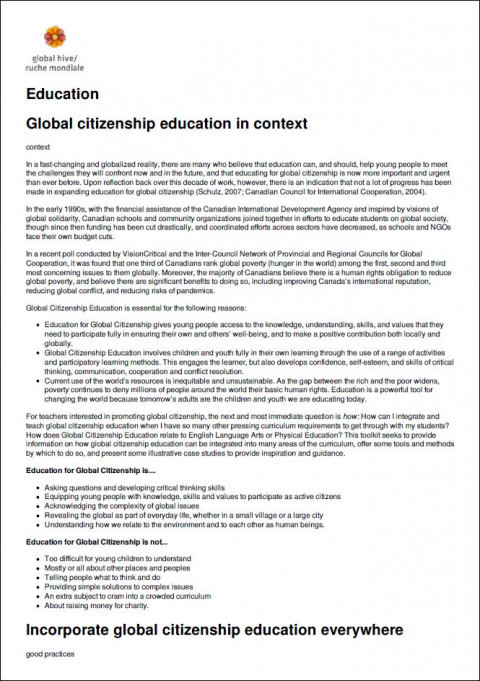 Education: global citizenship education in context Corporate author: Global Hive In a fast-changing and globalized reality, there are many who believe that education can, and should, help young people to meet the challenges they will confront now and in the future, and that educating for global citizenship is now more important and urgent than ever before. Upon reflection back over this decade of work, however, there is an indication that not a lot of progress has been made in expanding education for global citizenship (Schulz, 2007; Canadian Council for International Cooperation, 2004). In the early 1990s, with the financial assistance of the Canadian International Development Agency and inspired by visions of global solidarity, Canadian schools and community organizations joined together in efforts to educate students on global society, though since then funding has been cut drastically, and coordinated efforts across sectors have decreased, as schools and NGOs face their own budget cuts. In a recent poll conducted by VisionCritical and the Inter-Council Network of Provincial and Regional Councils for Global Cooperation, it was found that one third of Canadians rank global poverty (hunger in the world) among the first, second and third most concerning issues to them globally. Moreover, the majority of Canadians believe there is a human rights obligation to reduce global poverty, and believe there are significant benefits to doing so, including improving Canada’s international reputation, reducing global conflict, and reducing risks of pandemics. Global Citizenship Education is essential for the following reasons: Education for Global Citizenship gives young people access to the knowledge, understanding, skills, and values that they need to participate fully in ensuring their own and others’ well-being, and to make a positive contribution both locally and globally. Global Citizenship Education involves children and youth fully in their own learning through the use of a range of activities and participatory learning methods. This engages the learner, but also develops confidence, self-esteem, and skills of critical thinking, communication, cooperation and conflict resolution. Current use of the world’s resources is inequitable and unsustainable. As the gap between the rich and the poor widens, poverty continues to deny millions of people around the world their basic human rights. Education is a powerful tool for changing the world because tomorrow’s adults are the children and youth we are educating today. For teachers interested in promoting global citizenship, the next and most immediate question is how: How can I integrate and teach global citizenship education when I have so many other pressing curriculum requirements to get through with my students? How does Global Citizenship Education relate to English Language Arts or Physical Education? This toolkit seeks to provide information on how global citizenship education can be integrated into many areas of the curriculum, offer some tools and methods by which to do so, and present some illustrative case studies to provide inspiration and guidance. Citizenship education in Latin America: priorities of school curricula (IBE working papers on curriculum issues no. 14) Year of publication: 2014 Author: Cristián Cox | Martín Bascopé | Juan Carlos Castillo | Daniel Miranda | Macarena Bonhomme Corporate author: UNESCO International Bureau of Education (IBE) This work focuses on the curricula of six Latin American countries – Colombia, Chile, the Dominican Republic, Guatemala, Mexico and Paraguay – which at the close of the past decade agreed to be part of the project Regional System of Evaluation and Development of Citizenship Competencies (SREDECC). With the support of the Inter-American Development Bank, SREDECC developed the Latin American module of the International Civic and Citizenship Study (ICCS- 2009) undertaken by the International Association for the Evaluation of Educational Achievement (IEA), in addition to encouraging the participation of the countries in that study (Cox 2010; Schulz, Ainley, Friedman and Lietz 2011).This document comprises four parts. The first section takes stock of the state of democratic belief in the region, drawing upon the most significant opinion studies of the past decade, so as to offer broader meaning bases for curriculum analysis and, more generally, for educational work in the field of citizenship. The second section describes the organizational (or structural) characteristics of the curricula of the six countries and presents a framework of categories for their comparative analysis. The subsequent section describes and analyses the contents of the six curricula examined and how they deal with the values, institutions and citizenship relations in their civic (political) and civil (coexistence) dimensions. On the basis of the most significant findings, the closing section includes some reflections regarding curriculum development with regard to citizenship. 2nd European congress on global education: education, interdependence and solidarity in a changing world; final report Year of publication: 2012 Corporate author: North-South Centre of the Council of Europe | Global Education Network Europe (GENE) | CONCORD Europe | Portuguese Institute of Cooperation and Language | Portuguese NDGO Platform | University of Lisbon | European Commission The 2nd European Congress on Global Education: Education, Interdependence and Solidarity in a Changing World took place on 27 – 28 September 2012 in Lisbon. It was organised by the North-South Centre of the Council of Europe (NSC) in partnership with Global Education Network Europe (GENE) and CONCORD Europe, in cooperation with the Portuguese Institute of Cooperation and Language - Camões, the Portuguese NDGO Platform and the University of Lisbon and with the financial support of the European Commission. This Congress brought together approximately 200 stakeholders in global education, in particular international organisations, governments, parliamentarians, local and regional authorities, civil society organisations, as well as educators from Europe and beyond, using the principle of “quadrilogue” and a holistic approach to global education. This two-day event built on the efforts of the North-South Centre (NSC) and other stakeholders to promote global education since the Maastricht Congress Declaration (2002) which established a European strategy framework for improving and increasing global education in Europe to the year 2015. Thematic dialogue and exchange of ideas and practices together with a reflection on the political dimension of global education contributed to the formulation of a Lisbon Statement and the revision of the proposed Strategic Recommendations for Strengthening Global Education till 2015. The resume of the thematic dialogues, the Lisbon Statement on Global Education and the Strategic Recommendations represent an integral part of this report. This is also complemented with a short concluding section with follow-up proposals. Citizenship, identity and education: examining the public purposes of schools in an age of globalization Year of publication: 2006 Author: Fernando Reimers Corporate author: UNESCO International Bureau of Education (IBE) Educational institutions exist to achieve public purposes. One of those purposes is to develop citizenship. In the 21st century, citizenship includes global citizenship. In an era of globalization effective citizenship includes the knowledge, ability and disposition to engage peacefully and constructively across cultural differences for purposes of addressing personal and collective needs and of achieving sustainable human–environmental interactions, this requires internalizing global values. Addressing these challenges of globalization will require making citizenship education and the development of global values an explicit objective of efforts to improve quality throughout the world, critically examining theories and evidence about the effectiveness of various approaches to developing citizenship and global citizenship and supporting activities aligned with this public purpose. This public purpose should support the development of a political culture that fosters the rule of national and international law and respect of human rights, the development of understanding to support trade and economic and peaceful bilateral and international diplomacy as the preferred means to solve international disputes, the development of the capability to understand and address the serious environmental challenges facing humanity and to collaborate across national boundaries in the creation of sustainable forms of human–environmental interactions and in the development of the skills to promote rationality in deliberation and action, and to advance science and technology as means to improve human health and well-being. At present, however, many education systems and reforms are insufficiently focused on quality, or focus instead on a very narrow and self-referenced definition of quality. It is possible to educate people to understand and appreciate cultural differences and to understand and accept human rights in a framework of global values that includes compassion and caring, concern for others, respect and reciprocity. These values, dispositions, knowledge and skills can be developed in a range of institutions that societies have to pass on what they value to the young, and to re-create culture: families, religious institutions, the media, workplaces, political institutions and also schools. While there is no reason to assume that schools can be more effective in this task than any of these other institutions, they have greater potential to be aligned with transnational efforts to promote global civility. They are a public space, and consequently also a globally public space, in ways in which families and religious institutions are not. If schools actively engage in teaching hatred or intolerance, or if they fail to prepare students adequately for global civility, these failures can be noted by international institutions that can potentially mobilize resources to support national and local efforts to prepare students for global citizenship. There is not a similar network linking national and transnational institutions, public and private, governmental and non-governmental, that attends to the dynamics of families and other ‘‘private’’ spaces.
  Global education in Lithuania: challenges and opportunities Year of publication: 2014 Author: Indrė Augutienė | Zina Baltrėnienė Corporate author: Lithuanian Development Education and Cooperation Network of Non-governmental Institutions (Association LITDEA) | Lithuanian National Non-Governmental Development Cooperation Organisations‘ Platform (NGDO Platform) The publication has been produced implementing the project ‘‘Quality Partnership for Development-EU Presidency project for the Lithuanian EU Presidency, 2013“ (no. DCINSA ED/2013/319-124). Today we live in a constantly changing world which is bound by the spirit of relations between people, countries and cultures and which presents various challenges and opportunities. Every day we have to solve numerous economic, social and environmental issues connecting us with other countries, their cultures and citizens and providing an opportunity for all of us to become part of a global society.In order to accept the opportunities provided by the globalisation processes and cope with the emerging challenges it is necessary to create the conditions for people to acquire the knowledge on global realities, emerging global development problems and to relate them with their own life. It is also important to provide the opportunities for people to acquire the skills and enhance own values facilitating active global citizenship and responsibility. Global problems increasingly impact on the lives of everybody throughout the world, therefore we must realise that we are part of the world with the still prevailing poverty, social inequality, climate change and global warming problems. In the current society it is especially important to ensure that different forms of education enhance people‘s understanding about the above challenges and their impact on personal, communal, national and global development.Global Education is directed toward formation and development of people‘s skills, knowledge and values facilitating understanding and response to the challenges of the 21st century. So far the concept of Global Education was not validated in any national documents. Today non-governmental organisations are actively discussing this issue with the academic society and with the Ministries of Foreign Affairs/and Education and Science representing the state in the above area. Besides, Lithuania has not developed a uniform Global Education strategy yet, but the dimension of Global Education is included in several specific national policy documents. In view of this, this article reviews the prerequisites for integration of global education set forth in the main legal acts defining Lithuania‘s sustainable development, development cooperation and education. This document provides a review of the Global Education concept, prerequisites for its implementation and description of the current situation in Lithuania. It also includes the proposals for a successful development of Global Education activities in our country. Education for developing a global Omani citizen: current practices and challenges Year of publication: 2014 Author: Saif Al-Maamari Corporate author: Redfame Publishing Oman is a developing country which reformed its educational system in 1998 in order to meet the challenges of the 21st century, especially economic challenges. Strength of national identity and developing a sense of global citizenship were among the priorities of the new educational reform. This paper is based on a review of current practices regarding global citizenship education in educational system. The purpose of this theoretical study was to explore the current provision of the aspects of global citizenship education in Omani schools. Specifically, the study attempts to identify the current practices that are implemented by Omani schools to help Omani students to develop a sense of effective global citizenship. The study indicates that Omani education is not nationally centered as it aims to develop students who have global awareness. The study shows employing different approaches to develop a sense of global citizenship, namely, a separate school subject; integrated theme in social studies education, participation in some international initiatives in global citizenship education, and celebrating the international days and decades.