
Resources
Explore a wide range of valuable resources on GCED to deepen your understanding and enhance your research, advocacy, teaching, and learning.
8,376 Results found
 Global citizenship: from public support to active participation Year of publication: 2012 Author: Christine Carabain | Shelena Keulemans | Marije van Gent | Gabi Spitz Corporate author: National Committee for International Cooperation and Sustainable Development (NCDO) This publication explores the concept of global citizenship by drawing on the most relevant, mainly scientific, literature. This exploration will in the coming years be the basis for NCDO’s programmes in the area of research, staff training, and knowledge sharing. NCDO has the important task of engaging people in these two major changes in perspective: what does it mean, how important is it to us, how can we contribute to it? NCDO considers it its responsibility to raise awareness amongst Dutch citizens of the growing connection and mutual dependency between people across the globe, as well as to make them aware of the opportunities they have to help tackle global issues. In other words: NCDO aims to advance the global dimension of citizenship in the Netherlands. But what exactly is that global dimension of citizenship? Despite growing awareness of the importance of global citizenship, a clear and broadly accepted definition of the concept is still lacking (Hart, 2011). To date the concept is often explained by using examples and focus areas. This publication will present the definition of global citizenship that NCDO will employ in the coming period. Climate change starter's guidebook: an issues guide for education planners and practitioners Year of publication: 2011 Author: Alejandro Deeb | Amber French | Julia Heiss | Jason Jabbour | Dominique LaRochelle | Arkadiy Levintanus | Anna Kontorov | Rummukainen Markku | Gerardo Sanchez Martinez | Rosalyn McKeown | Nicolay Paus | Antoine Pecoud | Guillaume Pénisson | Daniel Puig | Vanessa Retana | Serban Scrieciu | Morgan Strecker | Vimonmas Vachatimanont | Benjamin Witte | Noriko Yamada. Corporate author: United Nations Environment Programme (UNEP) The Climate Change Starter’s Guide provides an introduction and overview for education planners and practitioners on the wide range of issues relating to climate change and climate change education, including causes, impacts, mitigation and adaptation strategies, as well as some broad political and economic principles. The aim of this guide is to serve as a starting point for mainstreaming climate change education into school curricula. It has been created to enable education planners and practitioners to understand the issues at hand, to review and analyse their relevance to particular national and local contexts, and to facilitate the development of education policies, curricula, programmes and lesson plans. The guide covers four major thematic areas: 1. the science of climate change, which explains the causes and observed changes; 2. the social and human aspects of climate change including gender, health, migration, poverty and ethics; 3. policy responses to climate change including measures for mitigation and adaptation; and 4. education approaches including education for sustainable development, disaster reduction and sustainable lifestyles. A selection of key resources in the form of publication titles or websites for further reading is provided after each of the thematic sections. The United Nations Educational, Scientific and Cultural Organization (UNESCO) provides its expertise and know-how in areas such as education, culture, and the social sciences. In particular, UNESCO emphasises the role of education in support of climate change adaptation and mitigation in providing skills and capacities but also through shaping the values, attitudes and behaviours needed to put the world on a more sustainable path. The United Nations Environment Programme (UNEP) works with countries to strengthen their ability to adapt to climate change, move towards low-carbon growth, reduce emissions from deforestation and forest degradation, improve understanding of climate science, and raise public awareness of the changing climate. UNEP is supporting countries to seize the opportunities of moving towards low-carbon growth, while improving human health and well-being, generating green jobs and moving towards a green economy. With this publication, the two organizations have embarked on a collaboration on climate change education that we are committed to building upon and expanding in the period ahead.
  UNESCO's work on education for peace and non-violence: building peace through education Year of publication: 2008 Corporate author: UNESCO The promotion of peace through education is at the heart of UNESCO’s mission. As stated in its constitution of 1945, UNESCO advances international peace and the common welfare of humanity through educational, scientific and cultural relations between peoples of the world. Though the world has changed over the past sixty years and continues to change at an ever increasing rate, UNESCO’s mission - a commitment to promoting universal values of peace and nonviolence, human rights and social justice, intercultural dialogue and mutual understanding – persists with growing urgency. UNESCO’s approach to educating for peace is multidimensional, in that it links education with a range of activities that address the root causes of violence, from human security to sustainable development. The goal of UNESCO’s education programmes and partnerships is the development of comprehensive systems of education that embrace the values of human rights, intercultural understanding and tolerance. Education for peace and non-violence promotes the knowledge, skills, attitudes and behaviours that reflect and inspire these values. As the lead agency within the UN system for the International Decade for a Culture of Peace and Non-Violence for the Children of the World, 2001- 2010, UNESCO is responsible for coordinating and directly implementing activities that promote the objectives of the Decade through education, the sciences, culture, communication and information. The culture of peace is defined as a set of values, attitudes, modes of behaviour and ways of life that reject violence and aim to prevent conflicts by tackling their root causes through dialogue and negotiation between individuals, groups and nations. UNESCO promotes the culture of peace through an intersectoral platform. This platform involves all five sectors of UNESCO: education, natural sciences, social and human sciences, culture, and communication and information. It seeks to mainstream intercultural dialogue in policies and actions with the aim of promoting mutual understanding, tolerance and respect, all of which are considered to be creative forces for a sustainable future. The intersectoral platform will also develop tools based on good practices in intercultural dialogue.
  UNESCO education strategy 2014-2021 Year of publication: 2014 Corporate author: UNESCO This publication is a result of extensive collective work by my colleagues in UNESCO’s Education Sector over the past two years. It elaborates on UNESCO’s Medium-Term Strategy (2014–2021), which was drafted by the Organization’s Secretariat and approved by the 37th session of its General Conference in November 2013. This publication elaborates on the education component of the Medium-Term Strategy. While continuing to focus efforts on the ‘unfinished business’ of EFA, such as literacy, teachers and vocational skills development, UNESCO will lead and advocate for strengthened action towards empowering learners to be creative and responsible citizens. In a world of change, when individuals are increasingly called upon to make a positive contribution to their communities through the promotion of peace, solidarity, and respect for others and the environment, I am convinced that Education for Sustainable Development and Global Citizenship Education must also be considered crucial elements for well-rounded educational systems.
 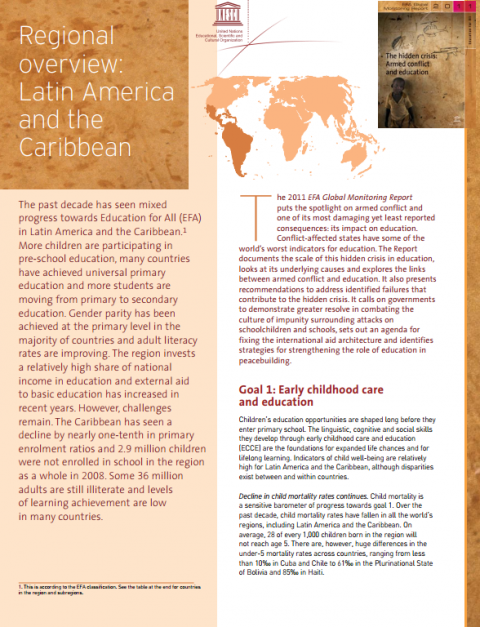 Regional overview: Latin America and the Caribbean Year of publication: 2011 Corporate author: UNESCO The past decade has seen mixed progress towards Education for All (EFA) in Latin America and the Caribbean. More children are participating in pre-school education, many countries have achieved universal primary education and more students are moving from primary to secondary education. Gender parity has been achieved at the primary level in the majority of countries and adult literacy rates are improving. The region invests a relatively high share of national income in education and external aid to basic education has increased in recent years. However, challenges remain. The Caribbean has seen a decline by nearly one-tenth in primary enrolment ratios and 2.9 million children were not enrolled in school in the region as a whole in 2008. Some 36 million adults are still illiterate and levels of learning achievement are low in many countries. The 2011 EFA Global Monitoring Report puts the spotlight on armed conflict and one of its most damaging yet least reported consequences: its impact on education. Conflict-affected states have some of the world’s worst indicators for education. The Report documents the scale of this hidden crisis in education, looks at its underlying causes and explores the links between armed conflict and education. It also presents recommendations to address identified failures that contribute to the hidden crisis. It calls on governments to demonstrate greater resolve in combating the culture of impunity surrounding attacks on schoolchildren and schools, sets out an agenda for fixing the international aid architecture and identifies strategies for strengthening the role of education in peacebuilding.
 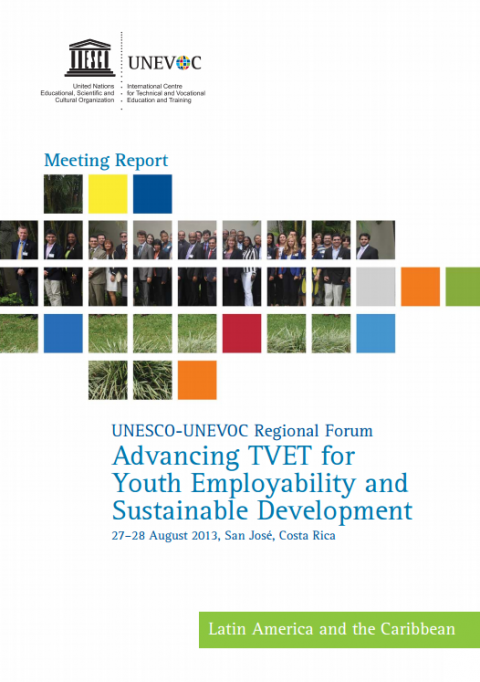 UNESCO-UNEVOC regional forum: advancing TVET for youth employability and sustainable development, Latin America and the Caribbean, 27-28 August 2013, San José, Costa Rica; meeting report Year of publication: 2013 Corporate author: UNESCO International Centre for Technical and Vocational Education and Training (UNEVOC) The Regional Forum of UNEVOC centres in Latin America and the Caribbean (LAC) presented in this report was one of a series of activities aiming to strengthen global and regional harmonization for the advancement of TVET transformation through the capacities of UNEVOC’s unique global network of specialized TVET institutions and affiliated partners, following the UNESCO Third International Congress on Technical and Vocational Education and Training (TVET) that took place in China in May 2012. The Forum also provided the opportunity to present evidence on the two priority thematic areas for UNESCO-UNEVOC for 2013, Youth and Skills and Greening TVET. This was achieved through the presentation and discussion of several promising practices in these two areas.
  Echoing Voices: Tenth Anniversary of the Adoption of the UNESCO Universal Declaration on Cultural Diversity Year of publication: 2011 Corporate author: UNESCO This founding text was the first to acknowledge cultural diversity as “the common heritage of humanity”. It is with great pride that UNESCO is commemorating the 10th anniversary of the Declaration. Commemorate – from the Latin cum memorare – means quite literally “to remember together” or “to remember with”. This collection is compiled the voices of all those who have contributed to the heightening of human awareness by throwing into relief the inestimable value of cultural diversity. These excerpts from books, articles and statements by global intellectual and political leaders, artists and Nobel Prize-winners all call for the safeguarding of cultural diversity, which is inseparable from respect for human dignity. Their voices resound in bearing witness to the strength of cultural diversity and to its capacity to enlighten the minds of women and men. We are duty-bound to ensure that it is central to public policies and a resource for development and dialogue among nations. The United Nations was born of the determination of men and women “to save succeeding generations from the scourge of war...”. In accordance with that principle, UNESCO was established on a key idea, expressed at the very beginning of its Constitution: “... since wars begin in the minds of men, it is in the minds of men that the defences of peace must be constructed”. In the world today, globalized, connected and interdependent as never before, this mission is more vital than ever. The rapprochement of peoples and cultures requires a commensurately global awareness. Cultural diversity has always been at the heart of international relations. It is also, increasingly, a feature of the contemporary mixed and plural societies in which we live. In view of this reality, we must formulate appropriate public policies and rethink the mechanisms of social cohesion and civic participation. How can we build common ground on the basis of such diversity? How can we construct genuine moral and intellectual solidarity of humanity? Any new vision of humanism must be grounded itself in the dynamism and diversity of cultural heritage. It is a source of inspiration and knowledge to be shared and a means of broadening our horizons. The goal of the UNESCO Universal Declaration on Cultural Diversity is to provide keys and benchmarks for capitalizing on this wealth. There can be no sustainable governance if cultural diversity is not acknowledged. There can be no economic and social development if specific features of every culture are belittled and ignored. Review of UNESCO culture sector's work on intercultural dialogue with a specific focus on: the general and regional histories, the slave route and cultural routes projects, plan Arabia, alliance of civilizations 'International vademecum' projects Year of publication: 2011 Author: Julie Carpenter Corporate author: UNESCO This review was commissioned from Education for Change Ltd by Internal Oversight Services (IOS) in UNESCO during June 2011 and completed in September 2011. The purpose of the review was to generate findings and recommendations regarding the relevance and effectiveness of the following priority initiatives on intercultural dialogue: • The General and Regional Histories (and related activities) • The Slave and Cultural Route projects (and related activities) • Plan Arabia • The Alliance of Civilizations (AoC) projects funded by the Government of Spain. The majority of activities in these flagship initiatives have been HQ-led and implemented with limited or no input from the field. Intersectoral work, essential to the effective implementation of the flagship initiatives and associated activities, was constrained by structural and budgeting factors common to most cross-sectoral work in UNESCO. Dissemination of the outputs of all the projects, with the possible exception of The Slave Route Project, has been a major and continuing challenge. The conception, writing, editing and direction of the Histories over more than 50 years have been the responsibility of an individual ISC for each History collection, supported by the UNESCO Secretariat in CLT. This highly participatory but complex process has caused delays and frustrations. However, the relevance of the Histories’ approach to history has not diminished over time. The interdisciplinary Histories have also been subject to the typical constraints within UNESCO of working across sectors. The use and re-use of the content in the Histories has recently been constrained by complex issues relating to co-publication and copyright covering volumes and illustrations and authors rights. The urgency of resolving these issues has arisen because of pressure from Member States to make the content of the Histories freely available online to enable access by institutions and individuals unable to afford the high costs of the published, printed volumes. The expensive printed formats selected for the Histories were predicated on the flawed assumption that university, college and public libraries exist in all countries that could afford to purchase relevant volumes and thus make available the content to researchers and the public. Overall effectiveness of these publications to date is impossible to measure, in terms of levels of takeup and use in universities or research for example, because over the years very limited data have been consistently or systematically collected, and little research or analysis has been done to determine the influence of the content of the Histories on written or broadcast material on history, on conference presentations etc. 2 Despite these constraints, the successful end in 2009 of this massive effort of developing, writing and publishing the history collections can and should be regarded as a significant achievement in itself, in which UNESCO has been effective in overcoming many problems and set-backs to achieve the completion of a project that only UNESCO itself, unique among all the international and UN bodies, could have achieved. National identity and xenophobia in an ethnically divided society Year of publication: 2005 Author: Noah Lewin Epstein | Asaf Levanon Corporate author: UNESCO Recent studies have suggested that national identity is empirically related to negative sentiments of individuals towards foreigners. This type of analysis has hitherto been based on the notion that xenophobia is shaped by the specific nature of national identity in a given society. Representing a stronger and more exclusive perception of national identity, ethnic national identity (compared with civic national identity) is expected in this line of research to result in less favourable perceptions of immigrants. In this paper we expand this approach by arguing that, in deeply divided societies, national identity itself may have different meanings among different social groups.
  Education for 'global citizenship': a framework for discussion Year of publication: 2013 Author: Sobhi Tawil Corporate author: UNESCO The notion of ‘global citizenship’ has recently gained prominence in international development discourse with the recently-adopted United Nations Secretary-General’s Global Education First Initiative (2012). Among the three priority areas outlined in this global initiative, the third aims to ‘foster global citizenship’. Education must fully assume its central role in helping people to forge more just, peaceful, tolerant and inclusive societies. It must give people the understanding, skills and values they need to cooperate in resolving the interconnected challenges of the 21st century. The notion of ‘global citizenship’, however, remains very broad, if not contested, and consequently difficult to operationalize in education. There are two possible reasons for this. Firstly, it is unclear whether the very notion of ‘global citizenship’ is a metaphor, a contradiction of terms, or an oxymoron (Davies, 2006). What does ‘global citizenship’ possibly imply both from a legal perspective, as well as from that of collective identity, sense of belonging, and civic engagement? Secondly, when applied to education, the notion of ‘global citizenship’ implies a certain degree of confusion. Is ‘global citizenship education’ (or ‘education for global citizenship’) merely an expression of a fundamental purpose of education systems? Does it also refer to a broad area of teaching and learning? If so, what are the contours of this domain? How does it relate to other often overlapping areas of learning associated with civic and political socialization?