
Resources
Explore a wide range of valuable resources on GCED to deepen your understanding and enhance your research, advocacy, teaching, and learning.
8,376 Results found
 Educação: um tesouro a descobrir, relatório para a UNESCO da Comissão Internacional sobre Educação para o Século XXI (destaques) Year of publication: 2010 Author: Jacques Delors Corporate author: UNESCO Brasilia Learning: The Treasure Within, commonly referred to as the 'Delors Report', proposes a holistic and integrated vision of education based on the paradigms of lifelong learning, and the four pillars of learning to be, to know, to do, and to live together.
  Literacy and education for sustainable development and women's empowerment Year of publication: 2014 Author: Anna Robinson-Pant Corporate author: UNESCO Institute for Lifelong Learning (UIL) The fact that women constitute two-thirds of the world’s non-literate population has been a cause for concern for several decades now. Despite a number of high-profile literacy interventions specifically targeting women – including UNESCO’s LIFE initiative – the disparity between male and female literacy rates persists in many countries of the world (UIL, 2013). This starting point for thinking about women’s literacy has however often led to a narrow focus on literacy access and outcomes. Whilst educational policy makers and planners have attempted to identify and overcome barriers to women’s participation, researchers have directed their attention to measuring the social and economic benefits of women’s literacy (see Robinson-Pant, 2004). Statistical correlations have been presented as evidence of the impact of women’s literacy: for instance, in Pakistan, women with a high level of literacy earned 95% more than women with no literacy skills yet there was only a 33% differential amongst men (UNESCO 2012: 196).Barriers to participation have been analysed in terms of structural (timing, location, women-only versus mixed gender) and social (marriage, poverty, language hierarchies) factors (see Ballara 1991). Within such analysis however, little attention has been given to the social processes associated with literacy learning and development. By contrast, this paper sets out to take a wider lens on literacy in order to explore not only ‘what works’ in practical terms of encouraging women to participate programmes, but also to look at how and why literacy programmes can contribute to sustainable development and processes of empowerment. Taking this perspective on women’s literacy involves asking alternative questions from the more usual ‘how can we make more women literate?’ Approaching literacy through the lens of sustainable development and women’s empowerment means that we develop a more nuanced understanding of how different kinds of literacy emerge from or support different development approaches and how women engage with such processes of change.How is literacy related to sustainable development programmes? What does empowerment mean to different women in different situations? What kind of research evidence and knowledge are literacy programmes and policy building on? How can adult learning facilitate economic, social and environmental change? These larger questions will guide the conceptual exploration of sustainable development, women’s empowerment and literacy, as well as the review of literacy programmes presented in this paper. The starting assumption is that only by looking in depth at the processes of literacy learning and development practice can we begin to address the challenge of narrowing the gender gap in literacy attainment.
 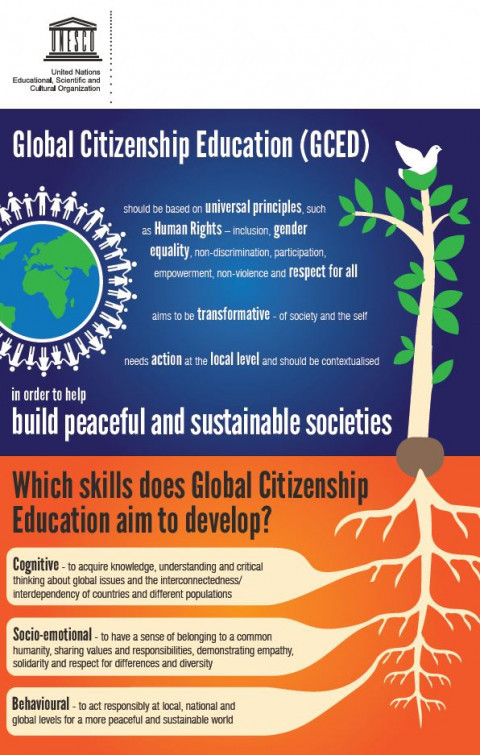 Global Citizenship Education (GCED) infographic Year of publication: 2015 Corporate author: UNESCO Which skills does Global Citizenship Education aim to develop? How can effectively implement Global Citizenship Education? Who are the key players? Ecopedagogy and citizenship in the age of globalisation: connections between environmental and global citizenship education to save the planet Year of publication: 2015 Author: Greg William Misiaszek Corporate author: Wiley‑Blackwell Teaching the connections between environmentally-harmful acts and social conflict is essential but is often ignored in education. This article presents two ways in which these are not taught because of the policies of those who benefit from the ignorance of these connections: first, the avoidance of teaching global-local connectivity and second, the devaluing of non-dominant cultures. Ecopedagogy is a democratic, transformative pedagogy centred on increasing justice by critically teaching the politics of environmental issues. I argue that global citizenship education (GCE) must be an element of ecopedagogy to contextually learn globalisation's effects upon local communities. In addition, GCE's goal is to increase students' understanding of diverse cultures to respect them. Ecopedagogy is also essential to GCE to fully teach social conflicts resulting from environmentally harmful acts. I offer policy and pedagogical changes to disrupt reproductive environmental pedagogies that help to sustain environmental ills for ecopedagogy-GCE models to emerge.
  Regional handbook on life skills programmes for non-formal education Year of publication: 2012 Corporate author: UNESCO Bangkok The Regional Handbook on Life Skills Programme for Non-formal Education (NFE) was developed for education policy makers, experts in curriculum development, materials development and trainers of personnel in the field of NFE, NFE practitioners such as Community Learning Centres (CLCs) personnel, teachers and facilitators, and researchers. It aims to provide information about life skills programmes and to serve as a practical guide to implement educational programmes to enhance life skills. It is expected to help NFE personnel with adopting, adapting and integrating life skills programmes in NFE. This Handbook consists of two parts as follows: Part one- overview of Life Skills Programme for Non-formal Education (NFE), Part Two- Practical Guide on Integrating Life Skills Programme in NFE. Part One provides answers to various questions related to life skills and life skills progrmmes. Part Two intends to provide practical information about the systematic planning and implementation of life skills programmes for NFE. It offers suggested steps for curriculum development, development of teaching and learning materials, delivery of life skills programmes and monitoring and evaluation strategies. Details of this process are elaborated for NFE practitioners at various levels, but in particular at the community level. This Handbook was developed based on the project outputs of UNESCO Bangkok's 'Life Skills Learning through Non-formal Education" carried out in Asia and the Pacific region from 2003-2006 within the framework of Asia-Pacific Programme of Education for All (APPEAL). The project consisted of country studies, regional meetings, pilot projects and action research in selected countries in the region. A group of experts from the region consolidated the main outputs of the project and developed this Handbook through a series of workshops in 2006-2007 in coordination with UNESCO Bangkok and the office of Non-formal and Informal Education (ONIE) of Thailand Ministry of Education. In addition, resource materials of various organizations including United Nations agencies, government institutions, universities and NGOs were also collected and used for developing this Handbook.
  Education for peace and sustainable development: concepts, clarity and cohesion Year of publication: 2013 Corporate author: Mahatma Gandhi Institute of Education for Peace and Sustainable Development (MGIEP) UNESCO MGIEP's focus lies in exploring and engaging with the strong interlinkages between peace and sustainable development and making interventions in the education systems to impart these principles. The first publication from the Institute Education for Peace and Sustainable Development: Concepts, Clarity and Cohesion explores the interlinkages and interdependencies of Education for Peace and Education for Sustainable Development. The monograph contains four concept papers which elaborate on the interlinkages between education, peace and sustainable development, define the gaps in the current approach to education for peace and sustainable development and argue for a comprehensive approach to issues of peace and sustainability to be incorporated in education systems. UNESCO MGIEP aims to develop a theoretical framework to look at the interlinkages between peace and sustainability in a holistic manner and this monograph is the first exercise towards building this discourse.
  Promoting the culture of dialogue between cultures in the Arab world Year of publication: 2013 Author: Selim El Sayegh Corporate author: UNESCO Beirut The major challenge of the Arab uprisings resides in the youth drive. Accounting for 60 per cent of the Arab population, Youth have been calling for political and economic reforms. During the revolts, these claims have become more radical seeking a fundamental change. This gradual evolution, from a relatively partial change to a more absolute comprehensive one, ushers in a new era with a different intellectual construct. With the ousting of dictatorships, all civil society forces are unleashed with huge actual and potential resources mobilized to contribute to building up the new order. Groups of solidarity, communities, parties, associations, and organizations of all nature among many others put forward new ideas and adequate action plans. Liberty thus acclaimed becomes the outcry for dignity, honor and pride. Never before in the Arab world has the individual had such a central place as it does today. An individual fully grasping the possibilities of restored liberty and recognized dignity gives birth to a new citizen acting in a new paradigm; a new citizen that seeks a transcendence of the ego to relate the individual to the common good. This fresh paradigm empowers the individual as a citizen in the name of equality, while simultaneously recognizing the right of difference of each citizen when it comes to belonging to a culture or sub‐culture. The right to be different involves more than the right to differ and to dispute and by the same token, the obligation of peaceful settlement. The right to be different, by belonging to a culture or a sub‐culture means in a new era of liberty and dignity, the obligation to conduct a transformation of the patterns generating disputes and conflicts among cultures. Henceforth, the issue of promoting the culture of intercultural dialogue in the aftermath of the Arab revolts represents major characteristics that will be reflected hereafter.
 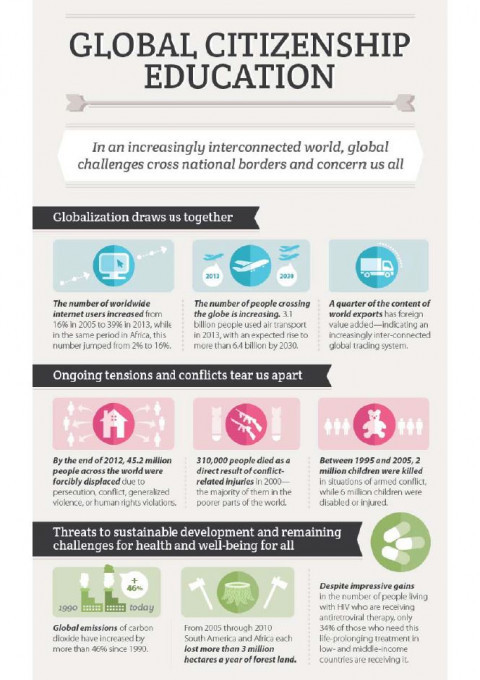 Global Citizenship Education infographic Year of publication: 2014 Corporate author: UNESCO In an increasingly interconnected world, global challenges cross national borders and concern us all. With issues like these threatening human and environmental well-being, we need to re-think the role and relevance of education. We need Global Citizenship Education. Global Citizenship Education is transformative. What are the barriers to this kind of education? What needs to change in education? What is UNESCO doing? What can you do? Active citizens: globally connected, locally engaged; facilitator's toolkit Year of publication: 2014 Corporate author: British Council This toolkit has been created to help facilitators to design and deliver the Active Citizens programme all over the world. Active Citizens is a social leadership programme which promotes intercultural dialogue and social responsibility as key leadership competencies in the 21st century. Active Citizens is run by the British Council working with civil society organisations all over the world. It began in 2009 and has been delivered in Europe, the Middle East, Africa and South Asia. It has reached more than 100,000 people to date through its training, conferences, social research and International Study Visits. The toolkit is in five sections - the introduction to the programme, preparing a workshop, delivering a workshop and post-workshop. There is also a large resource of workshop activity plans to support facilitators throughout the training cycle. The Active Citizens programme promotes community-led social development. It motivates members of communities to take responsibility for their social needs and gives them the knowledge, skills and experience to address them. The main audiences for the programme are community leaders working in, and with marginalised communities. They are people and institutions established, trusted and valued in the community - CSOs, NGOs, religious leaders, politicians, youth workers etc. They are influential and working to improve the lives of people living in their community. The programme develops skills and knowledge to identify and engage networks to help achieve goals as well as skills to plan and implement a project. The networks are between individuals at community level; institutions engaged in social action at community level; and institutions engaged in social policy dialogue at a national level. It includes cross-sectoral networking e.g. with the business community, media, etc. The building of these networks increases social inclusion, community resilience to conflict and increases social development in communities. See Diagram 1 on page 9. The programme is flexible and adaptable. It has been delivered to diverse groups, from rural communities in North-West Frontier Province Pakistan to urban communities in East London UK, to communities vulnerable to post-election violence in Kenya and internally displaced persons (IDPs) in Sri Lanka. Global citizenship in primary and secondary education in the Netherlands Year of publication: 2012 Author: Lette Hogeling Corporate author: National Committee for International Cooperation and Sustainable Development (NCDO) NCDO has examined the opinions and methods of teachers and directors with regard to global citizenship, as well as the obstacles and opportunities they experience around global citizenship in education. More than 1,500 teachers and almost 300 directors have participated in the research. A large majority of the teachers in primary and secondary education think that global citizenship is an important subject for Dutch education. Also, the majority of the teachers are of the opinion that it is important that the lessons link up with current events. Nevertheless, only a minority of the teachers in primary and secondary education believe that global citizenship should be a compulsory part of the curriculum. It is mainly teachers of geography, economics, cultural and social subjects who are of the opinion that global citizenship is an important theme.