
Resources
Explore a wide range of valuable resources on GCED to deepen your understanding and enhance your research, advocacy, teaching, and learning.
8,376 Results found
 Reflections on Progress, Sustainable Development and Global Citizenship Year of publication: 2013 Author: Georges Haddad Corporate author: UNESCO The arguments developed in this concise presentation demonstrate that sustainable development, progress and global citizenship, efficiently embedded in the context of the Knowledge Society, undeniably participate in the development of the New Humanism promoted by the Director-General of UNESCO, and which we all agree to consider essential for the wealth and prosperity of Humanity in an agreeable, peaceful and friendly common environment.
  Dialogue: cultural diversity and globalization, the Arab-Japanese experience; proceedings Year of publication: 2005 Corporate author: UNESCO The symposium on “Cultural Diversity and Globalization: the Arab-Japanese Experience, a Cross-Regional Dialogue”, organized on 6 - 7 May 2004 at UNESCO in Paris with the purpose of promoting dialogue and cooperation between the Arab world and Japan, gave its participants an opportunity to lay the groundwork for thinking about the key concepts enshrined in the UNESCO Universal Declaration on Cultural Diversity adopted by the General Conference at its 31st session, on 2 November 2001.
  UNESCO international meeting of experts: fostering a culture of intercultural dialogue in the Arab States; report Year of publication: 2012 Corporate author: UNESCO Beirut Within the framework of the project “Fostering a Culture of Peace and Dialogue” an international meeting of experts on Fostering a Culture of Intercultural Dialogue in the Arab States took place in Beirut, Lebanon on 6 and 7 March 2012 at the Holiday Inn Hotel in Verdun. The meeting was organized by UNESCO Beirut Office in partnership with the Government of Saudi Arabia and the King Abdulaziz Center of National Dialogue and in collaboration with the Arab Thought Foundation. The 2 days event was a landmark meeting of 35 experts and professionals from more than 11 countries, representing a wide range of fields in conflict resolution, research and education, media and journalism. The meeting is the first activity of a series of regional activities and interventions to be organized within the framework of the UNESCO project “Fostering a Culture of Peace and Dialogue”.
 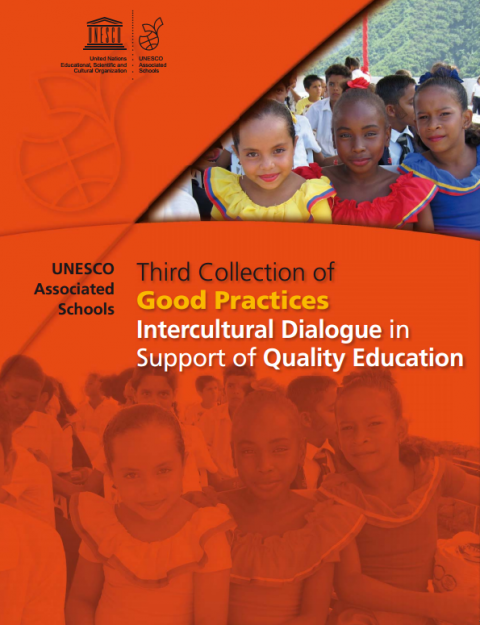 Third collection of good practices: intercultural dialogue in support of quality education Year of publication: 2013 Corporate author: UNESCO Associated Schools Project Network (ASPnet) The UNESCO Associated Schools Project Network (ASPnet) conducts pilot projects aimed at reinforcing the humanistic and ethical principles of UNESCO in school curricula and throughout the learning process, often within the framework of UN and UNESCO International Day, Years and Decades, Promoting intercultural dialogue is thus an ASPnet priority. The initiatives presented in this Third Collection of ASPnet Good Practices were carried out by ASPnet schools and their partner institutions in the context of the International Year for the Rapprochement of Cultures (2010). The selected projects illustrate both multicultural education and intercultural education in action.
  Measurement of global citizenship education Year of publication: 2013 Author: Vegard Skirbekk | Michaela Potančoková | Marcin Stonawski Corporate author: UNESCO In this study we provide an overview of Global Citizenship Education, focusing on definitions, methodological advances and data. We present an assessment of some of the existing initiatives for the measurement Global Citizenship Education, and make suggestions for how to move towards a globally consistent measure. Although there is some disagreement over how to measure global citizenship and global citizenship education, we also find consensus on parts of the concept. We are proposing to construct a composite indicator consisting of three complementary levels – the societal level (e.g., the level of democracy; macro level indicators of openness), the supplier level (e.g., provision of education; availability of training relevant for global citizenship); and the receiver level (civic identity, values, skills and knowledge). We conclude that one potential cost-effective approach could be to integrate evidence from several nationally representative surveys, providing us with world-wide coverage. We also discuss the feasibility and benefits of this measurement approach as well as its challenges.
 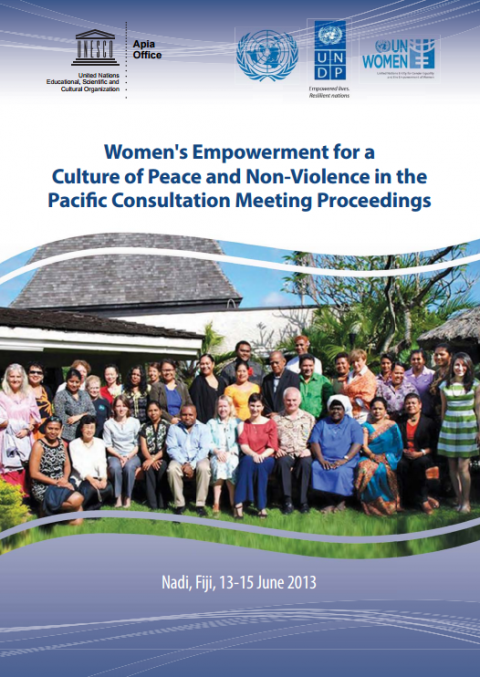 Women's empowerment for a culture of peace and non-violence in the pacific consultation meeting proceedings Year of publication: 2013 Corporate author: UNESCO Apia The Consultation on Women’s Empowerment for a Culture of Peace and Non Violence in the Pacific was held in Nadi, Fiji, from 13 to 15 June 2013. The consultation was an interagency collaboration between the United Nations Educational, Scientific and Cultural Organization (UNESCO), the United Nations Entity for Gender Equality and the Empowerment of Women (UN WOMEN) and the United Nations Development Programme (UNDP) Pacific Centre as part of the United Nations strategy “Delivering as One”. This collaboration focused on efforts to design, promote and strengthen a culture of peace in the Pacific at the country and regional levels. The consultation brought together 30 senior representatives, including development professionals and community members, from governments, regional organizations, women’s organizations, faith-based groups, academic institutions and development partners from the Cook Islands, Fiji, Kiribati, Palau, Papua New Guinea, Samoa, Solomon Islands, Tonga and Vanuatu. The consultation ended with an agreement on a range of actions that could be adopted at the local, national and regional levels to promote increased dialogue between leaders and policy makers on the contributions that culture and heritage can make to addressing issues of gender inequality and reducing GBV. The outcome statement identifies the importance of building positive cultural models, using a range of key factors, including female leaders, faith-based leaders and traditional leaders as well as political leaders and parties. The statement also emphasized education as a means of promoting a culture of peace and non-violence. The consultation’s outcome statement noted that the school curriculum should place a stronger emphasis on values, gender equality, sexual and reproductive health and rights, and the building of positive cultural models. The follow up actions identified include increasing public awareness on achieving equality for Pacific women, including women at the grassroots level, in bringing peace to conflict-affected communities; targeting young people as the next generation of leaders; using the arts and cultural and sports events to break down gender stereotypes; actions relating to economic empowerment, access to justice and service delivery; and intangible cultural heritage capacity building incorporating substantive gender equality components.
  Address by Mr Koïchiro Matsuura, Director-General of UNESCO on the occasion of the First Meeting of the UN Inter-Agency Committee (IAC) on the United Nations Decade on Education for Sustainable Development (2005-2014); UNESCO, 12 June 2006 Year of publication: 2006 Corporate author: UNESCO. Director-General, 1999-2009 (Matsuura, K.) This address was delivered by Mr. Koïchiro Matsuura, Director-General of UNESCO on the occasion of the first meeting of the UN Inter-Agency Committee (IAC) on the United Nations Decade on Education for Sustainable Development (2005-2014).
  UNESCO's role, vision and challenges for the UN decade of education for sustainable development (2005-2014) Year of publication: 2006 Corporate author: UNESCO This document elaborates on UNESCO's role in guiding the Decade of Education for Sustainable Development (DESD), its vision and challenges for the DESD.
  Globalization and education for sustainable development: sustaining the future Year of publication: 2006 Author: Laura Wong Corporate author: United Nations University This publication presents the contributions and outcomes of the stimulating two day gathering in Nagoya, where representatives of governments, academia and civil society gathered to share their experiences and develop their ideas about how to ensure ESD within the context of globalizing societies.
  Framework for a DESD communication strategy in support of the UN decade of education for sustainable development Year of publication: 2007 Corporate author: UNESCO The following framework for a DESD Communication Strategy seeks to provide guidelines for different stakeholders to come together and work on a joint harmonious communication strategy, dedicated to furthering the exchange of information on ESD issues in order to: • share ESD information and resources between and among partners; • promote better cooperation among partners doing ESD work and create synergies; • reduce duplication of efforts in programme planning, design, and ESD advocacy; • strengthen individual partner's ability to help create a viable future by working together with others, with each partner contributing its own "piece of the puzzle". Minimum elements of a DESD communication strategy include an appropriate emphasis on: • dissemination of basic ESD information to all partners; • dissemination of available information sources pertinent to partners’ needs in ESD; • sharing prototype training materials, experiences of demonstration activities and related resources for testing, adapting and translating them to other cultural contexts; • dissemination of information about the experiences of project participants, emphasizing openness and clarity about problems encountered, in order to allow others to benefit from the lessons learned in practice.