
Resources
Explore a wide range of valuable resources on GCED to deepen your understanding and enhance your research, advocacy, teaching, and learning.
8,376 Results found
 Innovative practices of youth participation in media: a research study on twelve initiatives from around the developing and underdeveloped regions of the world Year of publication: 2006 Author: Sanjay Asthana Corporate author: UNESCO This book will be useful as a research and reference guide to community-based media centres, media education practitioners, non-governmental organizations, policy-makers, planners, media professionals, social activists, researchers, etc. A direct contribution of the book are the several examples that can be adapted and/or replicated by various initiatives as they embark on building youth media programmes around the world.
  Second UNESCO Forum on Global Citizenship Education: building peaceful and sustainable societies: final report Year of publication: 2015 Corporate author: UNESCO The Second UNESCO Forum on Global Citizenship Education (GCED) was organized in Paris from 28 to 30 January 2015 under the overall theme 'Building peaceful and sustainable societies: preparing for post-2015'. The Forum was organized in support of the UN Secretary General's Global Education First Initiative (GEFI) and on the occasion of UNESCO's 70th Anniversary. The Forum was organized by the Division for Teaching, Learning and Content, Educatio Sector, UNESCO, with the support of Austria, the Sultanate of Oman and the Republic of Korea. Other partners also included the United Nations Secretary-General's Global Education First Initiative (GEFI), UNESCO's Mahatma Gandhi Institute of Education for Peace and Sustainable Development (MGIEP), UNESCO's Asia-Pacific Centre of Education for International Understanding (APCEIU), the King Abdullah Bin Abdulaziz International Centre for Interreligious and Intercultural Dialogue (KAICIID) and the Learning Matrix Task Force. Some 250 participants from 61 countries from all regions of the world attended the Forum. These included decision-and policy-makers, practitioners, teachers, development partners, academics, the private sector, civil society representatives (national, regional and international level) as well as learners and youth representatives. The Forum was organized around three plenary sessions and 20 concurrent sessions. Topics under consideration included, among others, GCED in the post-2015 education agenda, measuring GCED learning outcomes, teaching practices, peace and human rights education, respect for diversity and inter-religious education, tackling discrimination and violence, education for sustainable development, youth involvement, the use of ICT and social media, and others. For an overview of the programme, please see Annex I.
  Intercultural dialogue: involving young people around the world Year of publication: 2010 Author: Elizabeth Khawajkie Corporate author: UNESCO | DAIMLER It is hoped that this review will help to highlight why there is a persistent call for the continuation of such endeavors, like Mondialogo, which promoted dialogue among cultures and people, mutual respect and understanding so effectively. The Mondialogo journey, begun as an exploratory exercise, ended with compelling and often moving experiences. Address by Nicholas Burnett, Assistant Director-General for Education on the occasion of the Inauguration of the UNESCO Chair in Children, Youth and Civic Engagement, National University of Ireland, Galway (NUI Galway), Republic of Ireland, 4 March 2009 Year of publication: 2009 Author: Nicholas Burnett This speech is presented on the occasion of the inauguration of the UNESCO Chair in Children, Youth and Civic Engagement, addressing its goal of building bridges between institutions, serving as an intermediary between the academic community and policy-makers, and seeking to provide both groups with a greater voice in the context of the UN system.
  Educating for global competence: preparing our youth to engage the world Year of publication: 2011 Author: Veronica Boix Mansilla | Anthony Jackson Corporate author: Asia Society | Council of Chief State School Officers (CCSSO) Contemporary societies are marked by new global trends - economic, cultural, technological, and environmental shifts that are part of a rapid and uneven wave of globalization. The growing global interdependence that characterizes our time calls for a generation of individuals who can engage in effective global problem solving and participate simultaneously in local, national, and global civic life. Put simply, preparing our students to participate fully in today's and tomorrow's world demands that we nurture their global competence.This document introduces a definition of global competence developed by the Global Competence Task Force - a group of state education agency leaders, education scholars, and practitioners - under the auspices of the Council of Chief State School Officers EdSteps initiative (CCSSO-EdSteps) and the Asia Society Partnership for Global Learning (see page (iv) for task force participants). The definition builds on seminal work within the states and a broad range of organizations working to advance global knowledge and critical thinking skills. A process of careful articulation and vetting yielded the definition of global competence here proposed:Global competence is the capacity and disposition to understand and act on issues of global significance.Globally competent individuals are aware, curious, and interested in learning about the world and how it works. They can use the big ideas, tools, methods, and languages that are central to any discipline (mathematics, literature, history, science, and the arts) to engage the pressing issues of our time. They deploy and develop this expertise as they investigate such issues, recognize multiple perspectives, communicating their views effectively, and taking action to improve conditions.Educating for Global Competence: Preparing Our Youth to Engage the World is intended for classroom teachers, administrators, informal educators, policymakers, community leaders, researchers, parents, students, and all other stakeholders interested in preparing our youth for the 21st century. Becoming better at education for global competence involves rethinking practices and recognizing that there are no simple recipes for success. As such, this book is meant to be used flexibly - browse, make connections, and concentrate on the chapters that you find most pertinent to your work. Experiment with ideas, challenge concepts, and share with colleagues. Ultimately this book must work for you. It is meant to be read in the way that best meets your needs, inspires your curiosity, and proves fruitful in the classroom.Chapter one offers a rational for global education in our nation and worldwide. Chapter two introduces a conceptual framework for global competence and explains the key role of disciplinary and interdisciplinary foundations in student learning. Chapter three, four, five and six focus, respectively, on four core capacities associated with global competence: investigating the world, recognizing perspectives, communicating ideas, and taking action. Chapter seven considers core principles of instruction for teaching global competence. Chapter eight looks at what students and education institutions can do to promote global competence - and how they might create a culture of global competence for youth and adults. Finally, chapter nine places global competence in the larger framework of public education systems in and beyond the United States. Address by Irina Bokova, Director-General of UNESCO, on the occasion of Seminar on Global Citizenship Education, UNHQ; New York, 6 March 2015 Year of publication: 2015 Corporate author: UNESCO. Director-General, 2009-2017 (Bokova, I.G.) This document is an address by Irina Bokova, Director-General of UNESCO on the occasion of "Seminar on Global Citizenship Education" in New York, 6 March 2015. She highlights the importance of GCED for education in the 21st century.
 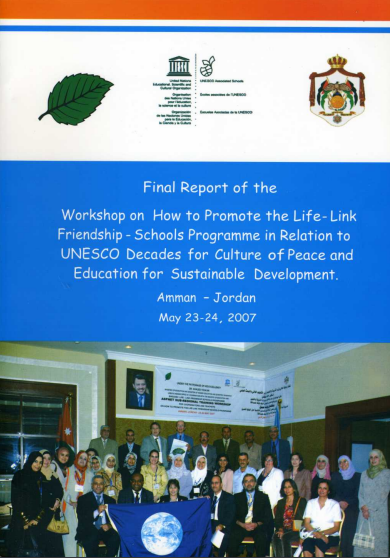 Final report of the workshop on how to promote the life-link friendship-schools programme in relation to UNESCO decades for culture of peace and education for sustainable development, Amman, Jordan, May 23-24, 2007 Year of publication: 2007 Corporate author: UNESCO Amman This chapter provides a brief summary of the speeches presented at the official opening and closing ceremonies as well as presentations delivered by the experts of Life-Link and UNESCO staff at the two day workshop The sub-regional workshop for ASPnet National Coordinators and Life-Link Friendship Schools Programme, organized in close collaboration with the Ministry of Education, was constructed according to the following format: (i). An organizing Committee was formed comprising of staff from the Ministry of Education and UNESCO Amman Office and Chairperson of Life-Link Programme. The committee oversaw the organization, preparation of documentation, venue, draft agenda, logistic and procedural aspects of the workshop. (ii). The selection of participants for the workshop was done by the National Commissions for UNESCO to Lebanon, Palestine, Iraq, Egypt, Oman and Jordan. The participating Arab Countries were selected by UNESCO Office-Amman and Life-Link. (iii).The selected participants comprised the National Coordinators and teachers for ASPnet in their countries. A member from Life-Link in Jordan was invited as an observer for the workshop. (iv).The resource persons (trainers) for the workshop were carefully selected on the basis of their expertise, experience and relevance to the main subjects of the workshop. The experts came from the Ministry of Education, Life-Link, UNESCO and UNRWA. (v). The format of the workshop was basically structured to firstly provide an overview and background of the Life-Link Friendship Schools Programme and ASPnet, followed by experts' presentations relevant to the main subjects of Life-Link Programme. The workshop also had three sessions of discussion on the different aspects of Life Link Programme. Participants were circulated to these sessions one after another. The workshop also had a session on how to plan for implementing peace actions as Extra Curricula Activities in schools. (vi). The ASPnet national workshop was organized under the patronage of his Excellency Dr. Khaled Toukan, the Minister of Education and the Minister of Higher Education & Scientific Research and Chairman of the Jordan National Commission for UNESCO. Regional workshop on enhancing teachers' competencies in education for sustainable development, Alexandria, Egypt, 7-9 May 2007: final report Year of publication: 2007 Corporate author: UNESCO Beirut | University of Alexandria In the framework of the UN decade of education for sustainable development, the UNESCO offices in the Arab region held their first workshop in September 2005 on the role of education and training for sustainable development. This second workshop was inaugurated in May 2007 on Enhancing Teachers’ Competencies in Education for sustainable Development. The choice of the teacher to be at the center of this workshop stresses the role teacher plays in development programs.
 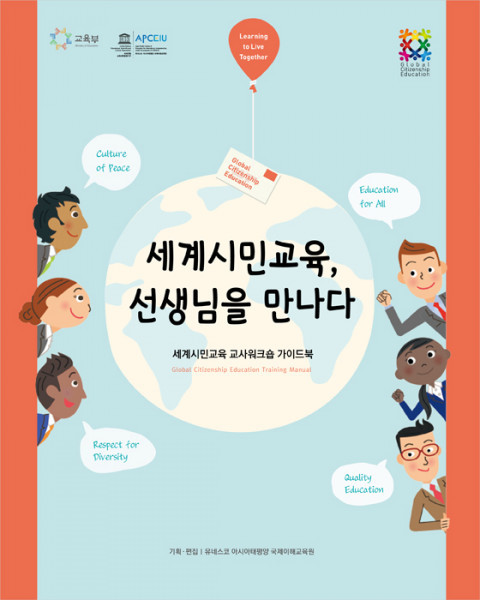 GCED Meets Teachers: GCED Teacher Workshop Guidebook Year of publication: 2015 Corporate author: APCEIU APCEIU published the GCED teacher workshop guidebook “GCED meets teachers.” This guidebook will be used at GCED workshops for teachers of 17 metropolitan and provincial offices of education carried out by GCED Lead teachers. The contents include the concept and the background of GCED, main contents, implementing methods at school. This GCED workshop manual provides teachers with opportunities to search for the ways to implement GCED at the schools, experience learning methods, and understand the main issues and themes of GCED through workshops. This guidebook is composed of 7 workshop sessions(refer to list below). Teachers and teacher educators planning GCED workshop can use this guidebook which includes the contents of the sessions, consultation to help plan and implement workshops based on participation and communication of the participants. “Global Citizenship Education meets teachers” GuidebookSession 1. Importance of World Education Forum and Global Citizenship EducationSession 2. Concept of GCED and its backgroundSession 3. Learning the contents and the theme of GCEDSession 4. Understanding the complexity and interrelationship of the issuesSession 5. Discussion class for cooperative communicationSession 6. Implementing GCED through Project Based LearningSession 7. Setting GCED action plans
  Learning: the treasure within; report to UNESCO of the international commission on education for the twenty-first century (highlights) Year of publication: 1996 Author: Jacques Delors Corporate author: International Commission on Education for the Twenty-first Century Learning: The Treasure Within, commonly referred to as the 'Delors Report', proposes a holistic and integrated vision of education based on the paradigms of lifelong learning, and the four pillars of learning to be, to know, to do, and to live together.