
Resources
Explore a wide range of valuable resources on GCED to deepen your understanding and enhance your research, advocacy, teaching, and learning.
8,376 Results found
 Address by Irina Bokova, Director-General of UNESCO on the occasion of the Plenary Session: Education for Intercultural Citizenship, AoC Third Global Forum; Brazil, 29 May 2010 Year of publication: 2010 Corporate author: UNESCO. Director-General, 2009-2017 (Bokova, I.G.) This is an address by Irina Bokova, Director-General of UNESCO on the occasion of the plenary session for Education for Intercultural Citizenship in Brazil, on 29 May 2010. She insisted the importance of education for 'Learning to Live together'. She also highlited education for inter-cultural understanding as an important theme for the 21st centry.
  Expert meeting on intercultural education, Paris, 20-22 March 2006; report Year of publication: 2006 Corporate author: UNESCO This report will give for each panel a summary of the presentation, the ensuing debates and a synthesis. The discussions of the draft UNESCO Guidelines and of the database on Intercultural Education, including the results and next steps to be taken are also presented. In addition, the report provides a summary of the debate around the presentation of the UNESCO World Report on Cultural Diversity.
 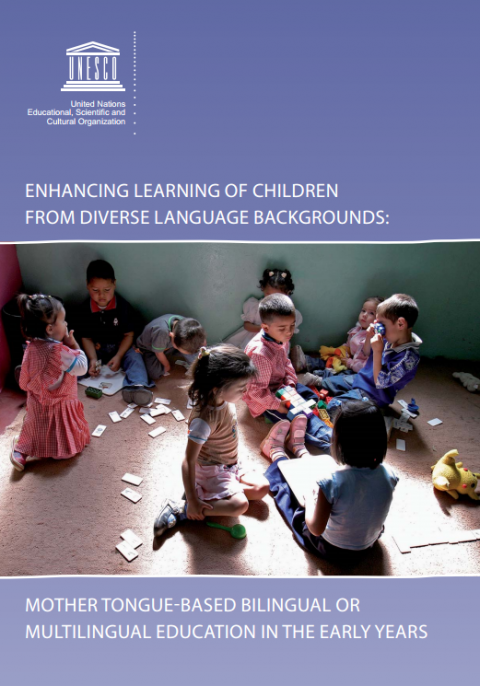 Enhancing learning of children from diverse language backgrounds: mother tongue-based bilingual or multilingual education in the early years Year of publication: 2011 Author: Jessica Ball Corporate author: UNESCO This literature review discusses mother tongue based bilingual or multilingual education for children starting in early childhood. The report: (1) informs policy-makers of existing research and practices in mother-tongue instruction in early childhood and early primary school years; and (2) raises awareness of the value of maintaining the world’s languages and cultures by promoting and resourcing mother tongue-based education for young children. This analysis of current literature is framed within UNESCO’s mandate and strong commitment to quality education for all and to cultural and linguistic diversity in education (UNESCO, 2003a). This discussion is especially timely, given the slow and uneven progress (UNESCO, 2000) in meeting international targets for universal education articulated in the Education for All Goals 1 (ECCE), Goal 2 (Primary Education), and Goal 6 (Quality of Education) (World Declaration on Education for All, 1990).1 Impetus for the current report is provided by the UNESCO (2008a) ‘Global Monitoring Report on Education for All: Will we make it?’ The 2008 GMR report calls for unwavering political will to ensure that education from early childhood onwards is a priority of national governments, civil society and the private sector in order to ensure educational inclusion for the 72 million children out of school and to reduce the numbers of young learners who leave school without acquiring essential skills and knowledge. The report calls for increased investments in the provision of pre-primary education for children aged 3 and above, and for policy measures to provide care and education to children below age 3. UNESCO (2007a) emphasizes the role of early childhood care and development in laying the foundation for learning and setting the stage for successful engagement in formal education. UNESCO has encouraged mother tongue instruction in early childhood and primary education since 1953 (UNESCO, 1953). Yet, monolingualism in official or dominant languages is still the norm around the world (Arnold, Bartlett, Gowani, & Merali, 2006; Wolff & Ekkehard, 2000). In its report, ‘Strong Foundations: Early Childhood Care and Education’, UNESCO (2007a) points out the overlooked advantages of multilingual education in the early years. When children are offered opportunities to learn in their mother tongue, they are more likely to enrol and succeed in school (Kosonen, 2005) and their parents are more likely to communicate with teachers and participate in their children’s learning (Benson, 2002). Mother tongue based education especially benefits disadvantaged groups, including children from rural communities (Hovens, 2002), and girls, who tend to have less exposure to an official language and tend to stay in school longer, achieve better, and repeat grades less oft en when they are taught in their mother tongue (UNESCO Bangkok, 2005).
  Global citizenship: a high school educator's guide (grades 9-12) Year of publication: 2013 Corporate author: TeachUNICEF Global Citizenship is a unit of four lessons designed to introduce the concept of global citizenship and place it in the context of international human rights; to engage students in a guided inquiry into the meaning of global citizenship and its relationship to national citizenship; to educate about how the United Nations has framed global rights and responsibilities for the 21st century and is acting on them via the Millennium Development Goals (MDGs); and to investigate how the U.S. Fund for UNICEF has engaged individuals in support of global citizenship as well as to engage students in designing and implementing a plan to act locally in support of global issues.
  Peace education: framework for teacher education, 2005 Year of publication: 2005 Corporate author: UNESCO New Delhi UNESCO has taken a commendable initiative in promoting peace education. It has generated some important literature and educational material on peace education. ‘Learning the Way of Peace: A Teacher’s Guide to Peace Education’ is a pioneering work. It is because of UNESCO’s initiative that this material on peace education for teacher education has been developed. It would be useful to read this document in conjunction with “Learning the Way of Peace.”
  Teaching respect for all: implementation guide Year of publication: 2014 Corporate author: UNESCO Teaching Respect for All is a joint UNESCO-United States of America-Brazil project launched in January 2012 to counteract discrimination both in and through education. Acknowledging that discrimination is on the rise worldwide, Teaching Respect for All promotes an educational response to counter discrimination and violence through strengthening the foundations of mutual tolerance and cultivating respect for all people, regardless of colour, gender, class, sexual orientation, national, ethnic, or religious orientation/identity. Teaching Respect for All has chosen to focus efforts on the formal and informal classroom, targeting learners of 8-16 years old, and aims to build curiosity, openness, critical thinking and understanding among youth learners, thus equipping them with the awareness, knowledge, and skills to cultivate respect and stop discrimination on all levels. The project is founded on the universal values and core principles of human rights, while acknowledging each country has its own history and mechanism for addressing the issue of discrimination in education. Fostering peaceful co-existence through analysis and revision of history curricula and textbooks in Southeast Europe: preliminary stocktaking report Year of publication: 2006 Author: Jean Damascène Gasanabo | Jade Maître Corporate author: UNESCO To accomplish this aim, the study reviews policies and processes for developing history curricula and producing history textbooks in ten participating countries: Albania, Bosnia and Herzegovina, Bulgaria, Croatia, Greece, Romania, Montenegro, Serbia, Slovenia and The Former Yugoslav Republic of Macedonia (FYROM). The resulting report has been compiled for the dual purpose of (1) presenting a composite picture of the educational policies and practices in these countries with regard to history teaching and textbook production, distribution and use; (2) laying the groundwork for the development of national and/or sub-regional initiatives aimed at improving the processes currently in place. Address by Mr Koïchiro Matsuura, Director-General of UNESCO, on the occasion of the International Forum on ESD dialogue 2008: to be delivered by Mr Mark Richmond, Director of Division for the Coordination of United Nations Priorities in Education Year of publication: 2008 Corporate author: UNESCO. Director-General, 1999-2009 (Matsuura, K.) This address by Mr Koïchiro Matsuura, Director-General of UNESCO, on the occasion of the International Forum on ESD Dialogue 2008 was delivered by Mr Mark Richmond, Director of Division for the Coordination of United Nations Priorities in Education. Monitoring education for global citizenship: a contribution to debate Year of publication: 2015 Author: Harm-Jan Fricke | Cathryn Gathercole | Amy Skinner Corporate author: DEEEP | CONCORD DARE Forum 1. This report aims to provide a stimulus for further thought, work and debate in the design of assessment frameworks for an education that supports people in leading fulfilling lives in a changing, globalised world, and in particular within the context of debates around post-2015 universal targets and indicators that are relevant to an education for global citizenship (EfGC). 2. In providing that stimulus the report addresses the following questions: a. What are the key differences and similarities between diverse forms of ‘adjectival educations’ that contribute to, or generally express themselves as allied to an ‘education for global citizenship’? b. What do they contribute to an education for global citizenship? c. How, if at all, do they interpret the notion of ‘transformation’? d. What do practitioners consider to be the major challenges and opportunities for monitoring (transformative) education for global citizenship? e. Which approaches and means of monitoring and assessing transformative education for global citizenship appear to be feasible? 3. The report is based on information obtained from: a. Literature reviews; b. Workshops, involving 65 educators in total, held in Brazil, Tanzania, Zimbabwe, and three locations in Europe; c. Responses to a questionnaire completed by 218 educators working in more than 50 countries, albeit with a predominance of respondents based in Europe. 4. The origins and key characteristics of development education, global education and global learning, human rights education, and education for sustainable development are explored, leading to statements about their commonalities and contributions to an education for global citizenship. These commonalties appear to be particularly in the areas of their shared global orientation, pursuit of personal and/or societal transformation, active and enquiry based teaching and learning methodologies, and overlapping content. 5. The commonalities which the discussed educations contribute to - and share with – education for global citizenship appear to be particularly around: a. values and dispositions which enable a response to, and advocacy for, change, b. engagement with diverse ideas, opinions and understandings, c. a stimulus to investigate and develop creativity by means of learning, d. building skills and capacities as part of a process of lifelong learning, e. a generic educational approach that aims at involvement in an explicit process of change. 6. Within such a context differences appear amongst practitioners and theoreticians in the use, meaning and function of the term ‘global citizenship’, with some seeing it primarily as a tool in advocacy while others view it primarily as a means of explanation of human relations globally. 7. Critique on the usefulness and use of the terms ‘global citizenship’ is outlined and the world-wide, universal, use of the term ‘education for global citizenship’ is questioned. However, its intentions as an approach of transformative education for critical and active engagement in a globalised society are seen as having universal relevance. 8. That approach is described as “a learning process for people’s critical and active engagement in and with global society, involving people in developing their capacities, capabilities and motivation to be actively engaged in personal and collective human development. It does this by drawing on a critical understanding and consideration of global processes and interdependencies, of other people’s perspectives and interests, of environmental opportunities and limitations, and of universal rights.” 9. The approach is further defined by a number of ‘core signifiers’ (which can form the basis for indicators of achievement) relating to: a. pedagogy – characteristics of the teaching process, b. capacities and capabilities – regarding the learner’s competence, c. values – as exhibited in the teaching and learning process, d. content – the learner’s acquisition of core understandings, e. outcome – regarding the learner’s dispositions, f. social transformation – regarding the learner’s contributions to community and wider society. 10. The report continues by providing a summary review of selected literature regarding the design of monitoring frameworks that appear pertinent to an education for global citizenship. It discusses work done in relation to universal targets and indicators, country based frameworks, education institutional monitoring, educator competence, and learner outcomes. It draws particular attention to the importance of quality assessment, the need to involve the range of education stakeholders in the design, application and interpretation of indicators, and the need to enable learning from experiences. 11. Further information about the challenges and opportunities for monitoring education for global citizenship is obtained from ideas and opinions given by workshop participants and questionnaire respondents. Respondents recognise that developing a universal monitoring framework can help to clarify the purpose and meaning of EfGC for both practitioners and policy makers. However, they also recognise that there is a risk that agreement might be reached around a lowest common denominator approach. The importance of participation by practitioners in, and their ownership of, the monitoring content and process is highlighted. The potential uses of monitoring data and analyses in demonstrating the impact of EfGC on broader cross-curricular outcomes and educational achievements, is seen by respondents as a means to gain further recognition of the value of EfGC. 12. Based on the foregoing, the final chapter of the report provides a number of suggestions as a stimulus for further work, thought and debate. These suggestions focus on: a. a monitoring framework that addresses the holistic nature of EfGC; b. an assessment framework to do with learning outcomes that exemplify the core signifiers mentioned in paragraph 9 above; c. indicators and a monitoring approach that is applicable at national levels, enabling monitoring of progress for specific sectoral aspects of EfGC (teacher education is given as an example of such a sectoral aspect); d. a universal target that builds on the description of EfGC given in paragraph 8 above; e. indicator groupings that can show progress against such a universal target. Human rights education in Russia: analytical report Year of publication: 2008 Author: Anatoly Azarov Corporate author: Moscow School of Human Rights The book examines the status, trends, and issues of human rights education, including HIV/AIDS prevention education in the Russian Federation. It spans the period from the early 1990s to December 2008, analyzing both positive preconditions for the spread of human rights and freedoms knowledge in Russia and obstacles encountered in the process. A special focus is on laws, regulations and standards applicable to higher education. The book describes the activities of the primary social institutions engaged in HRE: comprehensive schools and universities, human rights commissioners, NGOs. It shows examples of international humanitarian law teaching; offers an evaluation of HRE literature for Russian universities; offers a concept of Science and Discipline of Human Rights. The book also examines the condition of HIV/AIDS prevention education within the context of human rights observance. The authors’ conclusions and judgments are supported with a special opinion poll.