
Resources
Explore a wide range of valuable resources on GCED to deepen your understanding and enhance your research, advocacy, teaching, and learning.
8,376 Results found
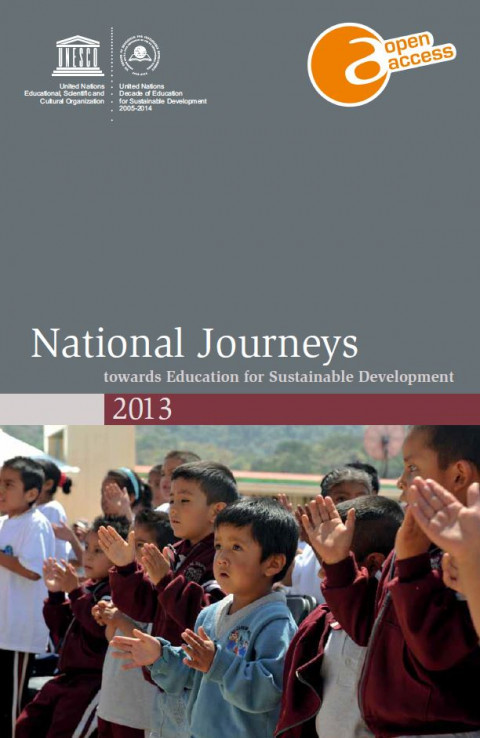 National journeys towards education for sustainable development, 2013: reviewing national ESD experiences from Costa Rica, Morocco, South Africa, Sweden, VietNam Year of publication: 2013 Corporate author: UNESCO This publication has sourced information from a series of national reviews commissioned by UNESCO in 2011/2012 and was written by experts in Costa Rica, Morocco, South Africa, Sweden and Viet Nam. The countries presented in this report are not necessarily the ‘best’ examples of the region, as many other countries are also progressing effectively towards implementing Education for Sustainable Development (ESD). Rather, the countries selected illustrate the wide diversity of ESD approaches and initiatives taking place in different parts of the world. The national studies were then edited and harmonized before common themes and lessons learnt were identified to support other national efforts in moving towards the end of the UN Decade of Education for Sustainable Development.
  Address by Mr Koïchiro Matsuura, Director-General of UNESCO, on the occasion of the Opening Ceremony of the UNESCO World Conference on Education for Sustainable Development: Moving into the Second Half of the UN Decade, delivered on his behalf by Mr Nicholas Burnett, Assistant Director-General for Education; Bonn, Germany, 31 March 2009 Year of publication: 2009 Corporate author: UNESCO. Director-General, 1999-2009 (Matsuura, K.) This address by Mr Koïchiro Matsuura, Director-General of UNESCO, on the occasion of the opening ceremony of the UNESCO World Conference on Education for Sustainable Development: Moving into the Second Half of the UN Decade, was delivered on his behalf by Mr Nicholas Burnett, Assistant Director-General for Education; Bonn, Germany, 31 March 2009. Integrating sustainable development in technical and vocational education and training: six case studies from Southern and Eastern Africa Year of publication: 2010 Author: Roland Dubois | Koontee Balgobin | Modesto Sylvester Gomani | Joy Kasandi Kelemba | Gabriel S. Konayuma | Matthews Lebogang Phiri | John W. Simiyu Corporate author: UNESCO International Centre for Technical and Vocational Education and Training (UNEVOC) The case studies in Southern and Eastern Africa were commissioned in Botswana, Kenya, Malawi, Mauritius and Zambia. They were carried out by writers connected with the UNEVOC Network as part of capacity building and of contributing to knowledge building and sharing. They have described and have analysed experiences, practices relating to integrating ESD in TVET programmes, primarily. Also, they have identified gaps for additional action so that the integration can be satisfactorily done. Through the case studies it is intended to build a pool of resources and tools of what works as part of the UNESCO-UNEVOC International Centre’s clearinghouse. Russian regions for sustainable development: education and culture of peoples in Russian Federation; proceedings of the international conference Year of publication: 2010 Author: Ilona Graf | Natalia Dulepova | Nikolai Lyakhov | Vera Markova | Vladimir Sobyanin | Victoria Shatrova Corporate author: Novosibirsk State University The publication gives careful consideration to RF regional efforts to contribute undertaking a survey of educational contents and methods promoting cultural diversity, including traditional modes of transmission, in Siberia as a vast territory involving three greatest regions of Russian Federation. The mainstream of this recognition and accommodation of Siberian cultural diversity – efforts to create opportunities and facilities for culture-specific learning in each region, adapting teaching methods to the requirements of the everyday life of learners with the support of educational policymakers, educational professionals at all levels and local communities. The goal of publication is contributing to raising the awareness of Siberian population in recognizing the cultural dimension as a central pillar of the UNESCO decade «Education for Sustainable Development» (2005-2014). The publication is aimed at teachers, ethnologists, sociologists, linguists, philosophers, those researching the education and culture of peoples in Russia, government specialists, representatives of national-cultural communities of indigenous peoples and ethnic minorities.
  The contribution of early childhood education to a sustainable society Year of publication: 2008 Corporate author: UNESCO This report originates from the international workshop, ‘The Role of Early Childhood Education for a Sustainable Society’, jointly organized in Göteborg, Sweden, by Göteborg University, Chalmers University of Technology and the City of Göteborg, from 2 to 4 May 2007. It was attended by thirty-five participants from sixteen different countries (see ‘List of Participants’). The workshop was a follow-up to the international conference on education for sustainable development, ‘Learning to Change Our World’, held in May 2004, in Göteborg. It was one of four preparatory workshops leading to another international conference on education for sustainable development, to be organized in 2008 or 2009, in the same city. The aim of the four workshops is to discuss promoters and barriers related to learning for sustainability, and to propose recommendations for the upcoming international conference. The present workshop was conceived for the following reasons. First, our societies urgently require new kinds of education that can help prevent further degradation of our planet, and that foster caring and responsible citizens genuinely concerned with and capable of contributing to a just and peaceful world. Second, these new kinds of education must be available to all – not only a handful of people – and take place in various settings, including families and communities. Third, they must begin in early childhood, as the values, attitudes, behaviours and skills acquired in this period may have a long-lasting impact in later life. Thus, early childhood education clearly has an important place in the efforts to bring about sustainable development. Education sector responses to homophobic bullying Year of publication: 2012 Corporate author: UNESCO This publication is part of a Good Policy and Practice series that addresses key themes of UNESCO’s work with the education sector including HIV and AIDS and safe, healthy educational environments for all learners. This volume, on the theme of homophobic bullying in educational institutions, builds on UNESCO’s work on gender, discrimination and violence in schools. Education sector responses to climate change: background paper with international examples Year of publication: 2012 Corporate author: UNESCO Bangkok Through a review of academic articles and project documents, this paper explores the relationship between the education sector and climate change. It introduces how education is both impacted by and has an impact on this phenomenon, and proposes various sector responses. Different theoretical frameworks for where and how climate change education fits into the education sector are made concrete with case studies from across the globe. An essential introduction to climate change and education, this paper brings together theory, policy and practice. A useful read for those working in either the education sector or on climate change. Education sector technical notes: Education for Sustainable Development (ESD) Year of publication: 2013 Corporate author: UNESCO The Education Sector is called to implement a significant and broad mandate, covering many challenging issues in education in a diverse and fast-changing world. More than ever, we need to better focus and ensure greater cohesion in implementing this mandate. This document is part of a series of Technical Notes that have been developed by colleagues in the Education Sector in order to facilitate programme delivery in thematic areas related to the work of the Sector. The Technical Notes are meant to serve as a quick reference tool for UNESCO staff, providing a brief overview including basic knowledge, key priorities for UNESCO and future directions as well as practical information on each topic. UNESCO associated schools news infos: human rights education Year of publication: 2011 Corporate author: UNESCO Associated Schools Project Network (ASPnet) Human Rights Education is as relevant today as it was in 1953 when it was acknowledged as one of the major themes of ASPnet at its foundation. Education should encompass values such as peace, non‐ discrimination, equality, justice, non‐violence, tolerance and respect for human dignity. Quality education, using a human rights‐based approach, means that rights are implemented throughout the whole education system and in all learning environments. L'Education au développement durable: visions d'enfants Year of publication: 2011 Corporate author: UNESCO These eleven drawings and paintings were entered in the UNESCO “Draw me peace” competition. Each drawing represents a particular aspect of Education for Sustainable Development and reflects the next generations’ vision for a better, fairer future.