
Resources
Explore a wide range of valuable resources on GCED to deepen your understanding and enhance your research, advocacy, teaching, and learning.
8,376 Results found
 Odpowiedzi sektora edukacji na homofobiczna przemoc rówiesnicza Year of publication: 2014 Corporate author: UNESCO This publication is part of a Good Policy and Practice series that addresses key themes of UNESCO’s work with the education sector including HIV and AIDS and safe, healthy educational environments for all learners. This volume, on the theme of homophobic bullying in educational institutions, builds on UNESCO’s work on gender, discrimination and violence in schools. Address by Mr Koïchiro Matsuura, Director-General of UNESCO, on the occasion of the Copenhagen Conference: Education for Intercultural Understanding and Dialogue; Copenhagen, 21 October 2008 Year of publication: 2008 Corporate author: UNESCO. Director-General, 1999-2009 (Matsuura, K.) This address is given by Mr Koïchiro Matsuura, Director-General of UNESCO, on the occasion of the Copenhagen Conference: “Education for Intercultural Understanding and Dialogue”. Address by Irina Bokova, Director-General of UNESCO on the occasion of the Plenary Session: Education for Intercultural Citizenship, AoC Third Global Forum; Brazil, 29 May 2010 Year of publication: 2010 Corporate author: UNESCO. Director-General, 2009-2017 (Bokova, I.G.) This is an address by Irina Bokova, Director-General of UNESCO on the occasion of the plenary session for Education for Intercultural Citizenship in Brazil, on 29 May 2010. She insisted the importance of education for 'Learning to Live together'. She also highlited education for inter-cultural understanding as an important theme for the 21st centry.
 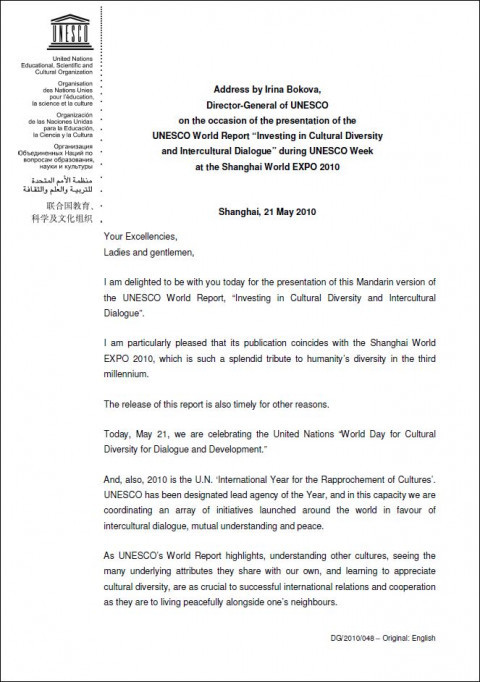 Address by Irina Bokova, Director-General of UNESCO on the occasion of the Presentation of the UNESCO World Report: Investing in Cultural Diversity and Intercultural Dialogue, during UNESCO Week at the Shanghai World EXPO 2010; Shanghai, 21 May 2010 Year of publication: 2010 Corporate author: UNESCO. Director-General, 2009-2017 (Bokova, I.G.) This address was delivered by Irina Bokova, Director-Geneeral of UNESCO on the occasion of the presentation of the UNESCO world report in investing in cultural diversity and intercultural dialogue during UNESCO week at the Shanghai World Expo 2010. In this address she highlited the importance of cultural diversity and intercultural communication, and requested the protection of Chinese cultural heritage by Chinese governments. Report on the survey on the implementation of the road map for arts education Year of publication: 2010 Corporate author: UNESCO The Road Map for Arts Education is a reference document that aims to explore the role of arts education in meeting the need for creativity and cultural awareness in the 21st Century, while placing emphasis on the strategies required to introduce or promote arts education in the learning environment. Within this conceptual framework, all UNESCO Member States interested in initiating or developing arts education practices can mould their own national policy guidelines, adapted to their socio-cultural specificities. With the Road Map, UNESCO advocates the essential role of arts education within societies, to create a common ground of understanding for all stakeholders. The development of the Road Map for Arts Education was a lengthy and comprehensive consultation process. The document was first elaborated by a group of experts and UNESCO, then presented at the First World Conference on Arts Education (Lisbon, 2006) and later revised and updated, following recommendations from NGOs and Member States. The Road Map was finally distributed to the UNESCO Member States in November 2007 in English and French and then translated into Spanish and Russian following popular demand. More than a year after this distribution, UNESCO launched a wide-ranging survey in order to assess the implementation of the Road Map in its 193 Member States. Through its National Commissions, the Organization relayed this document to Ministries of both Education and Culture. The aim of this exercise was threefold: to learn whether the Road Map was being applied and to what extent it was influencing policy decisions at national level; to act as a reminder of the importance of the UNESCO reference document and encourage its use; finally, to assess the situation of arts education in the responding countries. Thus, this survey not only acted as a catalyst for the implementation of the Road Map, but also provided precious knowledge on arts education around the world. The Member States’ responses also contributed greatly to the Second World Conference on Arts Education (Seoul, May 2010), inspiring one of its main themes and the topics for a number of workshops. They also encouraged a more integral participation of these States in the conference through preparatory consultations.
  Our creative diversity: report of the world commission on culture and development; summary version Year of publication: 1996 Corporate author: World Commission on Culture and Development This report is designed to address a diversified audience across the world that ranges from community activists, field workers, artists and scholars to government officials and politicians. We want it to inform the world’s opinion leaders and to guide its policy-makers. We want it to capture the attention of the world’s intellectual and artistic communities, as well as the general public. We aim to have shown them how culture shapes all our thinking, imagining and behaviour. It is the transmission of behaviour as well as a dynamic source for change, creativity, freedom and the awakening of innovative opportunities. For groups and societies, culture is energy, inspiration and empowerment, as well as the knowledge and acknowledgment of diversity: if cultural diversity is ‘behind us, around us and before us”, as Claude L&i-Strauss put it, we must learn how to let it lead not to the clash of cultures, but to their fruitful coexistence and to intercultural harmony. Just as in the tasks of building peace and consolidating democratic values, an indivisible set of goals, so too economic and political rights cannot be realized separately from social and cultural rights. The challenge to humanity is to adopt new ways of thinking, new ways of acting, new ways of organizing itself in society, in short, new ways of living. The challenge is also to promote different paths of development, informed by a recognition of how cultural factors shape the way in which societies conceive their own futures and choose the means to attain these futures. I have for some time been concerned with the “culture of peace”. There is now considerable evidence that neglect of human development has been one of the principal causes of wars and internal armed conflicts, and that these, in turn, retard human development. With government complicity and with the intention of raising export receipts, private businesses continue to sell advanced military technology, nuclear materials and equipment for the production of bacteriological and chemical warfare. The concept of state sovereignty which still prevails today has increasingly come under scrutiny. In the area of peace-keeping, the distinction between external aggression and internal oppression is often unrealistic. The predominant threat to stability are violent conflicts within countries and not between them. There is an urgent need to strengthen international human rights law. Many of the most serious troubles come from within states – either because of ethnic strife or repressive measures by governments. Conditions that lead to tyranny and large-scale violations of human rights at home sooner or later are likely to spill over into a search for enemies abroad. The temptation of repressive states to export internal difficulties is great. Consider the Soviet Union’s invasion of Hungary and Czechoslovakia after it had used domestic oppression and the persistent refusal - for many years - of the previous South African governments to grant independence to Namibia. An ounce of prevention is better than a ton of punishment.
 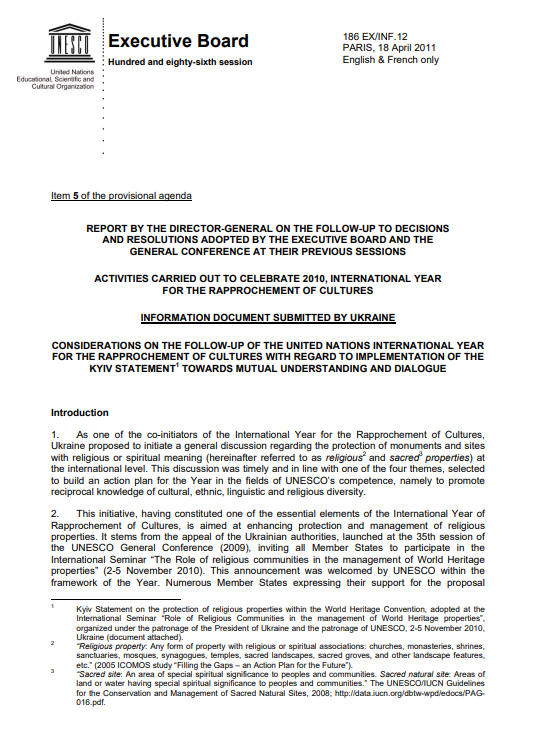 Considerations on the follow-up of the United Nations International Year for the Rapprochement of Cultures with regard to implementation of the Kyiv Statement towards Mutual Understanding and Dialogue Year of publication: 2011 Corporate author: UNESCO As one of the co-initiators of the International Year for the Rapprochement of Cultures, Ukraine proposed to initiate a general discussion regarding the protection of monuments and sites with religious or spiritual meaning (hereinafter referred to as religious2 and sacred3 properties) at the international level. This discussion was timely and in line with one of the four themes, selected to build an action plan for the Year in the fields of UNESCO’s competence, namely to promote reciprocal knowledge of cultural, ethnic, linguistic and religious diversity. 2. This initiative, having constituted one of the essential elements of the International Year of Rapprochement of Cultures, is aimed at enhancing protection and management of religious properties. It stems from the appeal of the Ukrainian authorities, launched at the 35th session of the UNESCO General Conference (2009), inviting all Member States to participate in the International Seminar “The Role of religious communities in the management of World Heritage properties” (2-5 November 2010). This announcement was welcomed by UNESCO within the framework of the Year. Numerous Member States expressing their support for the proposal designated representatives to participate in this Seminar. The elaboration of the Kyiv Statement (as one of the main outcomes of the Seminar) and its adoption in close cooperation with representatives of religious communities contributes to the creation of a culture of dialogue.
  Cultural aspects in Christian and Islamic religions Year of publication: 2011 Corporate author: UNESCO Beirut | Université Saint Joseph de Beyrouth This book allows the readers the opportunity to know about the cultural aspects related to religions, mainly in Lebanon and the Near East, their meaning and their aim. This knowledge will help the reader, firstly, to grasp the meaning of these various aspects, whether they concern him directly or the people who live in the same country, with whom he shares common space and living. Secondly, the book contributes to the Lebanese understanding one another’s behaviors and their own behavior concerning these aspects. Therefore, the book also contributes to the Lebanese looking at one another with more trust before starting to criticize. This book includes chapters that cover most of the different cultural aspects in Christian and Islamic religions. The first chapter deals with time, passing through each month of the year and its days, in a chronological manner. The second chapter delves into religious occasions in the Christian then Islamic religions. It explains the meaning of Holidays and remembrances of God and their particular aspects as well as the religious reasons of each. This chapter includes a part about al-‘awliya’ and Saints who are mentioned in some of the Lebanese daily rituals. Chapter three delves into the individual’s life stages from birth to religious vows, to marriage and death. The aspects that go with these stages constitute an important part in the life of the Lebanese. This chapter details the aspects and traditions of all these stages in which people take part, thus creating a common ground in a multi-religious society. Chapter four deals with religious practices, acts of worship, and legal prescriptions. It describes them and deals with their spiritual meaning to individuals who express their faith when practicing them. Prayer, Mass, and Pilgrimage, among others, are religious practices that are detailed in a way to make the reader understand what they mean to those who perform them. Chapter five leads us into religious places and their meaning, from churches to mosques and monasteries, khalwat and husayniyyat, all of which have different and divergent meanings to visitors. Yet, they all show the importance given by man to the place when expressing his faith and his relation with the Creator. Chapter six takes us to religious habits and customs, such as the clothes worn by religious dignitaries, their symbolism and meaning. It also deals with some general habits and customs. The reader may find that some chapters overlap. In fact, we have tried to make each part related to the others yet independent from them. This method facilitates the reading and understanding of any subject on its own without the need to refer to prior or subsequent parts. Finally, those who had any – minor or major – contribution in this book – despite the lacks that some readers might see – hope that they have offered a useful work in the process of discovering others who are different and who hold rich traditions as well human and spiritual values.
  IBE-UNESCO preparatory report for the 48th ICE on inclusive education Year of publication: 2007 Corporate author: UNESCO International Bureau of Education (IBE) The International Conference on Education (ICE) is a major international forum for educational policy dialogue among Ministers of Education and other stakeholders (researchers, practitioners, representatives of intergovernmental organizations and NGOs). The ICE is organized by the International Bureau of Education (IBE), the UNESCO institute specialized in assisting Member States in curriculum development to achieve quality Education For All. The IBE Council, composed of 28 UNESCO Member States, has proposed in January 2007 that the 48th ICE session, to be held in Geneva in November 2008, should focus on the theme “Inclusive Education: the Way of the Future”. The 48th ICE will focus on broadening the understanding of the theory and practice of inclusive education while discussing how governments can develop and implement policies on inclusive education. The IBE is hosting a series of regional preparatory workshops dedicated to exploring and advancing inclusive education in preparation for the ICE 2008. The Regional Preparatory Workshop "International Workshop on Inclusive Education, Andean and Southern Cone Regions” was held in Buenos Aires, Argentina on the 11-14 September 2007. This event was organized by the International Bureau of Education (IBE/UNESCO), the Division for the Promotion of Basic Education (ED/BAS, UNESCO Paris), the Regional Bureau of Education for Latin America and the Caribbean (OREALC/UNESCO); University of de San Andrés, Ministry of Science, Technology and Education, in collaboration with the Community of Practice - Southern Cone and Andean Regions; it had the participation of ten countries from the Southern Cone and Andean Regions. This report is based on the workshop’s country reports and presentations on the conception and status of inclusive education in participating countries, and on the ideas proposed by participants on what the next steps should be on how to advance inclusive education policy and implementation in the region.
  Education for conflict prevention and peacebuilding: meeting the global challenges of the 21st century Year of publication: 2012 Author: Phyllis Kotite Corporate author: UNESCO International Institute for Educational Planning (IIEP) The 21st century is witnessing global concern over the interrelated effects of climate change, the economic crisis, energy depletion, food and water shortages, natural disasters and conflicts all of which have devastating effects on humanity and the future of the planet. These events impact education systems and can impair the ability of governments to provide quality education for their citizens. However, when governments and ministries of education analyse and anticipate the risk of such events through careful planning, education can play an important role in preventing violent conflict, and in supporting peacebuilding efforts. An estimated 1.5 billion people live in countries affected by repeated cycles of political and other forms of violence, and the same population is often affected by hunger and poverty. Furthermore, such countries have difficulty meeting development goals. For example, no low-income fragile or conflict-affected country has yet achieved a single MDG (World Bank, 2011). In 2010 world military expenditures reached US$1.6 trillion as a result of fifteen ongoing conflicts (SIPRI, 2011). Yet, it is estimated that only US$16 billion is needed to fill the education gap to reach the EFA goals (UNESCO, 2011b: 11). This paper argues that we have the knowledge, legal instruments and mechanisms to prevent conflict and to transfer resources to sustainable development and education to meet the challenges of the 21st century. The paper describes a range of conflict prevention initiatives and examines the role of policy-makers, youth, women, and the media in maintaining and restoring peace as part of a holistic vision of education. International institutions, governments and civil society are increasingly developing conflict prevention mechanisms and utilizing political and economic incentives to avoid conflicts. They are also creating new technology for sustainable development, adaptation to climate change and renewable forms of energy. Educational planning must therefore go beyond traditional mechanisms. It must take into consideration the unpredictable nature of our times; be flexible and rapid in implementation and responsive to local needs. Training and research in sustainable development; and skills for peaceful inter-human relations, good governance, the prevention of conflict and peacebuilding are priorities elaborated in the paper. In addition, specific recommendations are highlighted such as: capacity development for conflict prevention within the education sector and other ministries, analysing the root causes of conflict and the role that education can play in mitigating tensions. This paper is an elaboration of Chapter 1.2 of the IIEP-UNESCO Guidebook for Planning Education in Emergencies and Reconstruction (IIEP-UNESCO, 2010). A brief treatment of additional global challenges (e.g. water scarcity, food insufficiency, energy depletion and economic instability), which are beyond the educational focus of this paper, may be found in Annex I.