
Resources
Explore a wide range of valuable resources on GCED to deepen your understanding and enhance your research, advocacy, teaching, and learning.
8,376 Results found
 Natural disaster preparedness and education for sustainable development Year of publication: 2007 Corporate author: UNESCO Bangkok Natural Disaster Preparedness and Education for Sustainable Development provides details of the development of culturally appropriate and locally relevant educational material for natural disaster preparedness that targets key stakeholder groups and integrates Education for Sustainable Development (ESD) principles and strategies. It is expected to develop and strengthen a regional network to implement and further ESD initiatives throughout the region by promoting education for natural disaster preparedness as well as ESD. This will underpin an identified key area of the Hyogo Framework for Action 2005-2015: Building the Resilience of Nations and Communities to Disasters. The publication articulates the lessons learned by the four in-country project teams (i.e., the Maldives, Thailand, Indonesia and India) and two collaborating organizations (i.e., Asia/Pacific Cultural Centre for UNESCO and Bangladesh Red Crescent Society) in developing materials in collaboration with community groups in the Asia-Pacific region. It provides insights into effective techniques to develop locally relevant educational materials, and highlights some of the challenges in that field.
  Astrolabe: a guide to education for sustainable development coordination in Asia and the Pacific Year of publication: 2011 Corporate author: UNESCO Bangkok An astrolabe is an ancient instrument used to measure the position of the sun and stars. In the past it was used for a number of purposes, such as determining the time of day or night and measuring one’s current position in relation to the north and south poles. A mariner’s astrolabe was used to determine the latitude of a ship at sea and guide its direction. Similar to the mariner’s astrolabe, the Asia-Pacific Education for Sustainable Development (ESD) Astrolabe aims to assist UNESCO Member States in determining the current position of ESD in their country and guiding education and learning in a desired direction, so as to support the advancement of sustainable development in the national context. The ESD Astrolabe is also intended to complement ongoing efforts to enhance the quality of education throughout the Asia-Pacific region.
  Pacific education for sustainable development framework; endorsed by the Pacific Ministers of Education, 27 September 2006, Nadi Fiji Year of publication: 2006 Corporate author: UNESCO Apia This paper presents a Pacific developed and driven Framework as a mechanism to assist in the implementation of the Pacific Plan and the basis for a regional approach to coordinating actions to achieve its vision of a prosperous region where “all people can lead free and worthwhile lives.” It further recognises the commitment made by Pacific countries in adopting the UN Decade of Education for Sustainable Development. The Framework can be adapted for national policy as well as regional strategy documents. The Framework can also be used by both national and regional organisations to identify priority initiatives for implementation in Education for Sustainable Development (ESD) within the Pacific.
  UN Decade of Education for Sustainable Development, 2005-2014: the DESD at a glance Year of publication: 2005 Corporate author: UNESCO This document briefs on the Decade of Education for Sustainable Development (DESD), detailing its objectives, the implementation plans, good practices, and challenges that DESD faces.
  Two concepts, one goal: education for international understanding and education for sustainable development Year of publication: 2007 Corporate author: APCEIU | UNESCO Bangkok EIU and ESD are not dogmas but evolving concepts that can contribute to social learning and transformation. EIU and ESD share many common issues, supporting each other’s scope of work and focus. This series of information sheets has been prepared to highlight key complementary areas and synergies. Education for sustainable development: shaping the future Year of publication: 2009 Corporate author: UNESCO This poster portrays the importance of education for sustainable development in terms of shaping the future. Aichi-Nagoya Declaration on Education for Sustainable Development Year of publication: 2014 Corporate author: UNESCO We, the participants of the UNESCO World Conference on Education for Sustainable Development held in AichiNagoya, Japan, from 10 to 12 November 2014, adopt this Declaration and call for urgent action to further strengthen and scale up Education for Sustainable Development (ESD), in order to enable current generations to meet their needs while allowing future generations to meet their own, with a balanced and integrated approach regarding the economic, social and environmental dimensions of sustainable development. This Declaration recognises that people are at the centre of sustainable development and builds on the achievements of the United Nations (UN) Decade of ESD (2005-2014); the deliberations of the UNESCO World Conference on ESD in Aichi-Nagoya; and the Stakeholder Meetings held in Okayama, Japan, from 4 to 8 November 2014, namely, UNESCO ASPnet International ESD events, the UNESCO ESD Youth Conference, the Global Regional Centres of Expertise Conference, and other relevant events and consultation processes, including regional ministerial meetings. We express our sincere gratitude to the Government of Japan for hosting the UNESCO World Conference on ESD.
 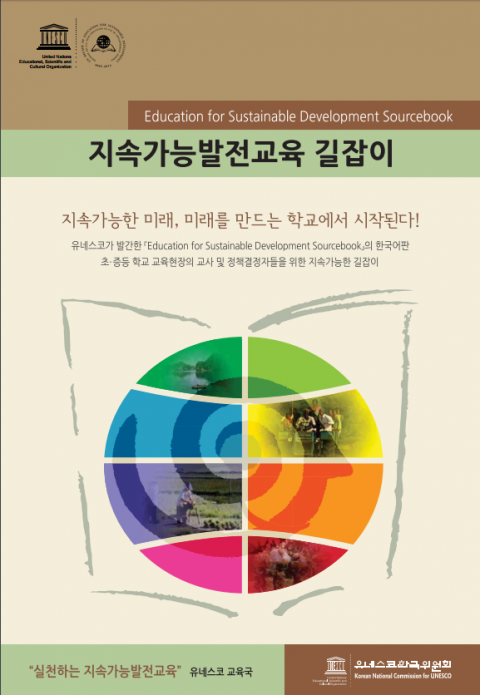 Education for Sustainable Devleopment: Sourcebook Year of publication: 2013 Corporate author: UNESCO The target audiences for the Education for Sustainable Development Sourcebook are primary and secondary teachers and mid-level decision-makers, who have responsibility for primary and secondary education. Another primary audience is teacher educators who work with pre-service and in-service primary and secondary school teachers. The purpose of the publication is to describe ways in which education for sustainable development (ESD) can be integrated into primary and secondary schooling. This collection of briefs is designed to complement other ESD materials published by UNESCO. The topics for the briefs were selected in consultation with UNESCO Field Offices and Institutes. The briefs for primary and secondary teachers are specifically written for professional educators who work in formal education settings. The briefs for teachers as well as those for decision-makers address “gaps” in the UNESCO ESD literature. Education for sustainable development: linking learning and happiness Year of publication: 2007 Author: Joel Bacha Corporate author: UNESCO Bangkok Education for Sustainable Development programmes demonstrating the link between learning and wellbeing and happiness are beginning to emerge throughout the Asia-Pacific region. In small communities throughout the Pacific islands, for example, ESD approaches are helping to engage communities in decision-making about their own lives. Regional guiding framework of education for sustainable development in the Arab Region Year of publication: 2008 Corporate author: UNESCO Beirut The Regional Guiding Framework of Education for Sustainable Education in the Arab Region (2005-2014) provides a general and reference vision of the activities that could be implemented by any of the partners such as education and training institutions, production and services, international and regional organizations, civil society and NGOs, within the framework of the DESD. The Framework highlighted the role of partners and beneficiaries in the implementation of joint activities related to society, life and work within the UN DESD. Annex (3) in the Arabic text provides details description of the expected role of partners in the region.