
Resources
Explore a wide range of valuable resources on GCED to deepen your understanding and enhance your research, advocacy, teaching, and learning.
8,376 Results found
 A Review of education for sustainable development policies from a cultural diversity and intercultural dialogue perspective: identifying opportunities for future action Year of publication: 2009 Author: Daniella Tilbury | I. Mulà Corporate author: UNESCO This review highlights the striking absence of culture in ESD, a gap also acknowledged by participants at the UNESCO World Conference on Education for Sustainable Development held in Bonn, Germany, from 31 March to 2 April 2009. The final declaration emphasizes that ESD is about 'creative and critical approaches, long-term thinking, innovation and empowerment for dealing with uncertainty', and for solving complex problems, highlighting in particular the interdependence of environment, economy, society, and cultural diversity from local to global levels. The review and its methodology provide an instructive example of ways to articulate the linkages between cultural diversity, intercultural dialogue and ESD, required for a sustainable future.
  EIU Best Practice Series No. 5: Peace and human rights education through education for sustainable development: lessons from four case studies in the Philippines Year of publication: 2007 Corporate author: APCEIU The four case studies showed that EIU through peace and human rights education in the context of education for sustainable development can build a critical mass of Filipinos who will reject wars and promote social security. Education can play a role to direct the children, youth, and adults toward peace building and better understanding of cultural differences. It should also be noted that when institutions adopt a peace culture, establishing local and international organizations and putting up resources for various peace-building initiatives become possible. Educational intervention can effect changes in the minds of men and build a lasting and substantive foundation for peace based on justice and respect for human rights.
  National journeys towards education for sustainable development, 2011: reviewing national experiences from Chile, Indonesia, Kenya, the Netherlands, Oman Year of publication: 2011 Author: I. Mulà | Daniella Tilbury Corporate author: UNESCO This publication has sourced information from a series of national reviews commissioned by UNESCO in 2010 and written by authoritative stakeholders in Chile, Indonesia, Kenya, the Netherlands and Oman. The selection of countries was based on: i) work showcased at the 2009 World Conference on Education for Sustainable Development held in Bonn, Germany; ii) submissions to the monitoring and evaluation process for the Decade of Education for Sustainable Development (DESD); as well as iii) through evaluation material submitted by UNESCO staff in regional bureaux of education.The countries showcased in this report are not necessarily the ‘best’ examples of the region, as many other countries are also progressing effectively towards implementing ESD. Rather, the countries selected illustrate the wide diversity of ESD approaches and initiatives taking place in different parts of the learnt world. The national studies were then edited and harmonized before common themes and lessons learned were identified to support other national efforts in moving towards the second half of the UN Decade of Education for Sustainable Development.
  Address by Irina Bokova, Director-General of UNESCO on the occasion of the Conference on Education for Sustainable Development in Support of Cultural and Biological Diversity; Oman, 24 January 2011 Year of publication: 2011 Corporate author: UNESCO. Director-General, 2009-2017 (Bokova, I.G.) This address was given by Irina Bokova, Director-General of UNESCO on the occasion of the Conference on Education for Sustainable Development in Support of Cultural and Biological Diversity.
 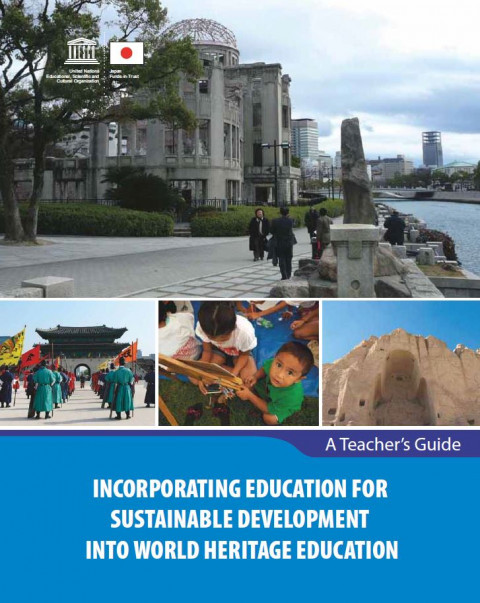 Incorporating education for sustainable development into world heritage education: a teacher's guide Year of publication: 2010 Corporate author: UNESCO Bangkok This publication, A Teacher’s Guide: Incorporating Education for Sustainable Development into World Heritage Education, represents the collective efforts of workshop participants to produce a practical tool for teachers to modify available curricula and incorporate ESD concepts and principles into WHE. It has taken a long time for the guide to be available in print. Nonetheless, the content of the guide remains practical and relevant in incorporating Education for Sustainable Development into World Heritage Education. Country reports on education for sustainable development: centred on the five cluster countries of UNESCO office, Jakarta Year of publication: 2011 Author: Meeyoung Choi | Robert J. Didham Corporate author: UNESCO Jakarta As the cluster office, UNESCO Office, Jakarta covers the implementation of all major programmes and mandates by UNESCO in these five countries as well as disseminates and shares information and knowledge in the fields of education, science, culture and communication in the Asia and Pacific region. Promoting sub-regional education for sustainable development in South-East Asia Year of publication: 2011 Corporate author: UNESCO Jakarta UNESCO Office, Jakarta, focuses on five cluster countries, helping their governments to plan and manage the education sector by enhancing national capacities to integrate sustainable development issues and practices into all types and levels of education.
  Proposed thematic programme on water education within the UN Decade on Education for Sustainable Development (DESD, 2005-2014) Year of publication: 2006 Corporate author: International Hydrological Programme (IHP) Water education is a very important component of UNESCO’s overall effort in water, including within the International Hydrological Programme. The UNESCO Executive Board has called for a UNESCO-wide strategy for water education at all levels. This document reviews the evolution of water education within UNESCO, and draws attention to the Draft Action Plan for the UN Decade on Education for Sustainable Development (DESD), which includes 12 Thematic Programmes one of which would be devoted to “Education for Sustainable Water Management”. The IHP would be expected to play an important role in such a UNESCO-wide effort for water education. Education for sustainable development: sourcebook Year of publication: 2012 Corporate author: UNESCO The target audiences for the Education for Sustainable Development Sourcebook are primary and secondary teachers and mid-level decision-makers, who have responsibility for primary and secondary education. Another primary audience is teacher educators who work with pre-service and in-service primary and secondary school teachers. The purpose of the publication is to describe ways in which education for sustainable development (ESD) can be integrated into primary and secondary schooling. This collection of briefs is designed to complement other ESD materials published by UNESCO. The topics for the briefs were selected in consultation with UNESCO Field Offices and Institutes. The briefs for primary and secondary teachers are specifically written for professional educators who work in formal education settings. The briefs for teachers as well as those for decision-makers address “gaps” in the UNESCO ESD literature. Education for sustainable development: building a better, fairer world for the 21st century Year of publication: 2012 Corporate author: UNESCO Education for Sustainable Development allows every human being to acquire the knowledge, skills, attitudes and values necessary to shape a sustainable future. Education for Sustainable Development means including key sustainable development issues into teaching and learning; for example, climate change, disaster risk reduction, biodiversity, poverty reduction, and sustainable consumption. It also requires participatory teaching and learning methods that motivate and empower learners to change their behaviour and take action for sustainable development. Education for Sustainable Development consequently promotes competencies like critical thinking, imagining future scenarios and making decisions in a collaborative way. Education for Sustainable Development requires far-reaching changes in the way education is often practised today. UNESCO is the lead agency for the UN Decade of Education for Sustainable Development (2005-2014).