
Resources
Explore a wide range of valuable resources on GCED to deepen your understanding and enhance your research, advocacy, teaching, and learning.
8,376 Results found
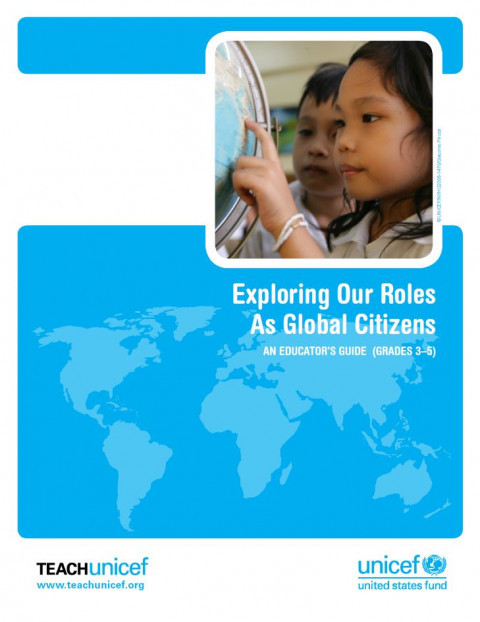 Exploring our roles as global citizens: an educator's guide (grades 3-5) Year of publication: 2013 Author: Elizabeth O. Crawford Corporate author: TeachUNICEF ‘Exploring Our Roles as Global Citizens’ is a four-lesson unit with extension activities and a student-led inquiry project that is designed to introduce the concept of global citizenship, including relevant knowledge, skills, values, and civic actions; to educate students about universal human rights outlined in the Convention on the Rights of the Child (CRC) and what their responsibilities are to ensure these rights are protected; to foster students’ skills in developing perspectives, critical and creative thinking, research, and decision-making about a chosen global issue using a student-led inquiry model; and to empower students to recognize and use their individual strengths to make a positive difference in their local communities. Lesson 1: What Is Global Citizenship? This lesson engages students in reflecting upon what it means to be a global citizen. Although students are often taught the concepts of citizenship and the characteristics of good citizenship during the elementary years, students may not have considered previously their roles as citizens in a global society. Using authentic examples of global citizenship among youth as a springboard for discussion, students determine how they are citizens at various levels. Afterward, students begin their inquiry of a chosen global issue about which they will take informed action at the end of the unit. Lesson 2: We Are Citizens of the World and We Have Rights! Building upon their prior learning about citizenship, students are introduced to human rights, or those rights to which all persons are entitled. Students learn about the Convention on the Rights of the Child (CRC) and create a concept map outlining categories and examples of human rights. Afterward, students relate human rights to contemporary global issues and how it is our responsibility to take action when the rights of others are violated. Lesson 3: Global Citizens Take Responsibility In this lesson, students learn about their individual and collective responsibility to protect human rights. Through analysis of authentic photographs depicting responsible citizenship, students explore the idea that global citizens are proactive when the rights of others are threatened. To demonstrate their learning, students role-play characteristics of global citizenship. Subsequently, in cooperative groups, students continue their global issue research and begin to consider how they will take informed action as global citizens. Lesson 4: Global Change Begins With Me In this culminating lesson, students reflect upon their learning about global citizenship and how they can be positive change agents in their communities. Students first explore how individuals take action to solve a problem or to improve conditions for others. Using these examples as inspiration, students determine how they, too, can be “changemakers.” As a final assessment, students synthesize what they have learned by creating a comprehensive definition of global citizenship, and develop an action plan to address the global issue they have researched.
  The role of education and training in sustainable development: social, economic and environmental dimensions Year of publication: 2006 Author: Mohammad Jabir Ali | Abdallah AmboSaeedi | Jilani Lamloumi | Sulieman Sulieman Corporate author: UNESCO Beirut Education, Training and Sustainable Development are three fields for life were selected to be the topic in the Regional Workshop on the Role of Education and Training in Sustainable Development (Manama - Kingdom of Bahrain, 19-21 September 2005), as part of TVET-UNEVOC programme for 2004-2005, and follow-up on Bonn Declaration issued at the end of the International Expert Meeting on “Learning for Work, Citizenship and Sustainability”, Bonn, 25-28 October 2004. Thirty five (35) officials, experts and specialists from thirteen (13) Arab countries, UNESCO Offices in Beirut and Doha, and the International Centre for TVET - Bonn Centre took part in Bahrain Workshop. The Organizing Committee for the Workshop had highlighted the social, economic and enviromental dimensions of sustainable development, according to the plan of action of the UN Decade on Education for Sustainable Development (2005-2014). The main working papers discussed in the Workshop were developed into a reference study in TVET-UNEVOC Searies to reflect on future orientations in the fields related to Sustainable Development in the Arab countries. Teaching resource kit for dryland countries: a creative approach to environmental education Year of publication: 2007 Author: Thomas Schaaf Corporate author: UNESCO Entitled A Creative Approach to Environmental Education/Teaching Resource Kitfor Dryland Countries, the kit is intended for secondary-school teachers in countries affected by desertification and is based on an innovative approach appealing to the creativity and artistic sensibility of pupils aged 10 to 15 years. This approach favours discovery of the environment through the senses, and emphasizes the visual and exploratory aspects of environmental study. The idea of using creativity and artistic sensibility to promote ecological awareness may in the future become a source of collaboration to be explored in detail by the different sectors of UNESCO. A teaching resource kit for mountain countries: a creative approach to environmental education Year of publication: 2010 Author: Thomas Schaaf Corporate author: UNESCO Entitled: A Teaching Resource Kit for Mountain Countries, it is a new environmental education kit similar to the Teaching Resource Kit for Dryland Countries published by UNESCO in 2008. It is based on the same innovative approach appealing to the creativity and artistic sensibility of pupils aged around 10 to 15, and is intended for secondary-school (and late primary-school) teachers and their pupils, this time living in mountain ecosystems, where climate and environmental conditions are harsh, often varying between extremes, and which are subject to the problems of erosion. As an educational tool, the kit offers a practical and attractive way of helping teachers and their pupils towards a better understanding of the environmental problems of their region and to stimulate their quest for possible solutions. In this respect, its content is a further contribution to the United Nations General Assembly’s resolution proclaiming 2002 the International Year of Mountains and is also consistent with the activities developed as part of the United Nations Decade of Education for Sustainable Development (2005-2014), the promotion of which is UNESCO’s responsibility. Environmental education in action: a story from the Tonle Sap biosphere reserve in Cambodia Year of publication: 2013 Author: Keat Kunthea Osmose is a not-for-profit association linking community-based conservation, ecotourism and environmental education in Prek Toal. Osmose has been supported by UNESCO in Phnom Penh in many projects including: production of a poster depicting the flooded forest and plants of the Tonle Sap Biosphere Reserve, handicraft, and particularly, environemental education (EE). EE was initiated in 2000 when Osmose realized there was an increase in the child population and that education was therefore needed in order to protect their natural resources.
  Thinkpiece on education and conflict Year of publication: 2009 Author: Lynn Davies Corporate author: UNESCO This paper looks first at the learning sites generally (violent schools, schools as a weapon of war, curriculum and textbooks). It then focuses on specific groups in conflict – gender, language, refugees, child soldiers. Thirdly it discusses education policy and donor intervention; and finally talks of the role of research. All these overlap hugely. This is not a prescription for how the Global Monitoring Report should be structured, but identification of themes and lessons learned that seem the most significant. Address by Mr Koïchiro Matsuura, Director-General of UNESCO, on the occasion of the Award Ceremony of the 2004 UNESCO Prize for Human Rights Education; Bangkok, Thailand, 23 March 2005 Year of publication: 2005 Corporate author: UNESCO. Director-General, 1999-2009 (Matsuura, K.) This speech was given by Mr Koïchiro Matsuura, Director-General of the United Nations Educational, Scientific and Cultural Organization (UNESCO) on the occasion of the Award Ceremony of the 2004 UNESCO Prize for Human Rights Education. Human rights education: learning counts! Year of publication: 2006 Corporate author: UNESCO This poster was originally published in 2006 and reissued for UNESCO Works for Human Rights: a Poster Exhibition on the Street, held at UNESCO, Paris, 2 December 2008 to 27 February 2009. Mahatma Gandhi Institute of Education for Peace and Sustainable Development: UNESCO's first category 1 institute in the Asia-Pacific brochure Year of publication: 2014 Corporate author: Mahatma Gandhi Institute of Education for Peace and Sustainable Development (MGIEP) The Mahatma Gandhi Institute of Education for Peace and Sustainable Development (MGIEP) is UNESCO’s first Category 1 Institute in the Asia-Pacific. The Institute will be a key strategic player in UNESCO’s work towards quality Education for All and the transformative shift envisioned for the Post 2015 agenda. Established in cooperation with the Government of India, MGIEP has been created to play a leading role in research, knowledge sharing, capacity building and policy formulation in the area of peace and sustainability education. The Institute aims to promote, assimilate and generate high quality research to lead the intellectual and policy discourse for education and global citizenship in the region. It was named after Mahatma Gandhi, as a tribute to his ideas of non-violence and sustainable living. The President of India and the Director-General of UNESCO jointly announced the establishment of the Institute in November, 2012. It is located in New Delhi. Envisioning education beyond 2015: Asia-Pacific regional perspectives; final report Year of publication: 2014 Corporate author: UNESCO Bangkok This report provides a thorough account of the discussions and deliberations that led to the construction of the Asia-Pacific Statement on Education Beyond 2015 (Bangkok Statement), the outcome document of this historic event. Participants reviewed in fine detail EFA progress across the Asia-Pacific region and debated key thematic areas of basic education, skills and competencies, global citizenship education, education for sustainable development, teachers, governance and finance. Participants also looked into implementation strategies, and education ministers from across the region shared their views on remaining challenges, future priorities and strategies for education beyond 2015.