
Resources
Explore a wide range of valuable resources on GCED to deepen your understanding and enhance your research, advocacy, teaching, and learning.
8,376 Results found
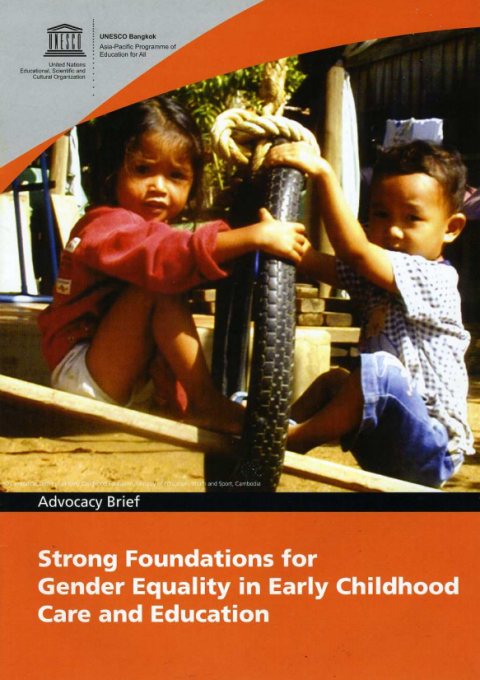 Strong foundations for gender equality in early childhood care and education: advocacy brief Year of publication: 2007 Corporate author: UNESCO The term Early Childhood Care and Education (ECCE) refers to services for children from birth to eight years of age. These include educating parents in how to care for their children and help them learn, as well as providing community-run and formal preschool programmes for pre-primary school-aged boys and girls. Given the varying needs of children from birth to eight years, educators have found it best to have different policies and strategies for children below and above three years of age. This brief focuses on the gender issues in the services provided for children who are three years of age or older in the Asia-Pacific region. Its scope is informed by UNESCO's commitment to holistic pre-primary services for this age group. The goal is to provide early childhood education that helps girls and boys succeed in primary school and in learning throughout their lives. The brief starts by looking into the growth of ECCE in the Asia-Pacific region and what is driving this growth. It explores why gender responsiveness is important in early childhood education, gives practical examples of what this looks like, and discusses the challenges of providing ECCE that equally values and benefits each girl and each boy. Flowing from this, the brief concludes with recommendations on how to make ECCE more gender responsive
  Mahatma Gandhi Institute of Education for Peace and Sustainable Development: a joint initiative by UNESCO and the government of India Year of publication: 2013 Corporate author: Mahatma Gandhi Institute of Education for Peace and Sustainable Development (MGIEP) The United Nations Educational, Scientific and Cultural Organization (UNESCO) and the Government of India are embarking on a major new partnership to create the Mahatma Gandhi Institute of Education for Peace and Sustainable Development. Through research and capacity-building, the Institute aims to develop and promote new approaches to education, empowering learners to transform their lives and build a more peaceful and sustainable world. Based in New Delhi, this will be the first UNESCO specialized education Institute in India, and the first in the Asia-Pacific region. It is particularly fitting that the Institute is hosted by India, the birthplace of Mahatma Gandhi and a country that has made a significant commitment to education over the past decades. Mahatma Gandhi Institute of Education for Peace and Sustainable Development: UNESCO's first category 1 Institute in the Asia-Pacific Year of publication: 2014 Corporate author: Mahatma Gandhi Institute of Education for Peace and Sustainable Development (MGIEP) The Mahatma Gandhi Institute of Education for Peace and Sustainable Development (MGIEP) is UNESCO’s first Category 1 Institute in the Asia-Pacific. The Institute will be a key strategic player in UNESCO’s work towards quality Education for All and the transformative shift envisioned for the Post 2015 agenda. Established in cooperation with the Government of India, MGIEP has been created to play a leading role in research, knowledge sharing, capacity building and policy formulation in the area of peace and sustainability education. The Institute aims to promote, assimilate and generate high quality research to lead the intellectual and policy discourse for education and global citizenship in the region. It was named after Mahatma Gandhi, as a tribute to his ideas of non-violence and sustainable living. The President of India and the Director-General of UNESCO jointly announced the establishment of the Institute in November, 2012. It is located in New Delhi. Education and national sustainable development strategies Year of publication: 2009 Corporate author: UNESCO Since the Rio Earth Summit in 1992 countries around the world have been developing and implementing National Sustainable Development Strategies (NSDS). Sustainable Development competes with many deeply entrenched values and therefore progress has been slow. Tensions between long term and short term thinking, and between economic growth and social and environmental sustainability, are not easy to resolve. The NSDS process has gained impetus following the 2002 World Summit on Sustainable Development, where it was agreed that countries need to take immediate steps to elaborate and formulate NSDS systems that can continuously improve. The UN Guidance Document describes an NSDS as a comprehensive, adaptable, continuous and long term undertaking that helps a country to achieve economic prosperity and higher levels of social welfare, while at the same time preserving the environment. An NSDS is not just something that can be put together in a document and be promulgated. Development of an NSDS requires multi-stakeholder participation, partnerships, country ownership, shared vision with a commitment to continuous improvement, capacity development and the ability to build on existing knowledge and processes and a clear focus on outcomes. Education is a central dimension of achieving sustainable development, and needs to be incorporated into the NSDS process. Learning is central to the process of NSDS development and implementation. Address by Ms. Irina Bokova, Director-General of UNESCO on the occasion of the Civil Society / Education on Human Rights Event; New York, 27 September 2012 Year of publication: 2012 Corporate author: UNESCO. Director-General, 2009-2017 (Bokova, I.G.) This speech was given by Ms. Irina Bokova, Director-General of UNESCO, on the occasion of the Civil Society / Education on Human Rights event . Le Risposte del settore educativo al bullismo omofobico Year of publication: 2014 Corporate author: UNESCO This publication is part of a Good Policy and Practice series that addresses key themes of UNESCO’s work with the education sector including HIV and AIDS and safe, healthy educational environments for all learners. This volume, on the theme of homophobic bullying in educational institutions, builds on UNESCO’s work on gender, discrimination and violence in schools. Contemporary issues in human rights education Year of publication: 2011 Corporate author: UNESCO The format of this publication presents the main strands concerning the role of human rights education as well as the key elements for its implementation. Each strand addresses current issues and challenges faced when incorporating a culture for human rights, also illustrating the collective importance of human rights education as a fundamental base for a peaceful and just society. Under each strand, a list of examples inspired by country initiatives is proposed.
  Declaration and Integrated Framework of Action on Education for Peace, Human Rights and Democracy Year of publication: 1995 Corporate author: UNESCO This document is Declaration of the 44th session of the International Conference on Education (Geneva, October 1994) endorsed by the General Conference Declaration of the 44th session of the International Conference on Education (Geneva, October 1994) endorsed by the General Conference of UNESCO at its twenty-eight session Paris, November 1995 of UNESCO at its twenty-eight session Paris, November 1995. Declaração e Plano de Ação Integrado sobre a Educação para a Paz, os Direitos Humanos e a Democracia Year of publication: 1995 Corporate author: UNESCO This document is Declaration of the 44th session of the International Conference on Education (Geneva, October 1994) endorsed by the General Conference Declaration of the 44th session of the International Conference on Education (Geneva, October 1994) endorsed by the General Conference of UNESCO at its twenty-eight session Paris, November 1995 of UNESCO at its twenty-eight session Paris, November 1995. Respostas do Setor de Educação ao bullying homofóbico Year of publication: 2013 Corporate author: UNESCO This publication is part of a Good Policy and Practice series that addresses key themes of UNESCO’s work with the education sector including HIV and AIDS and safe, healthy educational environments for all learners. This volume, on the theme of homophobic bullying in educational institutions, builds on UNESCO’s work on gender, discrimination and violence in schools.