
Resources
Explore a wide range of valuable resources on GCED to deepen your understanding and enhance your research, advocacy, teaching, and learning.
8,376 Results found
 The round table: putting human rights into practice-the role of education; report Year of publication: 2008 Corporate author: UNESCO This publication highlights some of the key ideas and features of the events based on the theme “60 years of Human Rights Education” at UNESCO headquarters in Paris from the 2nd of December 2008 till the 27th of February 2009. In addition to substantial opening and closing sessions, the Round Table consisted of four panels, the reporting of each consists of Summary, Introduction, Case Studies, Discussion and Recommendations. This publication can be read on a number of levels: as a retrospective commemoration of human rights education; as a celebration of current good practice; and, through its discussion and recommendations, as a source of guidance for future directions in human right education. Education sector technical notes: human rights education Year of publication: 2013 Corporate author: UNESCO Human rights are enshrined in international law, and states have an obligation to respect, protect and fulfil them. Despite this, human rights violations remain widespread. ◗ Educating children and adults on human rights is essential. Individuals and groups must understand their rights in order to see them upheld and to ensure that their own behavior does not compromise the rights of others. ◗ States have an obligation to promote human rights and human rights education is now recognized as a right in itself. ◗ UNESCO, along with the Office of the United Nations High Commissioner for Human Rights, co-leads the World Programme for Human Rights Education (2005-ongoing).
 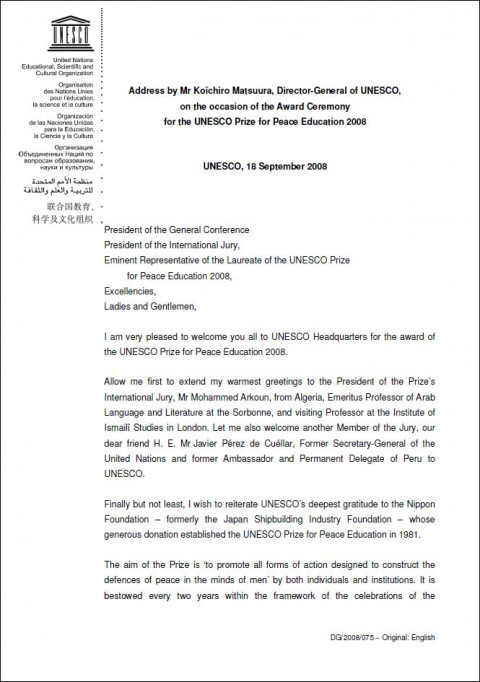 Address by Mr Koïchiro Matsuura, Director-General of UNESCO, on the occasion of the Award Ceremony for the UNESCO Prize for Peace Education 2008; UNESCO, 18 September 2008 Year of publication: 2008 Corporate author: UNESCO. Director-General, 1999-2009 (Matsuura, K.) This is an address by Address by Mr Koïchiro Matsuura, Director-General of UNESCO, on the occasion of the Award Ceremony for the UNESCO Prize for Peace Education 2008.
  UNESCO prize for peace education, 2008 Year of publication: 2009 Corporate author: UNESCO The UNESCO Prize for Peace Education 2008 was awarded to the Institute for Justice and Reconciliation (South Africa) by Mr Koïchiro Matsuura, Director-General of UNESCO, on the recommendation of the International Jury of the Prize. The prize-giving ceremony, organized as part of the celebrations of the International Day of Peace (21 September), the International Decade for a Culture of Peace and Non-Violence for the Children of the World (2001- 2010) and the 60th anniversary of the Universal Declaration of Human Rights, was held at UNESCO Headquarters on 18 September 2008 in the presence of Mr Mohammed Arkoun, President of the International Jury, and H.E. Mr Javier Pérez de Cuéllar, member of the International Jury, former Prize laureates, Permanent Delegates of Member States and representatives of governmental and non-governmental organizations. The award ceremony was preceded by the screening of an excerpt from the documentary Truth, Justice, Memory: South Africa’s Truth and Reconciliation Process and by a video message from Archbishop Emeritus Desmond Tutu, winner of the 1984 Nobel Peace Prize for his role as a unifying leader in the campaign to resolve the problem of apartheid in South Africa, and former Chairperson of South Africa’s Truth and Reconciliation Commission
 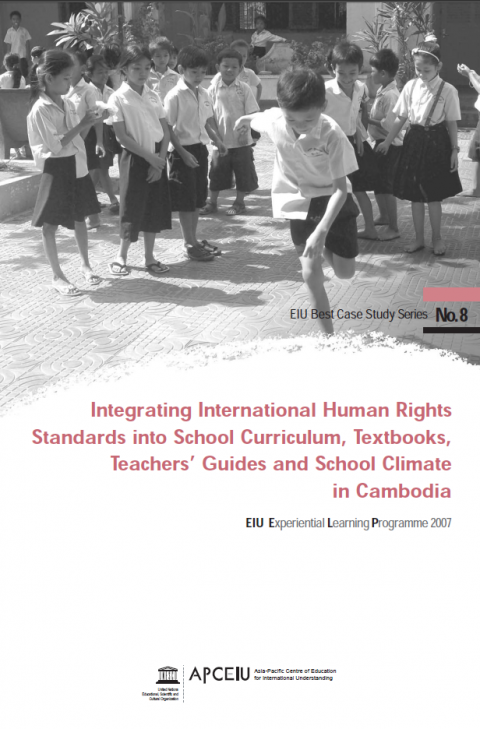 EIU Best Practice Series No.8: Integrating international human rights standards into school curriculum, textbooks, teachers' guides and school climate in Cambodia Year of publication: 2007 Author: Seungmi Lee | Hyewon Jung Corporate author: APCEIU It goes without saying that the aftermath of the war brings various challenges such as poverty, displacement, disability, destroyed culture, etc. and it is of critical importance that it should be well-remedied to preclude its recurrence. In this regard, value education and human rights education are considered crucial and to my mind, so is the educational role that religion can play. Although religions have harmonized the impaired society, but generally they have not been appreciated by their ignorant disciples or followers. Thus, value education is considered to be able to play a crucial role. It is in this context that human rihts education is gaining currency in Cambodia in recent years and has been implemented gradually.
 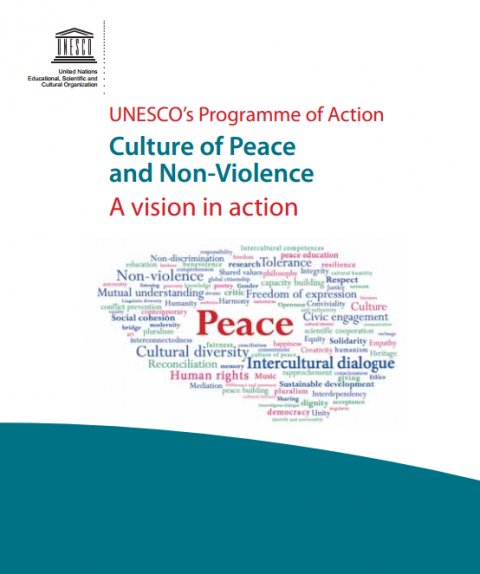 UNESCO's programme of action: culture of peace and non-violence, a vision in action Year of publication: 2013 Corporate author: UNESCO This document builds upon the experience and resources of the Intersectoral Platform for a Culture of Peace and Non-Violence and has benefited from the contribution of Professor Arjun Appadurai. This document shows the UNESCO's mission; Buidling the defences of peace in the minds of men and women and Culture of peace and Non-violence which is positive values, attitudes and behaviours for everyday peace. This document pointed out today's multiple crisis, and then introduced the programme of action on a culture of peace and non-violence. After drew the UNESCO's strategies, UNESCO's peace activities were followed. Recommendation concerning Education for International Understanding, Cooperation and Peace and Education Relating to Human Rights and Fundamental Freedoms, adopted by the General Conferences at its 18th session, Paris, 19 November 1974 Year of publication: 1974 Corporate author: UNESCO Following is the authentic text of the Recommendation duly adopted by the General Conference of the United Nations Educational, Scientific and Cultural Organization during its eighteenth session, which was held in Paris and declared closed the twenty-third day of November 1974. The General Conference recommends that Member States should submit to provisions as follows: to apply the following provisions by taking whatever legislative or other steps may be required in conformity with the Constitutional practice of each State to give effect within their respective territories to the principles set forth in this recommendation; to bring this recommendation to the attention of the authorities, departments or bodies responsible for school education, higher education and out-of-school education, of the various organizations carrying out educational work among young people and adults such as student and youth movements, associations of pupils’ parents, teachers’ unions and other interested parties; to submit to it, by dates and in the form to be decided upon by the Conference, reports concerning the action taken by them in pursuance of this recommendation.
 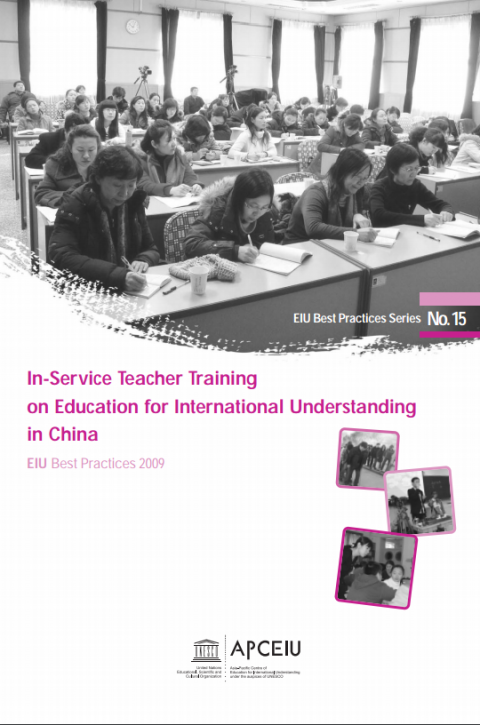 EIU Best Practices Series No.15: In-service teacher training on education for international understanding in China Year of publication: 2009 Author: Yu Xin Corporate author: APCEIU This document introduces an effective and systematic in-service teacher training programme on Education for International Understanding (EIU) in Beijing, China. In order for this training to take place, the Beijing Institute of Education (BIE) has been working to develop a school-based curriculum on EIU to be implemented in local schools. Through this effort, the in-service teacher training programme on EIU motivated and strengthened the capacity of teachers to incorporate EIU curriculum into various subjects they teach in schools. As a result of this practice, schools in which EIU have been implemented, raised the level of global awareness among their teachers and students. This effort to promote EIU in Beijing is an excellent model for policy makers, curriculum developers and educators to learn the effective strategies to promote EIU in schools. Eleventh meeting of the working group on Education for All, 2-3 February 2011, Paris, France: summary report Year of publication: 2011 Corporate author: UNESCO The eleventh meeting of the Working Group (WG) on Education for All (EFA) took place on 2 and 3 February 2011 at UNESCO headquarters in Paris. The meeting brought together people representing governments, bilateral and multilateral organizations, regional organizations, civil society organizations (CSOs), research institutes, foundations and the private sector. Consisting of seven sessions, the meeting aimed to review the world’s progress towards EFA and identify policy actions that can accelerate EFA progress, in particular as regards quality education, effective advocacy for education, violent conflicts and education and financing for education. The recommendations of the meeting were to be taken to the tenth meeting of the High Level Group (HLG) on EFA (Jomtien, Thailand, 22–24 March 2011). Teaching respect for all: activity 2: mapping of existing materials and practices in cooperation with universities and research centres; final report Year of publication: 2013 Author: Peter G. Kirchschlaeger | Stefanie Rinaldi | Franziska Brugger | Tanja Mitrovic Corporate author: University of Teacher Education (Switzerland). Centre of Human Rights Education The constant rise of racism, xenophobia and intolerance despite the renewed commitments made by the international community is giving the United Nations Educational, Scientific and Cultural Organisation (UNESCO) a reason to consider education as key to strengthen the foundations of tolerance, reducing discrimination and violence and learning to live together. It is required to cultivate respect for all people regardless of colour, gender, descent or national, ethnic or religious identity. The project “teaching respect for all” aims at reducing intolerance, violence and discrimination trough education. The project is founded on the universal values and common core principles promoted by UNESCO, even though UNESCO is aware, that the countries differ from one another in dealing with issues related to anti-racism and tolerance in education according to each country’s history and culture.