
Resources
Explore a wide range of valuable resources on GCED to deepen your understanding and enhance your research, advocacy, teaching, and learning.
8,376 Results found
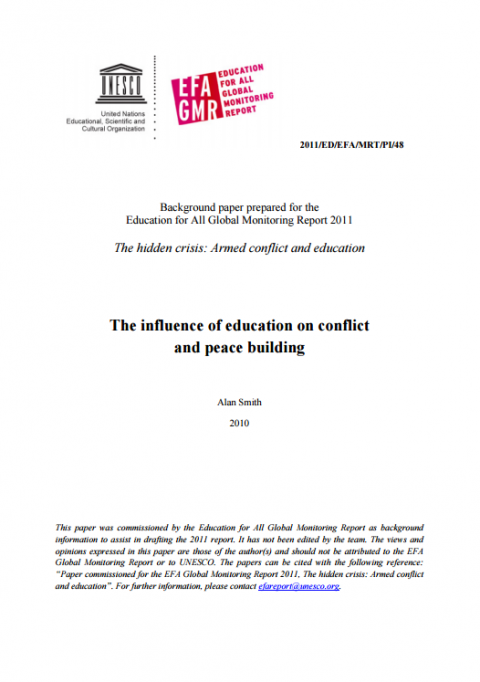 The Influence of education on conflict and peace building Year of publication: 2010 Author: Alan Smith Corporate author: UNESCO The purpose of this paper is to identify aspects of education that may have a positive influence on the dynamics of conflict or make a contribution to peacebuilding. The UN Secretary-General’s (2009) report on peacebuilding identifies a number of recurring priorities in conflict-affected situations, ‘establishing security, building confidence in a political process, delivering initial peace dividends and expanding core national capacity’. These priorities include ‘the provision of basic services, such as water and sanitation, health and primary education’. However, in conflict-affected situations education is also about more than service delivery because it is a means of socialization and identity development through the transmission of knowledge, skills, values and attitudes across generations. Education may therefore be a driver of conflict (fuelling grievances, stereotypes, xenophobia and other antagonisms), but can also be a way of contributing to ‘conflict transformation’ and ‘peacebuilding’.
 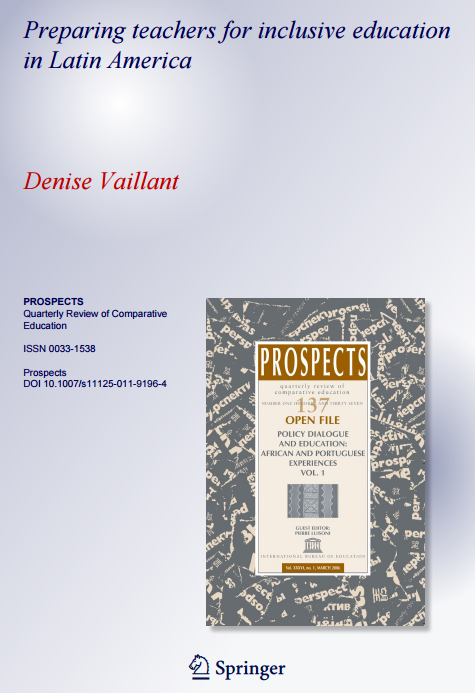 Preparing teachers for inclusive education in Latin America (Prospect: quarterly review of comparative education) Year of publication: 2011 Author: Denise Vaillant Corporate author: UNESCO International Bureau of Education (IBE) This article analyzes the current challenges facing inclusive education in Latin America and explores some possible solutions. The author suggests that teachers play a key role in providing education that is inclusive for all. In Latin America, today, however, inclusive education often does not respond to the needs of children and young people, and teachers often finish their professional training without acquiring the skills they need to work with children and young people living in difficult circumstances. Teachers also need incentives to work in remote or difficult geographical areas, and they benefit from national efforts to improve their status, including awards for innovative work. Much remains to be done, but the training of teachers for a more inclusive education system is gradually being incorporated as part of the educational policy agenda in Latin America.
  Inter-agency peace education programme: skills for constructive living; overview of the programme Year of publication: 2005 Author: Antonella Verdiani Corporate author: UN. Office of the United Nations High Commissioner for Refugees (UNHCR) | Inter-agency Network for Education in Emergencies (INEE) This manual is one of the components of the “Inter-Agency Peace Education Programme”. The programme is designed for education managers of ministries dealing with both formal and non-formal education and for agencies which implement education activities on behalf of the government. The implementation structure is based on the experience acquired over the eight years the programme has been in use, from 1998 to 2005. The programme has been evaluated by external experts and the new revised materials (2005) incorporate both the suggestions made in the evaluation and the feedback from the specialists who implemented it in the field. "Education First" - UN Secretary-General's video message Year of publication: 2012 Author: United Nations. Secretary-General, 2007-2016 (Ban, Ki-moon) UN Secretary-General, Mr. Ban Ki-moon launched a Global Initiative on Education (Education First), which aims to achieve quality, relevant and inclusive education for every child on 26 September, 2012.
 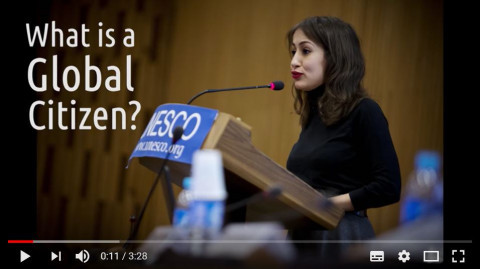 [Video] Global citizenship is ... Year of publication: 2015 Corporate author: UNESCO Participants of the Second UNESCO Forum on Global Citizenship Education (GCED) Building peaceful and sustainable societies: preparing for post-2015 (28-30 January 2015,UNESCO HQ, Paris) reflect on what Global Citizenship is. The Forum was organized by the Division for Teaching, Learning and Content, Education Sector, UNESCO, with the support of Austria, the Sultanate of Oman and the Republic of Korea, and the UN Secretary-General’s Global Education First Initiative (GEFI). Second UNESCO Forum on Global Citizenship Education video Year of publication: 2015 Corporate author: UNESCO Highlights of the Second UNESCO Forum on Global Citizenship Education (GCED) Building peaceful and sustainable societies: preparing for post-2015 (28-30 January 2015, UNESCO HQs, Paris). The Forum was organized by the Division for Teaching, Learning and Content, Education Sector, UNESCO, with the support of Austria, the Sultanate of Oman and the Republic of Korea, and the UN Secretary-General's Global Education First Initiative (GEFI).