
Resources
Explore a wide range of valuable resources on GCED to deepen your understanding and enhance your research, advocacy, teaching, and learning.
8,354 Results found
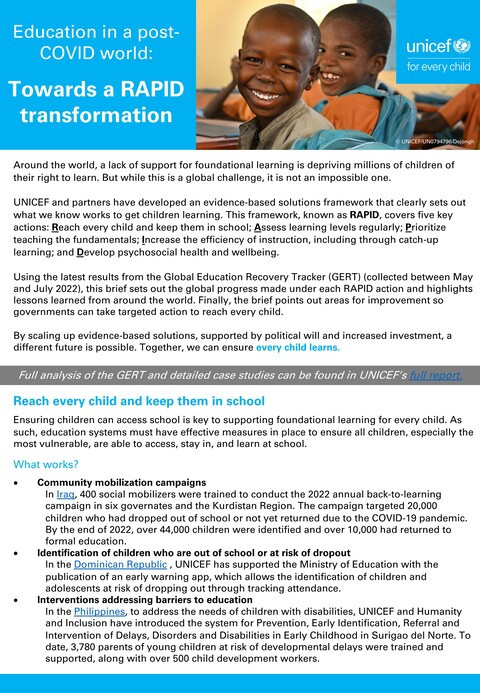 Education in a Post-COVID World: Towards a Rapid Transformation; Advocacy Brief Year of publication: 2023 Corporate author: United Nations Children's Fund (UNICEF) Around the world, a lack of support for foundational learning is depriving millions of children of their right to learn. But while this is a global challenge, it is not an impossible one. UNICEF and partners have developed an evidence-based solutions framework that clearly sets out what we know works to get children learning. This framework, known as RAPID, covers five key actions: Reach every child and keep them in school; Assess learning levels regularly; Prioritize teaching the fundamentals; Increase the efficiency of instruction, including through catch-up learning; and Develop psychosocial health and wellbeing. Using the latest results from the Global Education Recovery Tracker (GERT) (collected between May and July 2022), this brief sets out the global progress made under each RAPID action and highlights lessons learned from around the world. Finally, the brief points out areas for improvement so governments can take targeted action to reach every child.
  Artificial Intelligence Needs Assessment Survey in Africa Year of publication: 2021 Author: Prateek Sibal | Bhanu Neupane Corporate author: UNESCO There are encouraging signs of AI innovation and development across Africa, from community run AI classes over weekends, AI training bootcamps for students and young researchers to the establishment of private sector and government driven innovation hubs across the continent. Even as there is an enormous potential for AI development, there are also legacy challenges in terms of infrastructure availability as well as human and institutional capacity gaps to develop and govern AI to optimise benefits and minimise harms. Building upon the recommendations of UNESCO report Steering AI and Advanced ICTs for Knowledge Societies, the findings of this survey aim to bridge the information gap concerning the strategic priorities, policy measures, developmental challenges, human and institutional capacity needs, and legal frameworks concerning AI in African countries.
 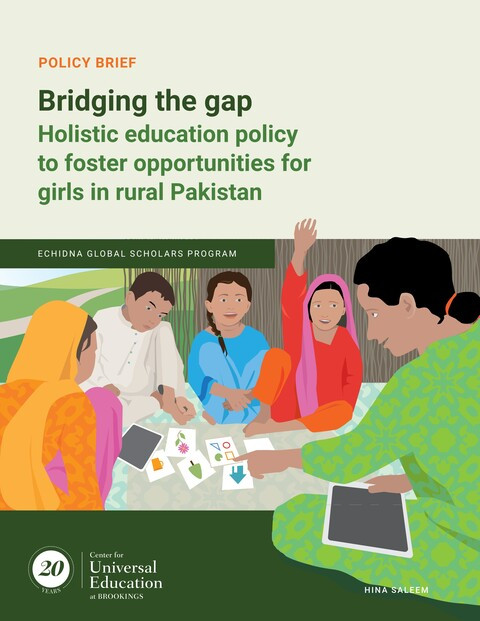 Bridging the Gap: Holistic Education Policy to Foster Opportunities for Girls in Rural Pakistan Year of publication: 2023 Author: Hina Saleem Corporate author: Center for Universal Education at Brookings Seven out of ten girls in rural Sindh are excluded from schooling. This happens for a myriad of reasons and occurs both in the presence and absence of operational school buildings. When schools are present, the challenges that children—especially girls—face due to their economic and social context often go unaddressed; children who are able to enroll in school often find their learning affected by classroom design and practices and experiences that mirror the exclusion they experience outside of school. At the broader level, this exclusion is reflected in limited representation of the needs and aspirations of sizable rural populations in Pakistan’s formal education system and the pathways beyond it. This policy brief presents findings from on-the-ground research in rural settlements in Sindh province that explores the disparities between boys and girls in enrollment and continuation of schooling in addition to overall inadequate education outcomes. It also provides policy recommendations to support all children and particularly girls in meeting their education needs and aspirations. Education policy must respond to these challenges of unmet education needs and aspirations by taking a holistic, welfare-based approach that supports children to overcome the effects of exclusionary conditions to meet their education needs. However, the benefits of such an approach can only be realized if teaching practices and learning experiences are contextualized, build a connection with local knowledge, question root causes of exclusion and support and prepare all children in negotiating pathways beyond education.
 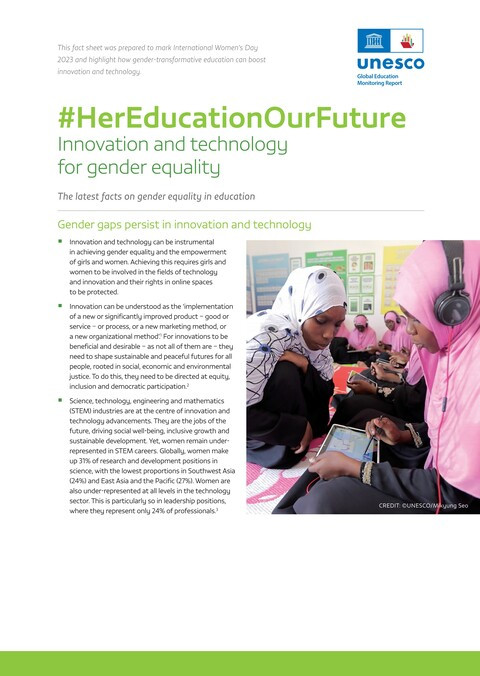 #HerEducationOurFuture: Innovation and Technology for Gender Equality; the Latest Facts on Gender Equality in Education Year of publication: 2023 Corporate author: UNESCO | Global Education Monitoring Report Team Gender gaps persist in innovation and technology Innovation and technology can be instrumental in achieving gender equality and the empowerment of girls and women. Achieving this requires girls and women to be involved in the fields of technology and innovation and their rights in online spaces to be protected.
 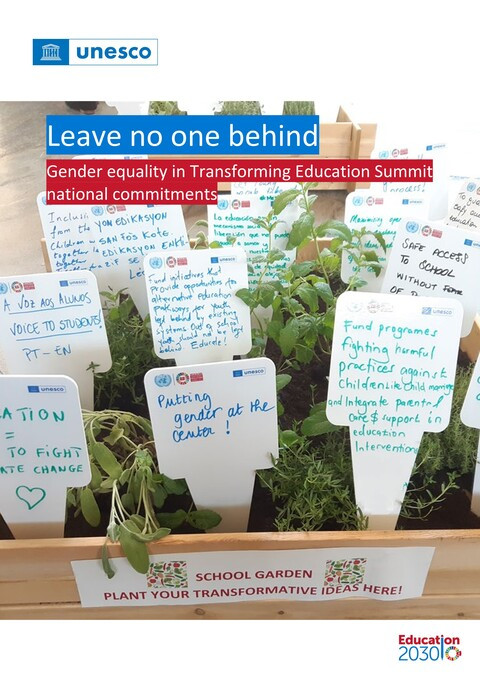 Leave No One Behind: Gender Equality in Transforming Education Summit National Commitments Year of publication: 2023 Corporate author: UNESCO The Transforming Education Summit was convened in response to a global crisis in education – one of equity and inclusion, quality and relevance. This paper applies a gender lens to the national statements of commitments made by countries during the Summit. It considers the scope of commitments to gender equality and gender- transformative education, common gender themes and considerations emerging across commitments, and notable gaps. It aims to inform future actions by the Global Platform to Drive Leadership and Accountability for Gender Equality and Girls’ and Women’s Empowerment in and through Education, and support to country action to transform education systems to advance gender equality.
  Protect Her Rights, Strengthen Your Laws: Her Atlas; Status Report on Girls’ and Women’s Right to Education Year of publication: 2022 Corporate author: UNESCO UNESCO’s Her Education, our future initiative, Her Atlas was launched in 2019 with the aim to enhance public knowledge and monitor the status of national constitutions, legislation and regulations related to girls’ and women’s education rights in order to encourage countries to take actions to improve their legal frameworks. Three years after its launch, the research phase has been completed: overall, the legal frameworks of 196 countries have been thoroughly analyzed to evaluate the level of protection of girls’ and women’s right to education around the world. In an interactive world map format, Her Atlas uses a color-coded scoring system to monitor 12 indicators of legal progress towards gender equality in the right to education. This report marks the completion of the first research phase and intends to highlight some key trends outlined by the research work, and to emphasize examples of legal provisions regarding some aspects of girls’ and women’s right to education guaranteed by States’ domestic laws.
  Her Atlas: Interactive Advocacy Tool on Girls’ and Women’s Right to Education Year of publication: 2023 Corporate author: UNESCO Many girls and women cannot exercise their right to education due to gender inequality and discriminatory practices. Poverty, early marriage, and gender-based violence are just some of the many reasons behind the high percentage of global female illiteracy and school drop-outs. Strengthening the right of girls and women to quality education is key to eliminate discrimination and to achieve equal rights between genders. This cannot be achieved without solid national legal frameworks that are rightsbased, gender responsive and inclusive. This is where HerAtlas comes in. HerAtlas, is a first of its kind online tool that maps the right to education of girls and women. It aims to enhance public knowledge and monitor the status of national constitutions, legislation and regulations related to education rights for girls and women to encourage countries to take action, strengthen their laws and policies, and lead to long term change. Concrete changes are already apparent. In 2019, 4% of countries were explicitly restricting the right to education of married, pregnant, and parenting girls. This has dropped to 2% in 2022, benefiting millions of girls who can now legally attend school when they marry or become pregnant.
  Freinet Pedagogy Adapted to French as a Foreign Language (FLE) Year of publication: 2021 Author: Alice Lenesley | Marianne Viader Corporate author: Culture FLE Interview with Alice Lenesley, who presents the Freinet method adapted to French as a Foreign Language (FLE) classes. In this video, she presents the teaching tools developed by Célestin Freinet, a teacher who adapted his way of teaching to his pupils and their physical constraints. Here are the tools presented in the video: getting out into nature, the "quoi de neuf", non-masterly teaching, the unexpected and spontaneity, autonomy, free text and little books.
  The Two Minutes of Citizenship Corporate author: Vie Publique "Les 2 minutes citoyennes" is a series of podcasts designed to provide a concise explanation of the concepts, notions and principles essential to understanding the workings of public life and French and European institutions. Produced by the editorial staff of vie-publique.fr, these educational capsules are aimed at all citizens.
 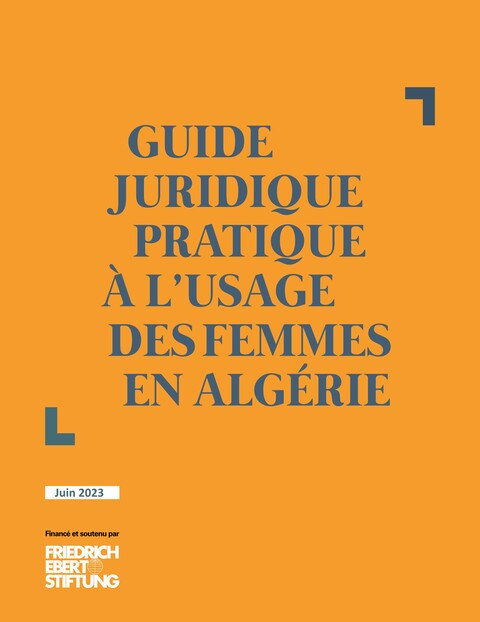 Practical Legal Guide for Women in Algeria Year of publication: 2023 Author: Fériel Khelil | Saadia Gacem Corporate author: Fondation Friedrich-Ebert This practical legal guide, in Arabic and French, enables women in Algeria to find out about their rights, the laws that protect them, but also the legislative inequalities they will encounter in their life course, through tools for practical understanding of the laws. It was produced by Feriel Khelil, jurist with the Réseau Wassila/Avife association, and Saadia Gacem, doctoral student in anthropology and feminist activist, and supported by the Friedrich Ebert Foundation.