
Resources
Explore a wide range of valuable resources on GCED to deepen your understanding and enhance your research, advocacy, teaching, and learning.
8,354 Results found
 Some Aspects of Sustainable Development of the Kyrgyz Republic (International Journal of Humanities and Natural Sciences; Vol.1-1, No.76) Year of publication: 2023 Author: А.И. Абдиева | Сыдыкова Жылдыз The article reveals the modern position of the Kyrgyz Republic in the field of promoting the principles of sustainable development, in particular, it discloses what strategic documents have been adopted and are currently being implemented in this area, the article attempts to draw attention to the state of air pollution and its impact on the health of the population of the republic.
  The SCO’s Role in Countering Terrorism in Central Asian Countries (Post-Soviet Studies; Vol.5, No.8) Year of publication: 2022 Author: А. К. Румянцева | К. Х. Рахимов Terrorism is one of the main threats to the security of humanity in the modern world. The intensification of the activities of the terrorist underground in the countries of Central Asia and the deterioration of the situation in Afghanistan raises the problem of terrorism to a new level and calls on the countries of this region to assist international and regional organizations in resolving this issue. Among the most actively developing interregional organizations in the Central Asian region is the Shanghai Cooperation Organization. The central goals of the SCO are directly related to countering and combating the "three evils": terrorism, separatism and extremism. The relevance of this paper relates to the growth of radicalization in the Central Asian region, as a result of which the proposed article analyzes the role of the Shanghai Cooperation Organization in countering terrorism in the countries of the Central Asian region, examines the history of the origin and emergence of terrorism in this region, reveals in detail the key areas of the organization. In addition, the main adopted international legal documents on combating terrorism have been studied, on the basis of which the main stages of the development of cooperation between the member states of the organization for the implementation of anti-terrorist activities of the SCO are observed. Particularly successful cooperation in the fight against terrorism is noted in the conduct of joint anti-terrorist exercises within the framework of the organization's activities, and the activities of the SCO RATS are also considered in detail. The purpose of the article is to assess the potential of the SCO in terms of responding to new security challenges of the member states, primarily in the Central Asian region. To achieve the goal, the following research methods were used: theoretical and methodological analysis, descriptive method, and content analysis. The authors come to the conclusion that at the present stage the SCO is the most influential integration in the space of Central Asia. The organization's anti-terrorist activities show that this field is one of the most successful within the organization's work.
  The Situation of the Russian Speaking Population in Central Asia: To the Historiography of the Problem (Post-Soviet Continent; Year of publication: 2023 Author: Марина Авимская Corporate author: ИНСТИТУТ СТРАН СНГ At present, the position of the Russian and Russian-speaking population is one of the most important problems in the domestic and foreign policy of the states - the former Soviet republics of the USSR and a significant aspect of their relationship with the Russian Federation. In this regard, this problem has been attracting increased attention of researchers (primarily historians and political scientists) from Russia and neighboring countries for quite a long time. The article deals with the issue of the situation of the Russian and Russian-speaking population in the post-Soviet period and how it is covered in modern Russian scientific literature over the past five years (2017–2021), using the example of the countries of Central Asia.
  The Impact of Online Learning on the Education System in Central Asia Year of publication: 2021 Corporate author: ИСАП The impact of the coronavirus pandemic on the global economy is only part of its global consequences. The most popular measure adopted in almost all countries of the world was the introduction of quarantine restrictions by the state on movement and live communication between people. Experts note that even without the limitations of the pandemic, the education sector in Central Asian countries is in a state of crisis.
 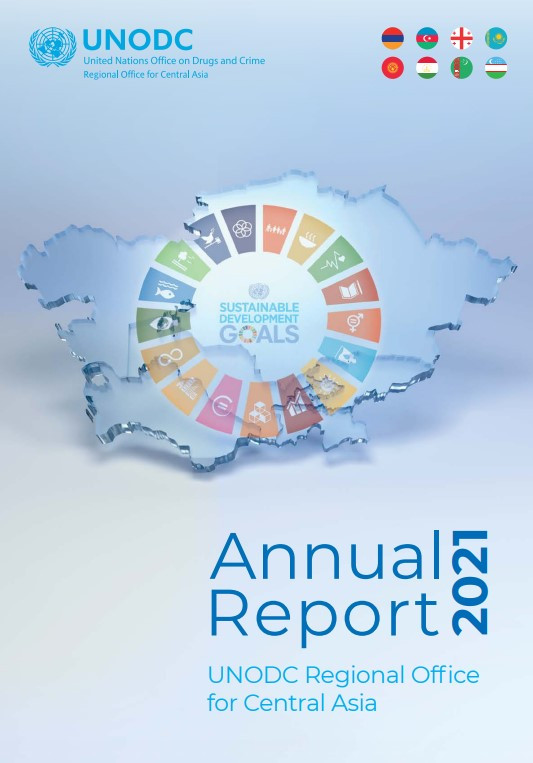 Annual Report for 2021 (UNODC Regional Office in Central Asia) Year of publication: 2022 Corporate author: UN. Office on Drugs and Crime (UNODC) This Annual Report provides an account of the main results achieved by the United Nations Office on Drugs and Crime, Regional Office for Central Asia (UNODC ROCA), in 2021. UNODC has stepped up efforts to help people in these challenging times, addressing emerging threats in line with human rights and gender equality standards, and the rule of law. Through our strategic interventions, we have contributed to strengthening peace, preventing conflict, and tackling the root causes and drivers of instability and violence.
 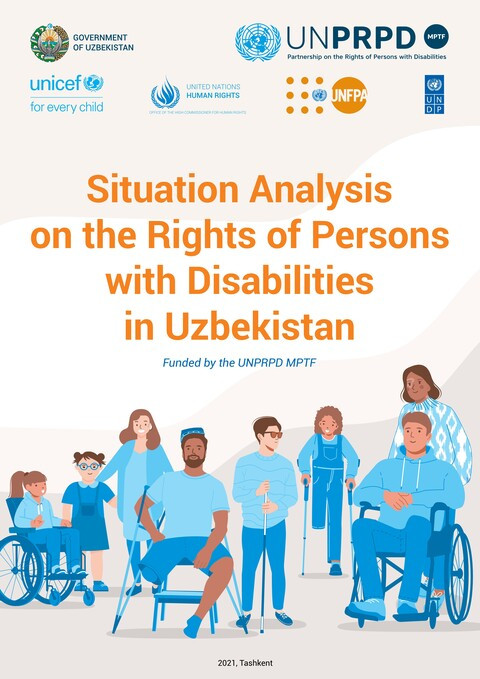 Situation Analysis on the Rights of Persons with Disabilities in Uzbekistan Year of publication: 2021 Corporate author: UNICEF Uzbekistan | United Nations Population Fund (UNFPA) | United Nations Development Programme (UNDP) | UN. Office of the United Nations High Commissioner for Human Rights (UN. OHCHR) This study is based on the results of a situation analysis of children and adults with disabilities conducted in 2019. The ambition of this Situation Analysis is not merely to point at problems but to lay ground for solutions by identifying the opportunities and catalytic forces emerging today. The report looks at the necessary preconditions for realisation of human rights of persons with disabilities, particularly women, girls, and boys with disabilities, such as a robust equality and non-discrimination framework, availability of inclusive and accessible services in the community, disability inclusive financial and coordination mechanisms, transparent monitoring and accountability systems and meaningful participation of persons with disabilities.
 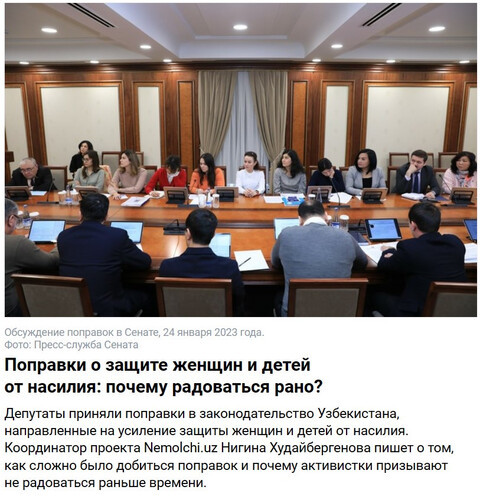 Amendments on the Protection of Women and Children From Violence: Why Is It Too Early To Rejoice? Year of publication: 2023 Author: Нигина Худайбергенова The deputies adopted amendments to the legislation of Uzbekistan aimed at strengthening the protection of women and children from violence. Nigina Khudaibergenova, the coordinator of the Project 'Nemolchi.uz'(Don't be silent) writes about how difficult it was to achieve amendments and why activists urge not to rejoice ahead of time.
  Statistics of the Sustainable Development Goals in Kazakhstan Year of publication: 2023 Corporate author: ООН-женщины | Бюро национальной статистики Агентства по стратегическому планированию и реформам Республики Казахстан The publication reflects data on the current state and progress in the field of sustainable development based on available official data and statistics on the SDGs, taking into account gender aspects. The collection was presented at the national seminar on the dissemination of official statistics organized by the Bureau of National Statistics of Kazakhstan and the United Nations Economic Commission for Europe (UNECE) on October 19-21, 2022.
 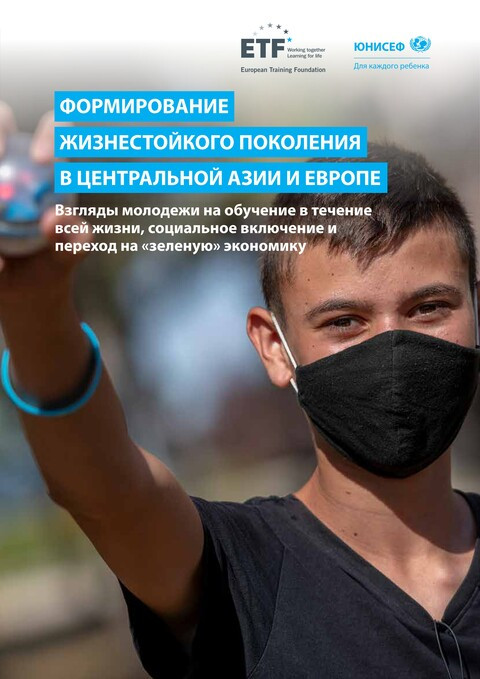 Formation of a Resilient Generation in Central Asia and Europe Year of publication: 2021 Corporate author: ЮНИСЕФ | Европейский фонд образования In this joint report of the United Nations Children's Fund (UNICEF) and the European Education Foundation (ETF) reflect the views, views and sentiments of young people in Central Asia and Europe, which will be taken into account in regional and international discussions on options for creating more effective lifelong learning systems, more inclusive communities and a more "green" society.
 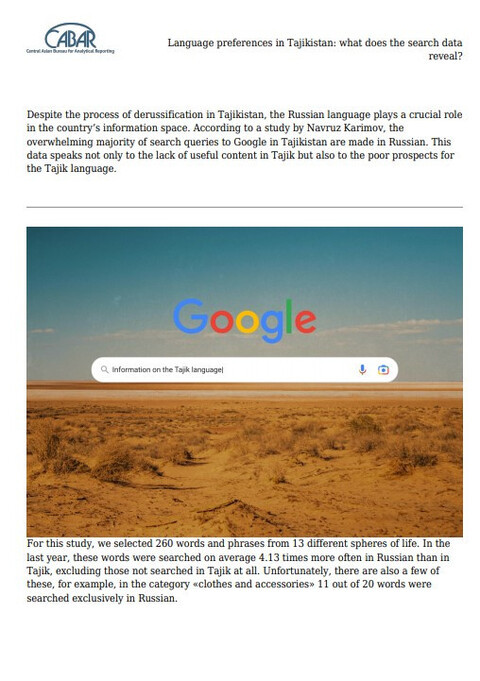 Language Preferences in Tajikistan: What Does the Search Data Reveal? Year of publication: 2023 Author: Navruz Karimov Corporate author: Central Asian Bureau for Analytical Reporting (CABAR) Despite the process of derussification in Tajikistan, the Russian language plays a crucial role in the country’s information space. According to a study by Navruz Karimov, the overwhelming majority of search queries to Google in Tajikistan are made in Russian. This data speaks not only to the lack of useful content in Tajik but also to the poor prospects for the Tajik language.