
Resources
Explore a wide range of valuable resources on GCED to deepen your understanding and enhance your research, advocacy, teaching, and learning.
8,354 Results found
 Reporting on Artificial Intelligence: A Handbook for Journalism Educators Year of publication: 2023 Author: Maarit Jaakkola Corporate author: UNESCO The rise and control of artificial intelligence (AI) is impacting society as a whole. It follows that AI coverage must inform audiences about the implication of the technology itself, beyond journalism. For instance, reporting on the power dynamics in the changing relationship between companies, authorities, citizens and computer chips, and between data and algorithms. While many AI deployments serve public interest, journalists also need insight and expertise to alert about aspects like exclusions, unequal benefits, and violations of human rights. As part of its journalism education series, UNESCO’s International Programme for the Development of Communication (IPDC) has supported the World Journalism Education Council in commissioning this handbook. The aim is to inspire and empower so that journalism educators can help both journalism students and working journalists do justice to one of the major issues of our times. The handbook covers:• Understanding machine intelligence and identifying different types of AI• Exploring AI’s potential, as well as its strengths and weaknesses• Imagining diverse futures with AI by recognising pervasive popular narratives that inform public consciousness• Understanding journalism’s role in mediating and shaping AI discourse• Finding ways of reporting about AI in a nuanced, realistic and accountable manner• Making connections to existing genres of journalism, ranging from general news reporting to data journalism. Strengthening journalism education is one of the key results sought by IPDC, a unique intergovernmental programme within the UN system that specializes in media development.
  Recommendation on the Ethics of Artificial Intelligence Year of publication: 2022 Corporate author: UNESCO This Recommendation addresses ethical issues related to the domain of Artificial Intelligence to the extent that they are within UNESCO’s mandate. The protection of human rights and dignity is the cornerstone of this Recommendation. It is based on the advancement of fundamental principles such as transparency and fairness, and remembers the importance of human oversight of AI systems. However, what makes the Recommendation exceptionally applicable are its extensive Policy Action Areas, which allow policymakers to translate the core values and principles into action with respect to data governance, environment and ecosystems, gender, education and research, and health and social wellbeing, among many other spheres.
  Ethical Impact Assessment: A Tool of the Recommendation on the Ethics of Artificial Intelligence Year of publication: 2023 Corporate author: UNESCO As stated in article 50 of UNESCO’s Recommendation on the Ethics of Artificial Intelligence (UNESCO, 2021), the goal of this instrument is to “identify and assess benefits, concerns and risks of AI systems, as well as appropriate risk prevention, mitigation, redressal and monitoring measures, among other assurance mechanisms. Such assessments should identify the impacts on human rights and fundamental freedoms, in particular but not limited to the rights of people in vulnerable and precarious situations, labour rights, the environment and ecosystems and ethical and social implications, and facilitate citizen participation in line with the values and principles set forth in this Recommendation”. This instrument is primarily designed to help government officials (individuals and teams) involved in the procurement of AI systems. The goal of the methodology is to equip procurement officers with the set of questions to ask in order to ensure that the AI systems they are purchasing are aligned with the ethical standards set out in the UNESCO Recommendation on the Ethics of AI.
  A Review of Research on Teaching and Learning Transformation under the Influence of ChatGPT Technology (Advances in Education; Vol.13, No.5) Year of publication: 2023 Author: 师璇 | 王绽蕊 Artificial intelligence continues to develop, and recently ChatGPT, which has caught the attention of various sectors of society in the internet boom. Starting from the perspectives of “teaching” and “learning”, this paper introduces the development history and learning path of ChatGPT, and reviews domestic and foreign literature from three aspects: teacher teaching, personalized learning for students, and teaching evaluation. It summarizes the attitudes and views of domestic and foreign scholars on the future development of education under the influence of ChatGPT technology.
  Readiness Assessment Methodology: A Tool of the Recommendation on the Ethics of Artificial Intelligence Year of publication: 2023 Corporate author: UNESCO In November 2021, the 193 Member States of UNESCO signed the Recommendation on the Ethics of Artificial Intelligence, the first global normative instrument in its domain. The Recommendation serves as a comprehensive and actionable framework for the ethical development and use of AI, encompassing the full spectrum of human rights. It does so by maintaining focus on all stages of the AI system lifecycle. Beyond elaborating the values and principles that should guide the ethical design, development and use of AI, the Recommendation lays out the actions required from Member States to ensure the upholding of such values and principles, through advocating for effective regulation and providing recommendations in various essential policy areas, such as gender, the environment, and communication and information. With these values, principles, and policy areas in mind, the UNESCO Secretariat elaborated a programme for the implementation of the Recommendation, with the core aim of building national capacities to discharge the actions set out in the Recommendation and bolster regulatory frameworks. The Recommendation mandated the development of two key tools, the Readiness Assessment Methodology (RAM) and the Ethical Impact Assessment (EIA), which form the core pillars of the implementation. These tools both aim to assess and promote the resilience of existing laws, policies and institutions to AI implementation in the country, as well as the alignment of AI systems with the values and principles set out in the Recommendation. The goal of this document is to provide more information on the Readiness Assessment Methodology, lay out its various dimensions, and detail the work plan for the implementing countries, including the type of entities that need to be involved, responsibilities of each entity, and the split of work between UNESCO and the implementing country.
  Guidance for Generative AI in Education and Research Year of publication: 2023 Author: Fengchun Miao | Wayne Holmes Corporate author: UNESCO This Guidance aims to support the planning of appropriate regulations, policies and human capacity development programmes to ensure that generative artificial intelligence (GenAI) becomes a tool that genuinely benefits and empowers teachers, learners and researchers. It explains the Al techniques used by GenAI and maps out a list of GPT models that are made publicly available, especially those under open-source licences. It also opens a discussion on the emergence of EdGPT - GenAI models that are trained with specific data to serve educational purposes. Furthermore, it summarizes some of the key controversies around GenAI, from worsening digital poverty to the homogenization of opinions, and from deeper deepfakes to issues of copyright. Based on a humanistic vision, the Guidance proposes key steps for the regulation of GenAI tools, including mandating the protection of data privacy and setting an age limit for independent conversations with GenAI platforms. To guide the proper use of the tools in education and research, this Guidance proposes a human-agent and age-appropriate approach to the ethical validation and pedagogical design processes.
  Stepping Forward: Parliaments in the Fight Against Hate Speech Year of publication: 2023 Author: Kevin Deveaux | Tim Baker | Mary O’Hagan | David Ennis Corporate author: United Nations Development Programme (UNDP) This brief provides an overview of the background, drivers, enablers and the impact of hate speech and identifies strategies to counter it, with a focus on the role of parliaments as a positive force for change. Of particular relevance are the concrete actions parliaments can take to address and mitigate the prevalence and impact of hate speech on those who are most vulnerable in society, including women, minorities and other underrepresented groups. The objective of this brief is to provide meaningful and practical guidance for parliaments and parliamentarians, as well as those who programmatically support them, on steps they can take to reduce and counter hate speech while fostering peace, constructive dialogue and trust.
  Happy Schools Guide and Toolkit: A Resource for Happiness, Learners’ Well-Being and Social and Emotional Learning Year of publication: 2021 Corporate author: UNESCO | UNESCO Bangkok The Happy Schools Guide and Toolkit is designed to support teachers and school leaders in primary and secondary schools across the Asia-Pacific region, in thinking about how they can create their own Happy School. It has therefore drawn from aspects of the Happy Schools Framework, which can be most readily addressed at the school level. While the Happy Schools Guide is targeted towards school leaders and teachers at the school level of administration and pedagogy development, the Happy Schools Toolkit is conceived for teachers at the classroom level.
  Guidelines for Implementing SEL in Schools Year of publication: 2022 Corporate author: Mahatma Gandhi Institute of Education for Peace and Sustainable Development (MGIEP) Schools that promote SEL help in their students’ academic and global learning. It enables learners to live peacefully with others in heterogeneous societies and build ‘tolerance’ and ethics in behaviour in terms of universal human traits that go beyond social, cultural and gender differences. SEL cultivates children’s wellbeing, and because schools are mirrors or microcosms of our larger and dynamic societies, it is vital that personal and social learning be mainstreamed in schools. The purpose of these guidelines is to share the latest research with policymakers, school leaders, and teachers looking to integrate SEL into school practices and present scientific evidence on creating school environments and recommending practices that are key to building peaceful and sustainable societies.
 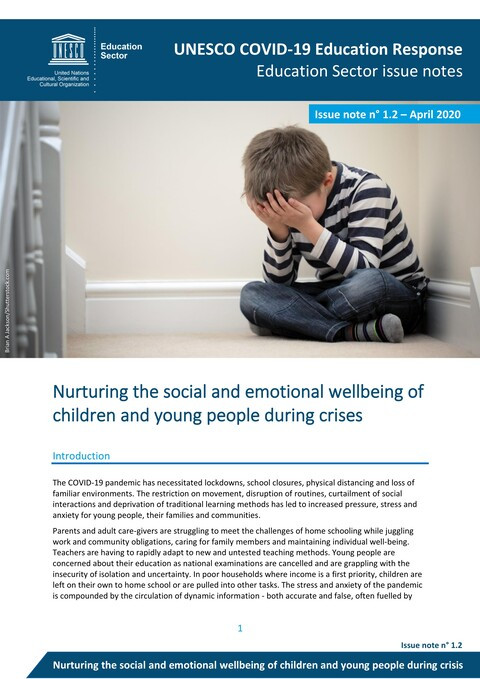 Nurturing the Social and Emotional Wellbeing of Children and Young People During Crises (UNESCO COVID-19 Education Response: Education Sector issue notes; No.1.2, 2020) Year of publication: 2020 Corporate author: UNESCO The COVID-19 pandemic has necessitated lockdowns, school closures, physical distancing and loss of familiar environments. The restriction on movement, disruption of routines, curtailment of social interactions and deprivation of traditional learning methods has led to increased pressure, stress and anxiety for young people, their families and communities. Parents and adult care-givers are struggling to meet the challenges of home schooling while juggling work and community obligations, caring for family members and maintaining individual well-being. Teachers are having to rapidly adapt to new and untested teaching methods. Young people are concerned about their education as national examinations are cancelled and are grappling with the insecurity of isolation and uncertainty. In poor households where income is a first priority, children are left on their own to home school or are pulled into other tasks. The stress and anxiety of the pandemic is compounded by the circulation of dynamic information - both accurate and false, often fuelled by sensationalist media reporting. This not only increases insecurity but also acts as fertile ground for the spread of intolerance, racism, xenophobia and hate crimes. To address and counter the social anxiety, emotional upheaval and fearful insecurity unleashed by COVID-19, it is urgent and necessary that families and communities build vital coping skills and emotional resilience. Social and emotional skills are well established, evidence-based practices, that can be adapted to help equip children, young people, parents and teachers with the knowledge, skills, attitudes and behaviours they need to stay healthy and positive, navigate emotions, practice mindful engagement, exhibit pro-social behaviour and cope with daily challenges.