
Resources
Explore a wide range of valuable resources on GCED to deepen your understanding and enhance your research, advocacy, teaching, and learning.
8,354 Results found
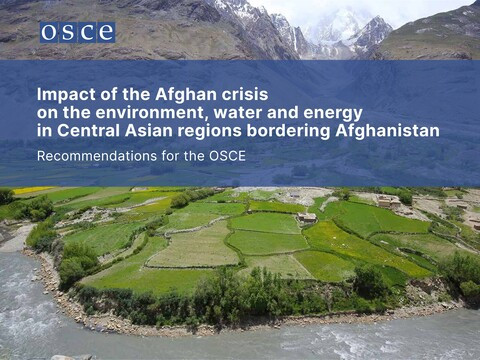 Impact of the Afghan Crisis on the Environment, Water and Energy in Central Asian Regions Bordering Afghanistan Year of publication: 2023 Corporate author: Organization for Security and Co-operation in Europe (OSCE) Development projects in Central Asia are diverse. In 2021, the Interstate Commission on Sustainable Development of Central Asia adopted the Central Asian Sustainable Development Program till 2030, while a regional climate adaptation strategy is being developed. Afghanistan is not involved in regional environmental and water processes. The results and lessons from the development projects could be useful in tackling the effects of the Afghan crisis.
  A New Social Contract for Education: Advancing a Paradigm of Relational Interconnectedness Year of publication: 2023 Author: Elena Toukan Corporate author: UNESCO This paper looks at recent calls for “a new social contract for education” through the lens of a relational ontology for humanity and a living planet. Through a critical view of social contract theory, the paper looks at how this call can be an entry point to a deeper paradigmatic shift in framing questions of justice, social organization, and education itself. It proposes a shift from a rules-based transactional model to a relationship-based model grounded in understanding and appreciation of interdependence and interconnectedness. In order to shape more just and sustainable futures for humanity and the planet, a new social contract for education will need to transcend atomistic, transactional, and adversarial social dynamics and instead be organized around relational interconnectedness.
  Legal Mechanisms for Participation of Legal Minorities in Tajikistan and Their Implementation: Comparison of the Framework Convention and Tajikistan’s Legislation Year of publication: 2022 Author: Berdikulov A. Corporate author: Central Asian Bureau for Analytical Reporting (CABAR) The policy analyzes the legal framework and provisions aimed at protecting the rights of national minorities in Tajikistan, and also provides a comparison of Tajik and European legislation regarding national minorities. Particular emphasis is placed on what legislative and legal practices from the European experience can be used as examples in the Tajik context in order to improve national legislation for the protection of national minorities and their rights. Recommendations are formulated for a number of ministries and the government of Tajikistan, for international donors, as well as for representatives of national minorities.
  Addressing Hate Speech Through Education: A Guide for Policy-Makers Year of publication: 2023 Corporate author: UNESCO | UN. Office on Genocide Prevention and the Responsibility to Protect Hate speech is spreading faster and further than ever before as a result of social media user growth and the rise of populism. Both online and offline, hate speech targets people and groups based on who they are. It has the potential to ignite and fuel violence, spawn violent extremist ideologies, including atrocity crimes and genocide. It discriminates and infringes on individual and collective human rights, and undermines social cohesion. Education can play a central role in countering hateful narratives and the emergence of group-targeted violence. Educational responses to hate speech and all forms of hateful communication include:• Training teachers and learners on the values and practices related to being respectful global and digital citizens;• Adopting pedagogical and whole-school approaches to strengthening social and emotional learning;• Revising and reviewing curricula and educational materials to make them culturally responsive and to include content that identifies hate speech and promotes the right to freedom of expression;This policy guide developed by UNESCO and the United Nations’ Office on Genocide Prevention and the Responsibility to Protect explores these educational responses and provides guidance and recommendations to policy-makers on how to strengthen education systems to counter hate speech.
 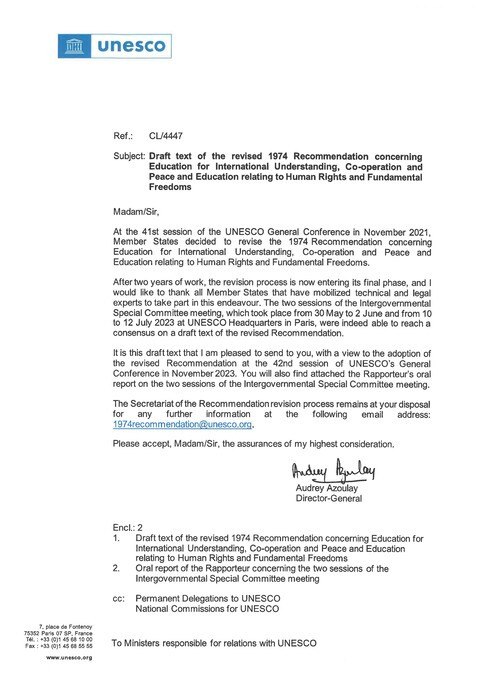 Draft Text of the Revised 1974 Recommendation Concerning Education for International Understanding, Co-Operation and Peace and Education Relating to Human Rights and Fundamental Freedoms Year of publication: 2023 Corporate author: UNESCO In accordance with the UNESCO Constitution and the Rules of Procedure concerning Recommendations to Member States and international conventions covered by the terms of Article IV, paragraph 4, of the Constitution, the draft text of the revised Recommendation concerning education for international understanding, co-operation and peace and education relating to human rights and fundamental freedoms, and the related preliminary report, were sent to UNESCO Member States through the circular letter CL/4401 (September 2022) for their written commentsand observations. On the basis of their comments, a second draft of the text was prepared. In circular letter CL/4433 (April 2023), the second draft together with the Definitive Report were submitted to Member States. The Special Committee meeting of experts designated by Member States took place from 30 May to 2 June 2023, as per the circular letter CL/4417 (November 2022), and from 10 to 12 July 2023, as per circular letter CL/4442 (June 2023).
  [Summary] Global Education Monitoring Report Summary 2023: Technology in Education; A Tool on whose Terms? Year of publication: 2023 Corporate author: UNESCO | Global Education Monitoring Report Team Technology’s role in education has been sparking intense debate for a long time. Does it democratize knowledge or threaten democracy by allowing a select few to control information? Does it offer boundless opportunities or lead towards a technology-dependent future with no return? Does it level the playing field or exacerbate inequality? Should it be used in teaching young children or is there a risk to their development? The debate has been fuelled by the COVID-19 school closures and the emergence of generative artificial intelligence. But as developers are often a step ahead of decision makers, research on education technology is complex. Robust, impartial evidence is scarce. Are societies even asking the right questions about education before turning to technology as a solution? Are they recognizing its risks as they seek out its benefits? Information and communication technology has potential to support equity and inclusion in terms of reaching disadvantaged learners and diffusing more knowledge in engaging and affordable formats. In certain contexts, and for some types of learning, it can improve the quality of teaching and learning basic skills. In any case, digital skills have become part of a basic skills package. Digital technology can also support management and increase efficiency, helping handle bigger volumes of education data. But technology can also exclude and be irrelevant and burdensome, if not outright harmful. Governments need to ensure the right conditions to enable equitable access to education for all, to regulate technology use so as to protect learners from its negative influences, and to prepare teachers. This report recommends that technology should be introduced into education on the basis of evidence showing that it would be appropriate, equitable, scalable and sustainable. In other words, its use should be in learners’ best interests and should complement face-to-face interaction with teachers. It should be seen as a tool to be used on these terms. Midway to the deadline, the 2023 Global Education Monitoring Report assesses the distance still to go to reach the 2030 education targets. Education is the key to unlocking the achievement of other development objectives, not least the goal of technological progress.
  Roundtable of the Group of Friends for Solidarity and Inclusion with GCED: "Art Education Fostering Global Citizenship" Year of publication: 2023 Author: Hyunmook Lim Corporate author: APCEIU This report shares the overview of the Roundtable of the Group of Friends for Solidarity and Inclusion with GCED: “Art Education Fostering Global Citizenship”, held on Friday, 16 June 2023. The event was co-organized by the Permanent Delegation of the Republic of Korea to UNESCO and the Asia-Pacific Centre of Education for International Understanding (APCEIU) in partnership with the Group of Friends for Solidarity and Inclusion with GCED (Afghanistan, Armenia, Austria, Bangladesh, Canada, Colombia, Italy, Jordan, Kenya, Kuwait, Philippines, Republic of Korea, Saudi Arabia, Senegal, Serbia, Nigeria and Oman). This report shares the summary of the event, particularly the presentations on GCED activities through arts education by experts from Finland, Lebanon, the Republic of Korea and Nigeria to promote the values and initiatives of GCED through arts education.
  21st Asia-Pacific Training Workshop on EIU GCED Mentorship Programme - Final Report Year of publication: 2022 Corporate author: APCEIU This report summarizes 18 GCED projects implemented in the Asia-Pacific region by the alumni of APCEIU’s 21st Asia-Pacific Training Workshop on EIU/GCED (2022).The Mentorship Programme consisted of two tracks.1) Track A: Individual Mentorship with APCEIU’s expert groups (Concretizing the GCED project with guidance from mentors)2) Track B: Developing GCED Training Programme using Design Thinking Strategy with APCEIU & Habi Education LabAsia-Pacific Training Workshop on EIU/GCED (APTW) is APCEIU’s flagship TOT (Training of Trainers) programme for educators and teacher trainers in the Asia-Pacific region, which benefitted more than 600 educators over the last 22 years. Since 2021, it has been shifted to a comprehensive training programme composed of online training workshops, mentorship, and local project implementation to further empower participants to bring changes in their local communities.In 2022, marking its 21st turn, APTW was virtually held from 30 May to 7 June with 52 passionate educators from 19 UNESCO member states in the Asia-Pacific region. This year with the theme of ‘Preparing educators for a post-pandemic world: GCED as a key to change’, the Workshop provided opportunities to explore the timely issues and pedagogies to prepare educators for the post-pandemic world.
  2022 Youth Leaders’ Mentorship & Local GCED Projects: Activity Report Year of publication: 2022 Corporate author: APCEIU This report summarizes 15 GCED projects implemented in different parts of the world by the alumni of APCEIU’s Youth Leadership Workshop on GCED in 2022. Ranging from community advocacy for global citizenship to girls’ empowerment projects, 15 GCED initiatives have been taken by the team of 15 young leaders in their own communities in Asia, Europe, Africa, Latin America, and the Caribbean. APCEIU offers GCED training programmes targeting youth leaders around the globe to encourage them to achieve the SDGs through global citizenship and GCED. Since 2015, the Youth Leadership Workshop on GCED has been held every year in the Republic of Korea, inviting 50 young global leaders to take part in an intensive training programme where they share their actions, deepen their knowledge on global/local issues, enhance their motivation to take actions for a change, and establish the young leaders’ network on GCED. Since 2021, it has been shifted to a comprehensive training programme composed of online training workshops, mentorship, and local project implementation.
  Asia-Pacific Teacher Exchange for Global Education 2022: Final Report Year of publication: 2022 Corporate author: APCEIU | Korea R. Ministry of Education The Asia-Pacific Teacher Exchange for Global Education (APTE), which has been in place since 2012, marks its 10th anniversary this year. APTE had been conducted according to the existing programme execution system and flow chart until 2019. However, the Office of International Teacher Exchange (ITE) focused on online exchange due to the pandemic crisis. This year’s APTE programme followed last year’s online formula and presented a new direction for utilization even post-pandemic. These efforts are expected to enhance global educational competencies for a more sustainable Global Citizenship Education.