
Resources
Explore a wide range of valuable resources on GCED to deepen your understanding and enhance your research, advocacy, teaching, and learning.
8,354 Results found
 Global Research Policy & Practices Report: Advancing Artificial Intelligence-Supported Global Digital Citizenship Education Year of publication: 2022 Corporate author: UNESCO Institute for Information Technologies in Education (IITE) | Shanghai Open University The UNESCO Institute for Information Technologies in Education (IITE) was established as an integral part of UNESCO by the General Conference of UNESCO at its 29th session November 1997) and is located in Moscow, Russian Federation. IITE is the only UNESCO Category 1 Institute that holds a global mandate for ICT in education.In line with the new Education 2030 Agenda, IITE has developed its strategic priority areas to meet new demands and tasks ahead. The mission of IITE in the new era is promoting the innovative use of ICT and serving as facilitator and enabler for achieving Sustainable Development Goal 4 (SDG 4) through ICT-enabled solutions and best practices. This report, supported by the Online Learning Consortium (OLC), is published in partnership with Shanghai Open University (SOU) to help amplify best practices regarding artificial ntelligence, digital literacy, and digital citizenship instruction for lifelong learning and success.
  The Implications of the COVID-19 Pandemic on Fundamental Rights and Civic Space Year of publication: 2022 Author: Filip Pazderski | Giada Negri | Chayma Khazzani | Ivana Rosenzweigova | Boglarka Szalma | Luben Panov | Carlotta Besozzi Corporate author: European Economic and Social Committee (EESC) This report was compiled for the European Economic and Social Committee at the request of the Diversity Europe Group by a consortium of four partners - European Civic Forum, Civil Society Europe, European Center for Not-for-Profit Law and the Institute of Public Affairs. It examines how the COVID-19 pandemic has affected the work of civil society organisations (CSOs) across Europe. It also focuses on how solutions implemented in individual EU Member States have impacted CSOs' ability to exercise their fundamental rights and freedoms.The report is based on in-depth analysis of existing studies and reports, a survey, 29 expert interviews and three focus groups. It showcases a number of ways in which the pandemic has affected the functioning of civil society organisations in the EU. The observations emerging from the different stages of the research were characterised by a high degree of consistency, validating the picture depicted.
  Citizenship Education at Regional Conflict Zones Year of publication: 2020 Author: Nazarii Boiarskyi | Aleksey Telichkin | Nikolay Nazarov | Yuriy Petrushenko | Alexandru Postica | Sasha Delemenchuk | Valery Balaian | Oleksandr Voitenko | Rauf Rajabov Corporate author: Human Rights Vector This publication is prepared by ‘Human Rights Vector’ NGO (Ukraine) as part of ‘Citizenship Education at Regional Conflict Zones’ projects that is being implemented by a ‘Citizenship Education at Regional Conflict Zones’ working group within EENCE network with the support of the Federal Agency for Civic Education (Bundeszentrale für politische Bildung) using funds appropriated by the Federal Foreign Office. This publication is the result of the activities of “Citizenship Education at Regional Conflict Zones” working group within EENCE network in 2020. The manual presents an understanding of conflicts in the modern world, as well as an overview of regional conflicts in the countries of the Eastern Partnership and Russia; it contains the analysis of the condition of formal and non-formal education in the conflict-affected areas; information on the specifics of planning and implementing citizenship education programs in the conflict-affected areas and for people from such areas, examples of the best educational practices.
  Spot and Fight Disinformation Year of publication: 2021 Corporate author: European Commission The pandemic demonstrated just how fast misleading or false information can spread online. With this toolkit, secondary school teachers can help their students separate what is real from what is fake when they are browsing online. The toolkit is comprised of an editable presentation (which includes real life examples and group exercises) and an instruction booklet for teachers.
 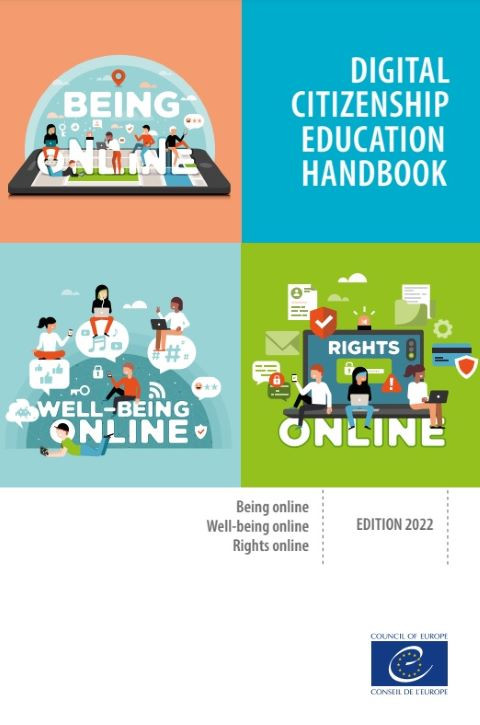 Digital Citizenship Education Handbook (Edition 2022) Year of publication: 2022 Author: Janice Richardson | Elizabeth Milovidov Corporate author: Council of Europe Digital citizenship competences define how we act and interact online. They comprise the values, attitudes, skills and knowledge and critical understanding necessary to responsibly navigate the constantly evolving digital world, and to shape technology to meet our own needs rather than to be shaped by it. The Digital citizenship education handbook offers information, tools and good practice to support the development of these competences in keeping with the Council of Europe’s vocation to empower and protect children, enabling them to live together as equals in today’s culturally diverse democratic societies, both on- and offline.The Digital citizenship education handbook is intended for teachers and parents, education decision makers and platform providers alike. It describes in depth the multiple dimensions that make up each of 10 digital citizenship domains, and includes a fact sheet on each domain providing ideas, good practice and further references to support educators in building the competences that will stand children in good stead when they are confronted with the challenges of tomorrow’s digital world. The Digital citizenship education handbook is consistent with the Council of Europe’s Reference Framework of Competences for Democratic Culture and compatible for use with the Internet literacy handbook.
 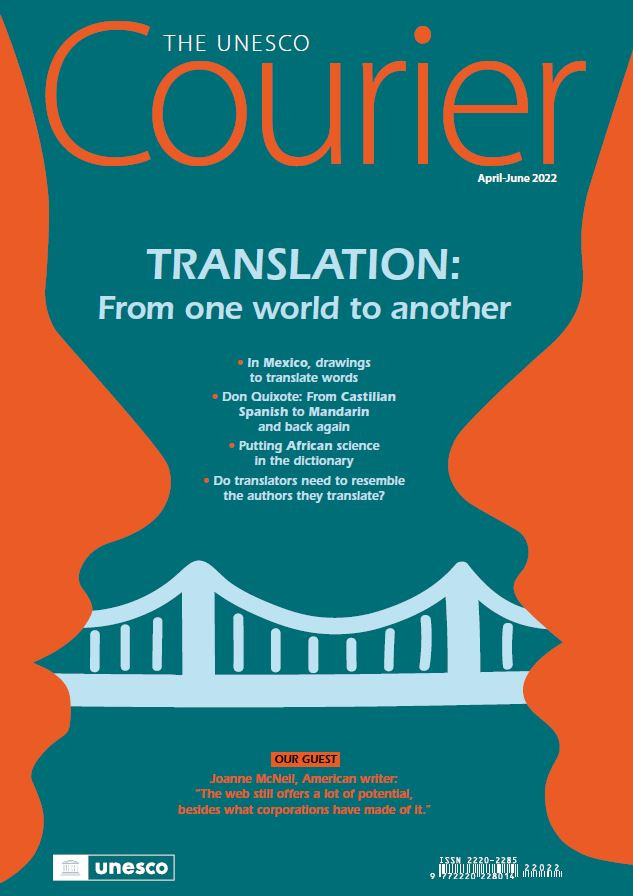 Translation: From One World to Another (The UNESCO Courier No. 2; April-June 2022) Year of publication: 2022 Corporate author: UNESCO To translate is “to say almost the same thing”, in the words of the Italian writer Umberto Eco. A whole world is contained in this “almost”. To translate is to confront the other, the different, the unknown. It is often the essential prerequisite for those who want to access a universal, multiple, diverse culture. It is therefore no coincidence that the League of Nations took up the issue in the 1930s, envisaging the creation of an Index Translationum.Taken over by UNESCO in 1948, this Index allowed the first census of translated works in the world. Two years later, the Representative Works programme was launched to translate masterpieces of world literature. UNESCO’s support for the publication last year of a lexicon of words from indigenous languages of Mexico that are untranslatable into Spanish is a continuation of these efforts.Although their disappearance was predicted as early as the 1950s, translators – who are most often women – have never been as numerous as they are today. The machines developed in the aftermath of the war have not been able to outdo this behind-the-scenes profession. Nor have digital translation tools, which have become the standard feature of our globalized conversations, even if they have contributed to transforming the job.This is because language is more than just a means of communication. It is that, and much more. It is what written or oral works make of it, contributing to forge what is sometimes called the ‘genius of the language’, which the most powerful applications cannot restore.
  Addressing Hate Speech: Educational Responses Year of publication: 2022 Author: Nicole Fournier-Sylvester Corporate author: UNESCO | UN. Office on Genocide Prevention and the Responsibility to Protect This paper is part of a collection of discussion papers, commissioned and produced by UNESCO and the United Nations Office of the Special Adviser on the Prevention of Genocide (OSAPG).The papers are a direct contribution to the United Nations Strategy and Plan of Action and are published in the context of the Multistakeholder Forum and Ministerial Conference on Addressing Hate Speech through Education in September and October 2021.The outbreak of the COVID-19 pandemic has highlighted the pertinence of the United Nations Strategy and Plan of Action, generating a wave of hate speech across the world –further exacerbating intolerance and discrimination towards particular groups and destabilizing societies and political systems. The discussion papers seek to unpack key issues related to this global challenge and propose possible responses and recommendations.
  International News, Reading Notes : From Restricted Citizenship to Citizenship Education (Nathanaël Wallenhorst et Éric Mutabazi (dir.), Le Bord de l’eau, 2021, 230 p.) Year of publication: 2021 Author: Jean-Pierre Véran Corporate author: Revue internationale d’éducation de Sèvres For readers of the Revue Internationale d’éducation de Sèvres, it should first be emphasized that this work raises the question of citizenship in the era of globalization. And, as an example, we will give chapter 2, which answers the question posed by its title: "How ethnicity prevented the realization of a community of citizens in Rwanda? It should also be emphasized that the thinkers called upon, from Kant to Arendt via Gramsci, have in common that they have considered the question of citizenship in very diverse historical and national contexts, but on a scale exceeding the national borders.We will also underline the second merit of this collective work of eleven researchers. It first paints a picture of the impeded citizenship of our present time before proposing an overcoming of these various impediments through cosmopolitical and existential citizenship.
 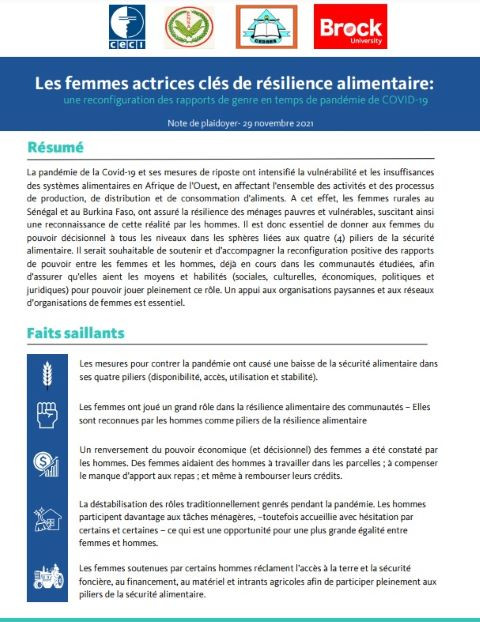 Women Key Actors of Food Resilience: A Reconfiguration of Gender Relations in Times of the COVID-19 Pandemic Year of publication: 2021 Corporate author: Centre for International Cooperation and Study (CECI) The Covid-19 pandemic and its response measures have intensified the vulnerability and shortcomings of food systems in West Africa, affecting all activities and processes of production, distribution, and consumption of food. To this end, rural women in Senegal and Burkina Faso, ensured the resilience of poor and vulnerable households, thus generating recognition of this reality by men. It is therefore essential to give women decision-making power at all levels in the spheres related to the four pillars of security eating. It would be desirable to support and accompany the positive reconfiguration of relationships of power between women and men, already in progress in the communities studied, to ensure that they have the means and skills (social, cultural, economic, political, and legal) to be able to fully play this role. Support for farmer organizations and networks of women's organizations is essential.
 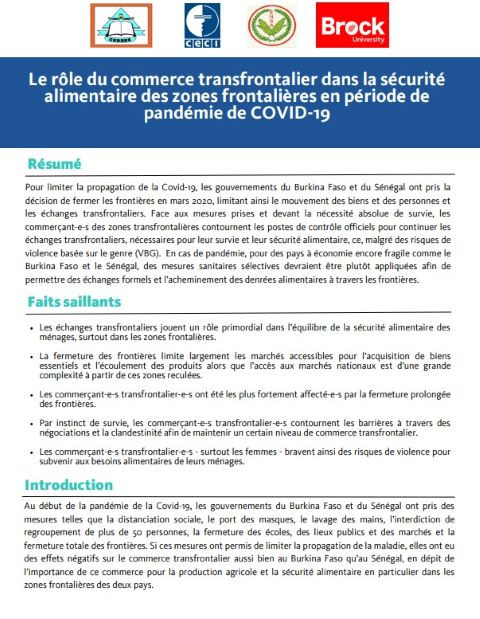 Advocacy Note: The Role of Cross-Border Trade in Security Food in Border Areas During Periods of COVID-19 Pandemic Year of publication: 2022 Corporate author: Centre for International Cooperation and Study (CECI) The Role of Cross-Border Trade in Security food in border areas during periods of COVID-19 pandemic To limit the spread of Covid-19, the governments of Burkina Faso and Senegal have decided to close the borders in March 2020, thus limiting the movement of goods and people and cross-border exchanges. Faced with the measures taken and faced with the absolute necessity of survival, the Traders in cross-border areas bypass official checkpoints to continue trade. cross-border exchanges, necessary for their survival and food security, despite the risks of gender-based violence (GBV). In the event of a pandemic, for countries with still fragile economies such as Burkina Faso and Senegal, selective sanitary measures should rather be applied to enable formal trade and the movement of food across borders.