
Resources
Explore a wide range of valuable resources on GCED to deepen your understanding and enhance your research, advocacy, teaching, and learning.
8,354 Results found
 Progress on the Sustainable Development Goals: The Gender Snapshot 2021 Year of publication: 2021 Author: Ginette Azcona | Antra Bhatt | Julia Brauchle | Guillem Fortuny Fillo | Yongyi Min | Heather Page | Yuxi Zhang Corporate author: United Nations Entity for Gender Equality and the Empowerment of Women (UN Women) | UN. Department of Economic and Social Affairs (UN. DESA) The pandemic has tested and even reversed progress in expanding women’s rights and opportunities. Women have not recovered lost jobs and income, hunger is on the rise, and school closures threaten girls’ educational gains. Women’s participation in government, research, and resource management remains far from equal. Vulnerable groups of women, including migrants, those with disabilities, and those affected by conflict, are frequently left behind. Disparities between rich and poor countries are preventing equal access to lifesaving COVID-19 vaccines and treatments, putting women in poorer countries at disproportionate risk.Moreover, despite women’s central roles in responding to COVID-19, including as front-line health workers, they do not have the leadership positions they deserve. Building forward differently and better will require placing women and girls at the centre of all aspects of response and recovery, including through gender-responsive laws, policies, and budgeting.“Progress on the Sustainable Development Goals: The gender snapshot 2021” presents the latest evidence on gender equality across all 17 Goals, highlighting the progress made since 2015 but also the continued alarm over the COVID-19 pandemic, its immediate effect on women’s well-being, and the threat it poses to future generations.
  Progress on the Sustainable Development Goals: The Gender Snapshot 2022 Year of publication: 2022 Author: Ginette Azcona | Antra Bhatt | Julia Brauchle | Guillem Fortuny Fillo | Yongyi Min | Heather Page | Yuxi Zhang Corporate author: United Nations Entity for Gender Equality and the Empowerment of Women (UN Women) | UN. Department of Economic and Social Affairs (UN. DESA) The latest available Sustainable Development Goal (SDG) 5 data show that the world is not on track to achieve gender equality by 2030. COVID-19 and the backlash against women’s sexual and reproductive health and rights are further diminishing the outlook for gender equality. Violence against women remains high; global health, climate, and humanitarian crises have further increased risks of violence, especially for the most vulnerable women and girls; and women feel more unsafe than they did before the pandemic. Women’s representation in positions of power and decision-making remains below parity. Only 47 per cent of data required to track progress on SDG 5 are currently available, rendering women and girls effectively invisible.Nearly halfway to the 2030 endpoint for the SDGs, the time to act and invest in women and girls is now.“Progress on the Sustainable Development Goals: The gender snapshot 2022” presents the latest evidence on gender equality across all 17 Goals, calling out the long road ahead to achieve gender equality. It emphasizes the interlinkages among the goals, the pivotal force gender equality plays in driving progress across the SDGs, and women and girls’ central role in leading the way forward.
  Generation Equality Accountability Report 2022 Year of publication: 2022 Corporate author: United Nations Entity for Gender Equality and the Empowerment of Women (UN Women) In the UN Decade for Action on Gender Equality, people around the world have pledged to move from rhetoric to action and to work together to drive lasting change, starting now. Through the 2021 Generation Equality Forum in Mexico and France, world leaders and partners committed to eliminating gender inequalities and to financing and implementing laws, policies, and programmes to meet priority actions and targets in a Global Acceleration Plan for Gender Equality. The aim is simple but profound: deliver irreversible, quantifiable results for women and girls in all their diversity.Together, commitment makers and signatories of a series of Action Coalitions, along with the Compact for Women, Peace and Security and Humanitarian Action have begun to build an ambitious global movement. It unites diverse partners committed to collective accountability for women and girls. This accountability is the driving force of this report, which takes stock of the bold commitments made at the Forum one year into implementation. Through a survey of commitment-makers, the report sheds light on the nature of the commitments and assesses measurable progress. It highlights trends and notes where more work is needed.Generation Equality was born from the idea that the world could make catalytic progress on gender equality if a wide range of stakeholders united around a transformative vision and worked together to achieve it. These preliminary findings demonstrate that, while more remains to be done, collective action is powerful in making commitments real in the lives of women and girls.
  National Education Curriculum for the Third Grade of Secondary Year of publication: 2022 Author: Moahmmed Ali Corporate author: ELkheta Seniors The video reviews a full episode of the national education curriculum for the third secondary grade in Egypt. The teacher tries to talk about all the topics included in the curriculum, and makes an integrated review of the curriculum. The video is important for students who study independently to understand civics.
 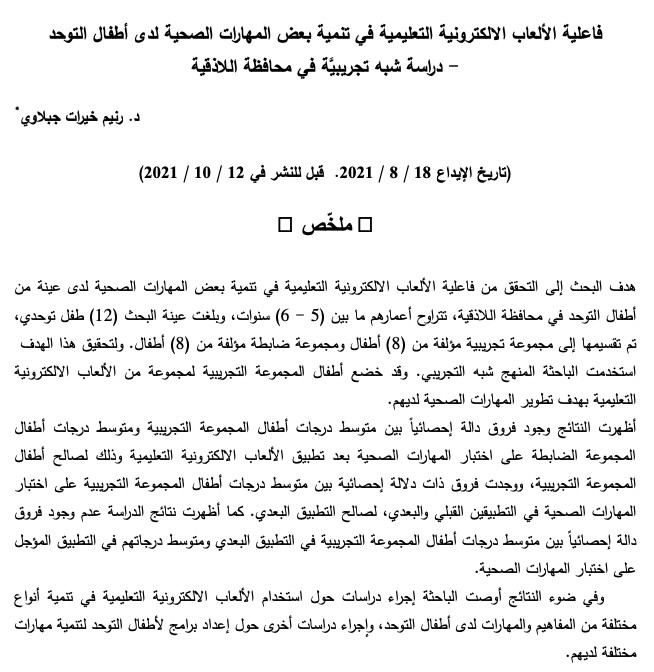 The Effectiveness of Educational Electronic Games in Developing Some Health Skills of Autistic Children Semi-Experimental Study in Lattakia Governorate (Tishreen University Journal for Research and Scientific Studies, Arts and Humanities; vol. 43, no. 5) Year of publication: 2021 Author: Raneem Jablawi Corporate author: Tishreen University "The aim of the research is to verify the effectiveness of educational electronic games in developing some health skills among a sample of autistic children in Lattakia Governorate, their ages ranged between (5-6) years, and the research sample amounted to (12) autistic children, which were divided into an experimental group consisting of (8) children and a control group consisting of (8) children. To achieve this goal, the researcher used the quasi-experimental method. The children of the experimental group were subjected to a set of educational electronic games in order to develop their health skills.The results showed that there were statistically significant differences between the average scores of the children of the experimental group and the average scores of the children of the control group on the health skills test after the application of educational electronic games, in favor of the children of the experimental group, and there were statistically significant differences between the average scores of the children of the experimental group on the health skills test in the two tribal applications. and dimensional, in favor of dimensional application. The results of the study also showed that there were no statistically significant differences between the average scores of the experimental group children in the post application and their average scores in the delayed application on the health skills test.In light of the results, the researcher recommended conducting studies on the use of educational electronic games in developing different types of concepts and skills for autistic children, and conducting other studies on preparing programs for autistic children to develop different skills for them."
  The Arab Program for Early Childhood Development Year of publication: 2012 Author: Ghanim Bibi | Sawsan Alqadi Corporate author: Arab League Educational, Cultural and Scientific Organization (ALECSO) The file reviews a report on the "Arab Program for Early Childhood Development" workshop. The Arab Program for Early Childhood Development is a framework for sharing good practices in policies and programs, through the following four objectives: enhancing quality through innovation in on-the-job programmes, increasing the effectiveness-to-cost ratio, supporting the measurement of the impact of early childhood care and development approaches, and stimulating regional professional exchange and technical assistance. Increasing the use of media and information and communication technology to qualitatively raise the level of early childhood development programmes.
  Digital Transformation of TVET and Skills Development Systems in Africa: State of Play and Prospects Year of publication: 2022 Corporate author: UNESCO IIEP Regional Office for Africa This publication, produced by SOFRECO at the request of IIEP-UNESCO, takes stock of the digitalization of technical and vocational education and training (TVET) in Africa based on a sample of five countries (Madagascar, Nigeria, Rwanda, Tunisia and Chad). This report describes the systems in these five countries that provide the population with access not only to digital tools but also to the skills that will enable everyone to use digital technology.
  Embracing Diversity: Toolkit for Creating Inclusive, Learning-Friendly Environments Year of publication: 2014 Corporate author: UNESCO Beirut The UNESCO Regional Office - Beirut has translated and localized the collection of manuals produced by the UNESCO Regional Office for Education in Asia and the Pacific - Bangkok. The guides, “Accepting Diversity: A Guidebook for Creating Learning-Friendly University Environments,” provides practical tools and guidance for making schools and classrooms inclusive, learning-friendly, and social, gender- and physical-sensitive among children.This guide is one of the nine guides that have been produced, which, in total, aim to assist teachers, school principals and educational officials to create an inclusive and learning-friendly learning environment, by providing a variety of methods, examples, tools, tips and instructions that help the teacher to perform his duties, manage the classroom and prepare A suitable learning environment for all.
  Women's Right to Education Year of publication: 2021 Author: Alya Shaker Corporate author: Qaf TV The video is an episode of the program "The Women's State" on the interactive Qaf channel. The episode entitled "Women have the right to education". In it, the presenter addressed the issue with Dr. "Nassiba Jalal". The episode discusses the views of women's right to education, the social and economic reasons that prevented women from learning, their reality today, and the many positive effects in the case of women's education from a personal, social and economic point of view. It also discusses the reasons that help facilitate and implement this right today.
  International Guarantees to Protect the Right to Education in International Humanitarian Law (Thi Qar Arts Journal; vol. 33, no. 1) Year of publication: 2019 Author: Firas Jasim Corporate author: Dhi Qar University The right to education is one of the most important human rights that international law is keen to ensure its protection in times of peace and armed conflicts. International humanitarian law, along with other legal systems, reinforces legal provisions aimed at ensuring that individuals obtain their right to education, which is often violated in situations of armed conflict. The research was divided into three sections, the first included the concept of the right to education, while the second dealt with the mechanisms of international humanitarian law in protecting the right to education, while the third section presented legal means to confront violations of the right to education.