
Resources
Explore a wide range of valuable resources on GCED to deepen your understanding and enhance your research, advocacy, teaching, and learning.
8,354 Results found
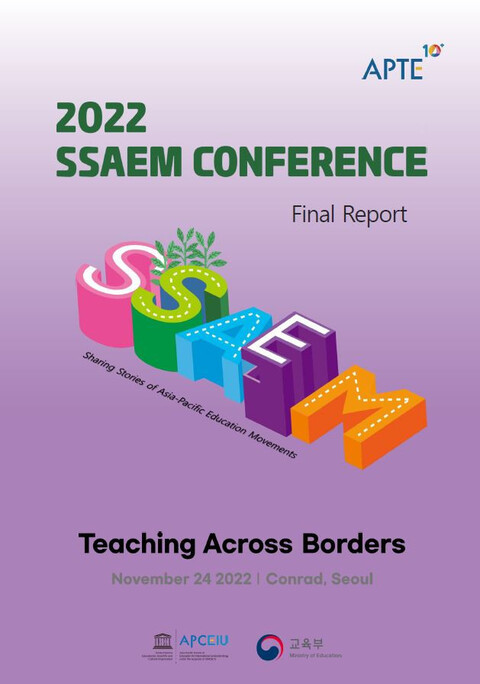 2022 SSAEM Conference: Final Report Year of publication: 2023 Corporate author: APCEIU | Korea R. Ministry of Education The 2022 SSAEM (Sharing Stories of Asia-Pacific Education Movements) Conference is a space for examining and sharing the educational outcomes of the participating teachers and schools of the programme. This conference, which has been held annually since 2014, aims to provide an excellent opportunity for the participants and stakeholders to showcase the impact of the programme and to explore methods for strengthening cooperation for further development of the programme. The main programme included the panel discussion of the Ministry representatives of the 8 countries, the presentation of 2022 programme participants, etc.
 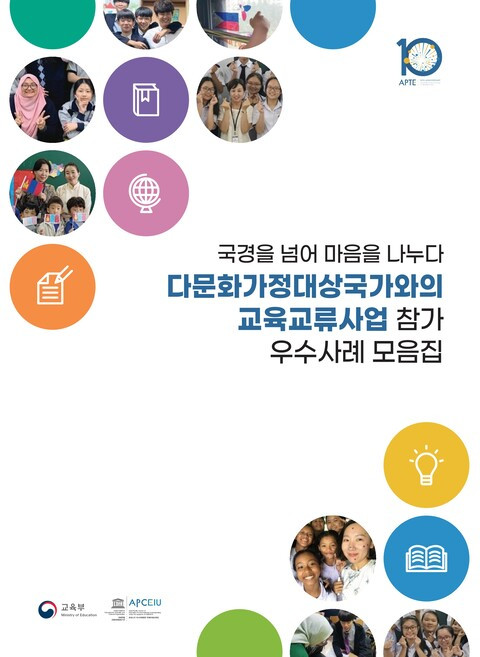 다문화가정대상국가와의 교육교류사업 참가 우수사례 모음집 Year of publication: 2023 Corporate author: APCEIU A carefully curated collection of best practices is presented as part of the 10th-anniversary celebrations of the Asia Pacific Teacher Exchange for Global Education (APTE). Over 30 teachers share their honest and vivid experiences, as well as outstanding follow-up activities. Each story aims to inspire teachers who are interested in the APTE Programme, and to serve as a valuable resource for future participants.
  다문화가정대상국가와의 교육교류사업 후속활동 길라잡이 Year of publication: 2023 Corporate author: APCEIU The Asia-Pacific Teacher Exchange for Global Education(APTE) is a bilateral teacher exchange programme between the Republic of Korea and Asia-Pacific countries, hosted by the Ministry of Education of the Republic of Korea (MOE ROK) and implemented by the Asia-Pacific Centre of Education for International Understanding under the auspices of UNESCO (APCEIU), in collaboration with the Ministries of Education of the partner countries. Since 2012, the Office of International Teacher Exchange of APCEIU has been playing a pivotal role in implementing APTE. APCEIU prepared this book in the hope of spreading the fruits of teachers’ efforts and the seeds of peace in them, which were nurtured on the ground of APTE, to a broader world. <Contents>IntroductionI. Understanding follow-up activitiesII. Types of follow-up activities and model examples1. Types of follow-up activities2. Model examples of follow-up activities- [Real-Time Online Video Class] Starting online international education exchange- [Visiting / Invitational Program] An insight into international exchange programme- [Club-Oriented Inter-School Exchange] Follow-up exchange with invention club activity- [Inter-School Cooperative Agreement] Precious ties- [Participation In Various Support Programs] Heart of Korea, multicultural values: overcoming the limits of the classroomIII. Follow-up activity operation1. The nine-step preparation process for independent operation of educational exchange2. Procedures for independent operation of international exchangeIV. Annex1. Asia-Pacific Teacher Exchange for Global Education2. UNESCO APCEIU: Asia-Pacific Centre of Education for International Understanding under the auspices of UNESCO3. Reference programs for follow-up activities
 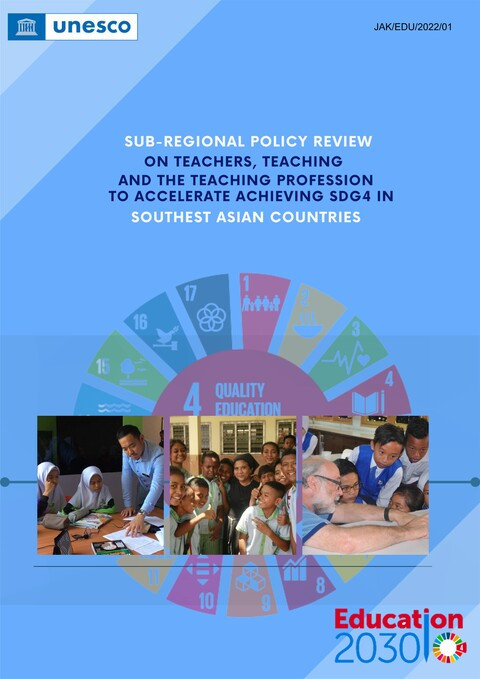 Sub-regional Policy Review on Teachers, Teaching and the Teaching Profession to Accelerate Achieving SDG4 in Southeast Asian Countries Year of publication: 2022 Author: Azlina Abdul Aziz | Kamisah Osman | Khairul Farhah Khairuddin | Meeyoung Choi Corporate author: UNESCO Jakarta The objectives of this report are to analyse existing national policies related to Teachers, Teaching and the Teaching Profession and examine their implementation in the five UNESCO cluster countries, namely Brunei, Indonesia, Malaysia, the Philippines and Timor-Leste. Eight themes have emerged from the systematic review of literature and they are i) Teacher Standard Competence, ii) Teacher professional Development, iii) Teacher Support, iv) Teaching Quality, v) Formative and Summative Assessment Framework on Teaching, vi) Showcasing and Rewarding Best Teaching Practices, vii) Teacher Professionalism and finally viii) Teacher Career Development.
  Higher Education, Peace & Security in the Eastern Africa Region Year of publication: 2023 Author: Sabiti Makara Corporate author: UNESCO Nairobi This paper stems from issues that were deliberated on at a regional conference titled, Emerging Issues in the Sciences, Climate Change, Peace and Security and Information and Communication Technologies (ICTs), organized in Djibouti, in May 2017 by UNESCO Regional Office for Eastern Africa. The paper examines the issues and challenges of peace and security in Eastern Africa region. It puts into perspective higher education in the region, in terms of assess, quality, relevance, knowledge and skill products, and capacity to solve social challenges of society. The May 2017 Djibouti Conference on Higher Education, Peace and Security aimed at placing higher education at the center of understanding the complex regional challenges with regard to peace and security in a broad context, including poverty, climate change and environment, intergenerational transfer of knowledge, colonial/neo-colonial heritage, regional integration, cultural resources, and unemployment. The centrality of education as a tool for social transformation in Africa, and elsewhere is a critical element of transforming society, however that very element is up for debate. Specifically, the impact of higher education as a means of accelerating the sciences (natural and social sciences) is due for robust debate, as to whether or not, it is leading to innovations, creativity, and research-led solutions to challenges of society. The critical issue for the Djibouti Conference deliberations was: could Science, technology and in more recent years, information and communications technology, lead to transformation of society in the region? The other issue was: is it only the natural sciences that have the greatest potential for that transformation, or that the social sciences and humanities are relevant in this context? Besides, since issues of peace and security are complex, could multidisciplinary approaches be appropriate? This paper is not a rapporteur's report of the Djibouti conference. It is a set of reflection and reframing of issues for further debate and discussion.
 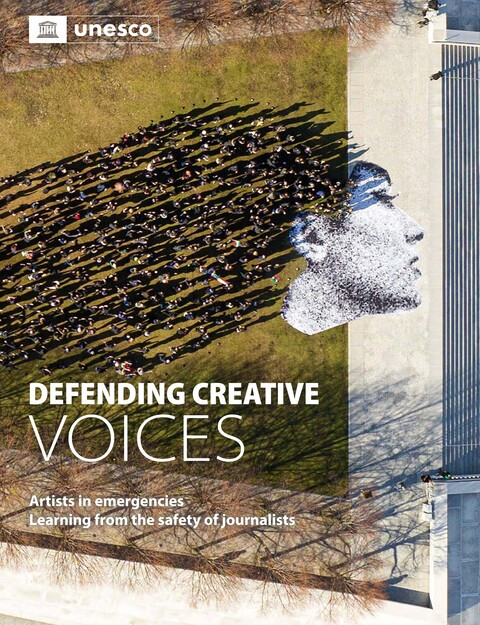 Defending Creative Voices: Artists in Emergencies, Learning from the Safety of Journalists Year of publication: 2023 Author: Rosario Soraide Corporate author: UNESCO Artists and cultural professionals often come across significant challenges to their freedom of expression, including violence and harassment – online and offline – legal persecution, detention, imprisonment and, in the worst of cases, murder. Emergency situations can result in additional risks for them, as many become increasingly targeted in connection to the visibility of their work and see their livelihoods impacted upon by income loss and unemployment in the cultural sector. While the attacks and threats that artists and cultural professionals face during emergencies are similar to those affecting journalists, they do not receive the same level of attention nor access to protection mechanisms and opportunities for assistance. Over the past decades, a strong framework has emerged to advance journalists’ safety at international, regional and national levels, including through legal and regulatory instruments, protection mechanisms, support networks and consistent collective mobilization for their rights. Despite growing awareness of the vulnerability of artists and cultural professionals in emergency contexts and increased efforts to safeguard their rights and ensure their safety, progress in this regard remains comparatively much more incipient. With the support of UNESCO’s Culture and Communication and Information Sector, and based on a comparative analysis, this study therefore aims to strengthen the protection of artists and cultural professionals during emergencies by drawing lessons from the experience, challenges, and achievements in the field of journalists’ safety. It presents actionable recommendations and identifies areas in which synergies between key stakeholders promoting, respectively, artistic and media freedom could serve to reinforce the protection of both at-risk artists and journalists.
 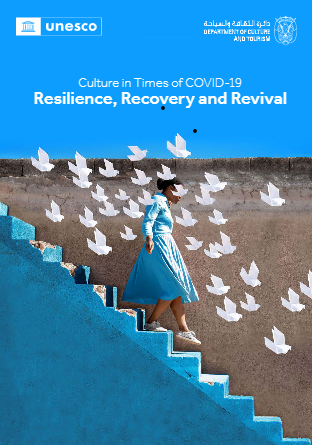 Culture in Times of COVID-19: Resilience, Recovery and Revival Year of publication: 2022 Corporate author: UNESCO | United Arab Emirates. Department of Culture and Tourism Culture in Times of COVID-19: Resilience, Recovery and Revival offers key insights on trends and structural transformations that can boost the culture sector as a cornerstone of an economy built on sustainability and well-being.A set of strategic development considerations are put forward for governments and their partners, in both the public and private sectors, to promote the value of culture as a public good, encourage cross-sector collaboration and holistically address the essential needs of the sector, while supporting cultural professionals in adapting to a changing world and providing equal access and opportunities across the culturalvalue chain.
  Revised Recommendation Concerning Education for International Understanding, Co-operation and Peace and Education Relating to Human Rights and Fundamental Freedoms ('1974 Recommendation') Year of publication: 2022 Corporate author: UNESCO The revision of the 1974 Recommendation provides the international community with the opportunity to strengthen the instrument so that it can support the design and implementation of effective educational policies and programmes, which can put the world on a pathway to lasting peace and sustainable development for all, in line with the requirements of the 2030 Agenda and the body of international legal norms adopted since 1974.
 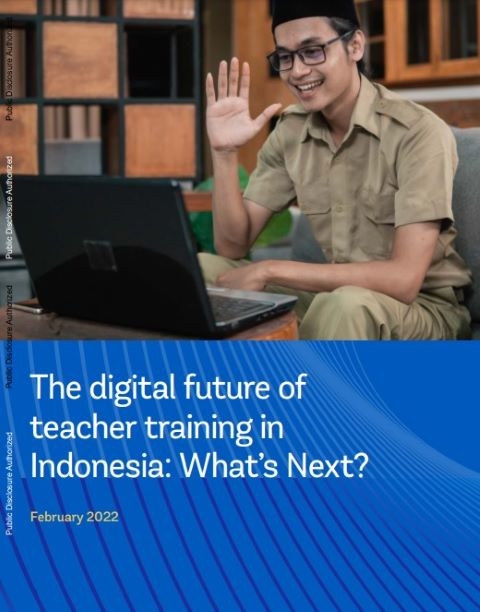 The Digital Future of Teacher Training in Indonesia: What’s Next? Year of publication: 2022 Author: Noah Yarrow | Noviandri Khairina | Jacobus Cilliers | Indah Dini Corporate author: World Bank | Government of Australia This report reflects on the Indonesia’s online teacher training ecosystem based on unique data collected from both teachers and providers during the COVID-19 period. A detailed mapping of the eight largest providers of online teacher training in Indonesia was conducted, covering 25 programs. We find that the majority of programs are short in duration and focus on digital literacy skills and remote learning. Training programs were mostly provided using online lectures, few provided individual coaching, while none provided opportunities for personalized learning. Second, we conducted a nationally representative phone survey of 435 primary and junior secondary teachers spanning 30 provinces across Indonesia (66 percent of whom are female teachers). The teacher survey was conducted between February and March 2021 and covered teachers under both the Ministry of Education, Research, and Technology (MoECRT) and the Ministry of Religious Affairs (MoRA). We find that 44 percent of teachers participated in online learning during the pandemic, and that three quarters of these teachers had never participated in online training prior to the pandemic. Many training participants reported challenges in implementing what they learned from online training. Most of the teachers who participated (88 percent) would like to continue receiving training online even after the pandemic ends. These results suggest that demand for online training is expected to persist, but more can be done to improve their quality.
  G7 Global Objectives On Girls’ Education: Baseline Report Year of publication: 2022 Corporate author: United Nations Girls' Education Initiative (UNGEI) This publication serves as a baseline report to accompany efforts of the G7 Accountability Working Group to monitor progress towards the two global objectives. It presents evidence on low- and lower-middle-income countries’ progress in achieving the two global objectives and what remains to be done.It is important to stress that the two G7 global objectives on girls’ education are measures of gender parity, which are necessary but not sufficient as measures of gender equality. Assessing progress towards the latter requires information, which tends not to be available systematically enough to allow a comparative perspective. However, this report provides insights to remaining challenges.