
Resources
Explore a wide range of valuable resources on GCED to deepen your understanding and enhance your research, advocacy, teaching, and learning.
8,354 Results found
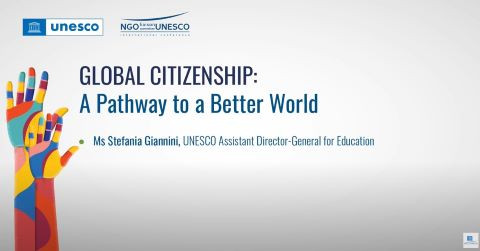 Global Citizenship: A Path to a Better World Year of publication: 2022 Corporate author: NGO-UNESCO Liaison Committee Presentation at the Forum of NGO Liaison Committee (UNESCO) by Stefania Giannini, Deputy Secretary General, UNESCO. The need for new pedagogies and solidarity that respects diversity. Education must also aim to develop peace, gender equity, and the meaning of the ODDs, notably 4.7 in relation to Global Citizenship Education. Civil society partners are critical to fighting extremism and hate.
  Indicators for Monitoring the Sustainable Development Goals Year of publication: 2019 Author: Frédéric Vey | Anne-Sophie Hesse Corporate author: Université Virtuelle Environnement et Développement durable (UVED) Frédéric Vey and Anne-Sophie Hesse, from the Ministry of Ecological and Solidarity Transition, discuss in this video (12'40) the indicators for monitoring the Sustainable Development Goals (SDGs). After a theoretical approach aimed at defining and showing the limits of the indicators, they show how the "SDG" indicators are available from the international scale to the national scale.
  Towards Indigenization: Inspirational Educational Practices the Era of Reconciliation Year of publication: 2021 Author: Constance Lavoie | Natasha Blanchet-Cohen | Marco Bacon Corporate author: Education and Francophonie Today, Aboriginal people are re-establishing their knowledge, know-how, and know-how to be in the educational space. The present historical period is filled with hopes and educational initiatives to preserve, revitalize and transmit cultures, Indigenous worldviews, and knowledge in education. This thematic issue towards indigenization aims to highlight such often-overlooked educational advances in order to promote the path to be traveled for reconciliation.
  The Articulation of Organizational Levels During Interactions of International Students: Current Situation in Various Regions of Quebec (Canada) Year of publication: 2020 Author: Jorge Frozzini Corporate author: Alterstice This introduction to the thematic issue presents the state of interactions between international students (IS) and the social agents who rub shoulders with them in various regions of Quebec (Canada) as well as in a locality in Bulgaria. They also propose a theoretical framework that focuses on the articulation of three organizational levels affecting the interactions of IS and therefore their resocialization. This framework also pays particular attention to the management technologies that come into play from the first moments when IEs show their desire to study elsewhere until the moment they leave or settle in the new environment. Intercultural encounters in a context where there is an increase in the presence of IEs are thus influenced by the subtleties of the shaping of social relations, which are favored by the articulations of these organizational levels and the coordination made possible by the management technologies in question. a place to ensure control and follow-up (surveillance) with IEs.
  “Racism, Sexism, Homophobia, Which Card do You Want?” The Post-Migration Experience of Northern LGBTQ People Global and Global South Year of publication: 2021 Author: Barbara Andrade de Sousa | Line Chamberland Corporate author: Alterstice This article examines the life stories of seven LGBTQ immigrants, from the Global North and South, who live in Montreal. The research on immigration has long been carried out according to a framework heteronormative, which sets aside a whole series of questions relating to the impact of sexual orientation and non-normative gender identity on the migratory experience. Societies impose distinct constraints on LGBTQ people. Once settled in the host society, these subjects can experience more sexual possibilities. However, their origin can become a marker that places them inside a relationship of power with the majority group. This article aims to shed light on how LGBTQ immigrants construct their life stories in a context where their experience is crossed by the interweaving of several aspects of identities such as sexual orientation, gender identity, ethnicity, and religion, to name a few. The intersectional approach makes it possible to identify the systems of binding powers which participants face daily. The thematic analysis gave us allowed to listen to individuals to know the categories of power and the systems of oppression they talk about — the goal being to position respondents as knowledgeable subjects, not mere study objects. Analysis of the interviews shows that LGBTQ individuals who express a diverse combination of identities face specific challenges linked to the migratory route.
  The Genesis of the Category of “LGBT Refugee” Within the United Nations High Commissioner for Refugees Year of publication: 2021 Author: Ahmed Hamila Corporate author: Alterstice The international protection system is governed by the Geneva Convention of 1951, supplemented by the New York Protocol of 1967. These international conventions list five grounds for granting refugee status: persecution based on race, religion, nationality, membership of a certain social group, and political opinions. These international instruments do not explicitly recognize persecution based on sexual orientation and gender identity as grounds for granting refugee status. However, over the past three decades, the Office of the United Nations High Commissioner for Refugees (UNHCR) has come to recognize such persecution as grounds for granting international protection. In this article, I focus on the genesis of the "LGBT refugee" category within the UNHCR in the early 2000s. The essay argue that the emergence of this new category of refugees is part of two parallel dynamics, which both led to the development of the UNHCR Guidelines, which explicitly recognize persecution based on sexual orientation as a ground for granting refugee status. On the one hand, it is in the context of greater attention paid to refugee women, and in particular to gender-related persecutions, that persecutions related to sexual orientation are for the first time discussed. On the other hand, the category of “LGBT refugee” also appears in the context of the interpretation of the notion of “belonging to a certain social group”.
  Interculturality of Disability Situations: From Designation to Recognition Year of publication: 2021 Author: Geneviève Piérart | Mélissa Arneton Corporate author: Alterstice Alterstice has been offering, for ten years, a unique space for scientific production responding to socially acute questions related to the consideration of inter-individual, social, and societal diversity. This thematic issue is linked to the creation in 2017 of a thematic axis within the International Association for Intercultural Research (ARIC). This network has enabled researchers to organize symposia questioning disability, intersectionality, and how the work carried out in more mainstream currents take into account or not the intercultural dimension to study the paradigm shift of disability. Fifteen years after the launch of the International Convention on the Rights of Persons with Disabilities (CRPD) marks a societal desire to renew living together at the international level as well as at the national level for the countries that have ratified it, as revealed by the work scientific studies carried out from an intercultural perspective. After an introduction to the notions of disability and interculturality, which also refer to designation processes, which may or may not be crossed and compared in scientific analysis. From a multidisciplinary perspective, different angles relating to the diversity of representations of disability and the issues it raises in situations of contact between cultures are discussed.
  The Digitization of School Through the Prism of Citizenship Year of publication: 2021 Author: Lionel Alvarez | Mathieu Payn Corporate author: Éthique en éducation et en formation Digital devices have colonized many facets of our daily lives, and compulsory schools are now appropriating this evolution. The announced learning goals are often associated with the notion of digital citizenship. At the same time, educational institutions are defining the digital learning environments that teachers and students must adopt. Positioning themselves in the digital humanities, the authors question the posted definitions of digital citizenship, confront them with the sui generis nature of the digital and its industry, and finally question the connection between these and the public school. Issues of citizen empowerment, autonomy, and governance serve the analysis and allow us to conclude that it is necessary to debate the pedagogical-digital contradictions.
 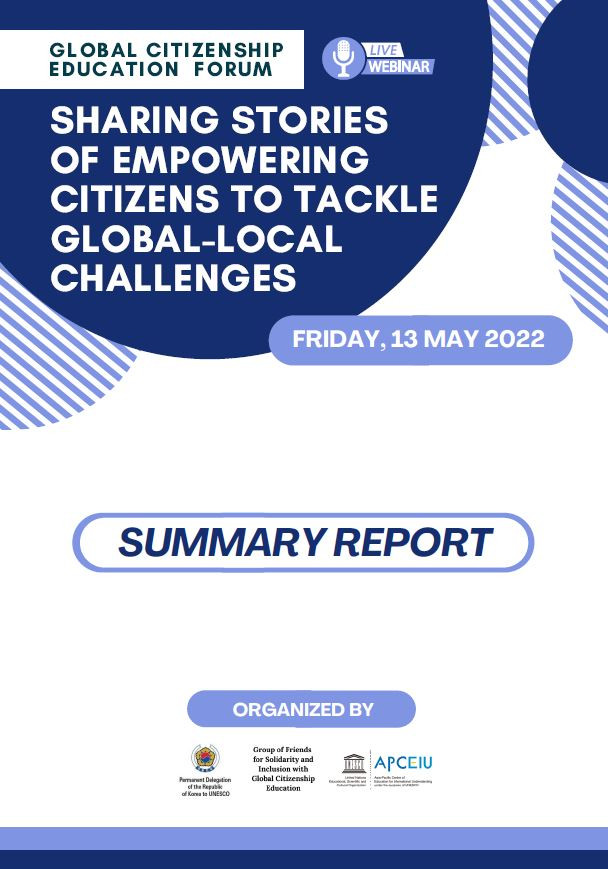 [Summary] Global Citizenship Education Forum: Sharing Stories of Empowering Citizens to Tackle Global-Local Challenges Year of publication: 2022 Corporate author: Permanent Delegation of the Republic of Korea to UNESCO | Group of Friends for Solidarity and Inclusion with Global Citizenship Education | APCEIU This report shares the overview of the Global Citizenship Education Forum held under the theme ‘Sharing Stories of Empowering Citizens to Tackle Global-Local Challenges’ on Friday, 13 May 2022. The event was co-organized by the Permanent Delegation of the Republic of Korea to UNESCO and the Asia-Pacific Centre of Education for International Understanding (APCEIU) in collaboration with the Group of Friends for Solidarity and Inclusion with GCED (Afghanistan, Armenia, Austria, Bangladesh, Canada, Colombia, Italy, Jordan, Kenya, Kuwait, Philippines, Republic of Korea, Saudi Arabia, Senegal and Serbia). This report shares the summary of the event, particularly the presentations on GCED activities implemented by practitioners from Armenia, Austria, Colombia, Jordan, Kenya and the Philippines to influence more GCED programmes/initiatives on various contexts and backgrounds.
  Building Knowledge Societies in the Arab Region: Arabic Language as a Gateway to Knowledge Year of publication: 2019 Corporate author: UNESCO Cairo Building knowledge economies and societies is a professed objective in the Arab region. Most of the development plans in the Arab states clearly call for action to produce, transfer, localise and harness knowledge in various fields, in service of the sustainable human development goals. The Arabic language has an important role to play in this key development process, as the production, assimilation and dissemination of knowledge is more effective and more widely spread when the mother tongue is used. Hereupon, a fundamental question must be addressed: To what extent does the Arabic language today constitute a true gateway to knowledge in the Arab region?This report, prepared by a group of distinguished Arab experts, under supervision and coordination of the UNESCO Regional Bureau for Sciences in the Arab States, seeks to research this central question by reviewing and evaluating the state of knowledge in the Arab region on the one hand, and analysing the role of the Arabic language in the processes of establishing knowledge societies and economies in the Arab region on the other. The general section of the report addresses the question of knowledge and language at the Arab regional level. It also features field research conducted in three Arab states (Saudi Arabia, Egypt and Morocco), that examines the state of knowledge and the Arabic language in those states, and to a certain extent, reflects the situation in the Arab sub-regions to which they belong.