
Resources
Explore a wide range of valuable resources on GCED to deepen your understanding and enhance your research, advocacy, teaching, and learning.
8,354 Results found
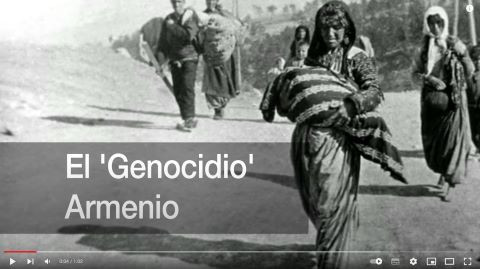 What is the Armenian "Genocide"? Year of publication: 2015 Corporate author: BBC News World This video recounts how tens of thousands of Armenians died when the rulers of the then Ottoman Turkish Empire deported them en masse from the eastern Anatolia region to the Syrian desert and elsewhere in 1915-16. The Armenians were described as collaborators with Russia, a country that was facing the Ottomans in the Caucasus region. The total number of victims is in dispute.
  What Can Education Do to Prevent Violence? Year of publication: 2021 Author: Rafael Bisquerra Corporate author: BBVA We learn together 2030 In this video, the educator Rafael Bisquerra reflects on emotional management as a way to reduce the rates of violence in society, contributing to the improvement of conflict management.
  Youth Guide on Education for Peacebuilding and the Prevention of Violence Year of publication: 2022 Corporate author: UNESCO International Institute for Capacity-Building in Africa (IICBA) This publication is a training guide for the youth in both formal or non-formal education. It is a resource to work with children and young people in various settings, including schools, non-formal educational program, community activities and other settings. The goal of the training guide is therefore the youth to become a facilitator with the disposition, knowledge, skills and commitment to support other youth in developing their full potential as peace-builders. It provides a foundation of conflict analysis, peacebuilding and describes a learner centered approach to peace education and community engagement.
  The Role of the School in Dealing With Violent Radicalization: The Risks and Benefits of a Safe Approach (Éducation et francophonie; vol. 46, no. 2) Year of publication: 2018 Author: Victorine Michalon-Brodeur | Élise Bourgeois-Guérin | Jude Mary Cénat | Cécile Rousseau Corporate author: Association canadienne d’éducation de langue française Violent radicalization is a social phenomenon with vague contours and strong political investment. Those mainly at risk of becoming involved are young people. Several Western countries are dealing with this phenomenon by opting for a security response, encouraging close collaboration between education and law enforcement. This article explores issues related to strengthening connections between the school and law enforcement for the prevention of violent radicalization. While there is a lack of evidence that would be needed to paint a full picture of these relationships, some studies on the impact of the War on Terror on young people and securing American schools in response to school shootings call for restraint. In light of these studies, this article argues that clear boundaries must be established between the mandates of the school and the police. The importance of these firewalls must be emphasized in the training school personnel in the prevention of violent radicalization in order to preserve the school’s ability to be a place that promotes the development of critical thinking and awareness of the Other.
  Citizenship and Civics: Learn From These Young Senegalese Leaders Year of publication: 2020 Corporate author: Vibe Radio Senegal This is a video of young Senegalese leaders presenting on Citizenship and civics.
 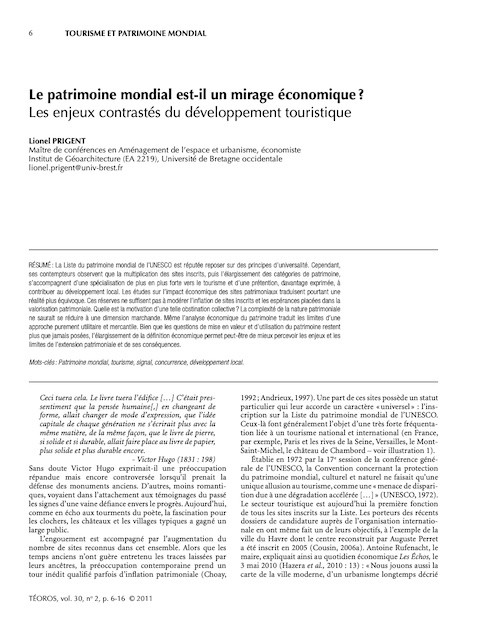 Is World Heritage an Economic Mirage? (Téoros; vol. 30, no. 2) Year of publication: 2011 Author: Lionel Prigent Corporate author: Université du Québec à Montréal (UQAM) The UNESCO World Heritage List is deemed to be based on principles of universality. However, its critics observe that the multiplication of listed sites, then the widening of heritage categories, is accompanied by an increasingly strong specialization towards tourism and a claim, more expressed, to contribute to local development. . Studies on the economic impact of heritage sites, however, reflect a more equivocal reality. These reserves are not enough to moderate the inflation of listed sites and the hopes placed in heritage enhancement. What is the motivation for such collective obstinacy? The complexity of the nature of heritage cannot be reduced to a commercial dimension. Even the economic analysis of heritage reflects the limits of a purely utilitarian and mercantile approach. Although the questions of enhancement and use of heritage remain more than ever raised, the broadening of the economic definition perhaps makes it possible to better understand the issues and the limits of the extension of heritage and its consequences.
  Global Citizenship Education, Year 2019-2020 Year of publication: 2020 Corporate author: CRÉDIL Joliette As part of our 2019-2020 Annual General Meeting, our colleague, Laura Vergara has created this video to keep you informed of the highlights of this year's Global Citizenship Education component! Discussion on living together, intercultural dialogue, recognition and respect for cultural diversity, migration issues in Quebec and around the world, climate change and social justice and gender equality.
 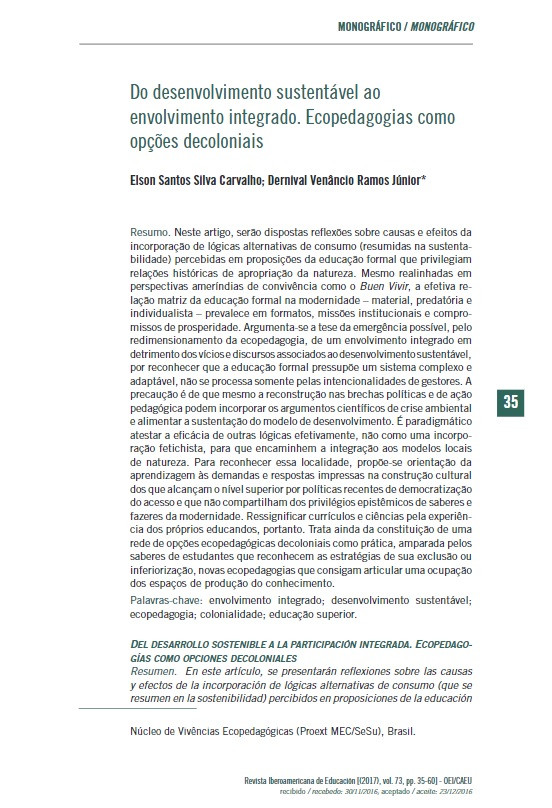 From Sustainable Development to Integrated Participation: Ecopedagogies as Decolonial Options (Revista Iberoamericana De Educación; vol.73) Year of publication: 2017 Author: Elson Santos SilvaCarvalho | Dernival Venâncio Ramos Junior In this article, reflections will be presented on the causes and effects of the incorporation of alternative logics of consumption (which are summarized in sustainability) perceived in propositions of formal education that emphasize the historical relationships of appropriation of nature. Even realigned with an Amerindian perspective of coexistence such as Good Living, the matrix relationship of formal education in modern times - material, predatory and individualistic - prevails in formats, institutional missions and prosperity commitments. The thesis of the possible emergence, through the new dimensions of ecopedagogy, of an integrated participation at the expense of vices and discourses related to sustainable development is sustained, recognizing that formal education requires a complex and adaptive system, not only the intentions of managers for your process.
 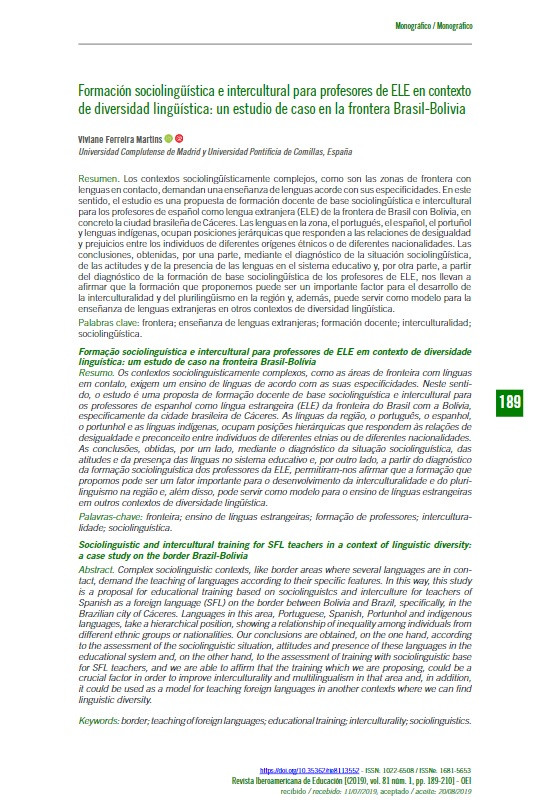 Sociolinguistic and Intercultural Training for SFL Teachers in the Context of Linguistic Diversity: A Case Study on the Brazil-Bolivia Border(Revista Iberoamericana De Educación; vol.81, no.1) Year of publication: 2019 Author: Vivianne Ferreira Martins Sociolinguistically complex contexts, such as border areas with languages in contact, demand language teaching in accordance with their specificities. In this sense, the study is a sociolinguistic and intercultural teacher training proposal for teachers of Spanish as a foreign language (SFL) from the Brazilian-Bolivian border, specifically the Brazilian city of Cáceres. The languages in the area, Portuguese, Spanish, Portuñol and indigenous languages, occupy hierarchical positions that respond to relations of inequality and prejudice between individuals of different ethnic origins or different nationalities. The proposed training can be an important factor for the development of interculturality and multilingualism in the region and, in addition, can serve as a model for the teaching of foreign languages in other contexts of linguistic diversity.
 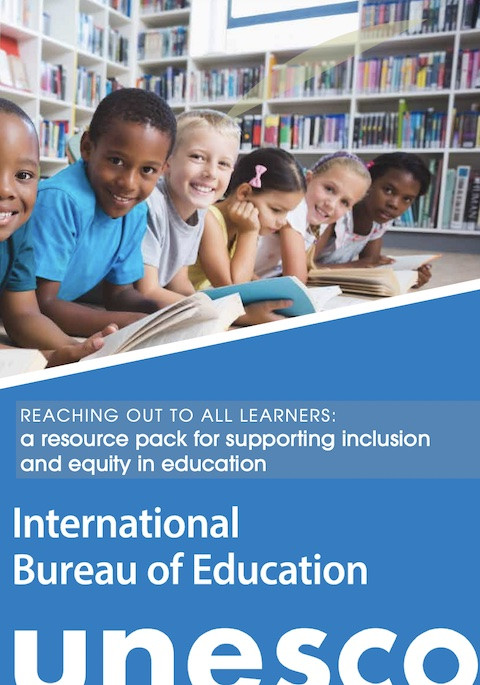 Reaching Out to All Learners: A Resource Pack for Supporting Inclusion and Equity in Education Year of publication: 2021 Corporate author: UNESCO International Bureau of Education (IBE) The Reaching Out to All Learners resource materials tackle the practicalities of addressing these challenges in schools and other education centres, including early years and further education provision. More specifically, the materials focus on three strategic questions:How can schools be developed in order to respond positively to student diversity?How can classroom practices be developed that will ensure that lessons are inclusive?How can practitioners engage families, partner schools and the wider community in their efforts to become inclusive and equitable?