
Recursos
Exploren una amplia gama de recursos valiosos en GCED para profundizar su comprensión y promover su búsqueda, incidencia, enseñanza y aprendizaje.
8,354 resultados encontrados
 Museo del Holocausto Buenos Aires The Museo del Holocausto in Buenos Aires contains numerous resources for Holocaust Education. As a support, teachers have dowloadable lessons, FAQ Column, literature reviews, timeline and a few Spanish language testimonies. La ensenenza del Holocausto : Shoa como acontecimiento clave del siglo XX : Aportes para una agenda educativa en tiempo presente This report reviews important historical facts, but it is mainly a combination of several research papers on Holocaust and resilience and the issue of transmission.
  Educación 2030: Declaración de Incheon y Marco de Acción para la realización del Objetivo de Desarrollo Sostenible 4: Garantizar une aducación inclusiva y equitativa de calidad y promover oportunidades de aprendizaje permanente para todos Año de publicación: 2016 Autor corporativo: Organización de las Naciones Unidas para la Educación, la Ciencia y la Cultura (UNESCO) The Incheon Declaration articulates the collective vision and commitment of the international community on global education. The 2030 Framework for Action provides guidance for the implementation of Sustainable Development Goal 4.
  Ensinando sobre o Holocausto na Escola : Informações e Propostas para Professores dos Ensinos Fundamental e Médio This textbook aims at helping teachers of primary and secondary education to address the Holocaust theme in their classes. This book contains suggested activities, lists of books and films references to help pupils to make connections between the Holocaust and others genocides but also to develop critical thinking and respect for human rights. Quelques constats à propos de la transmission scolaire de la Shoah en Suisse This study is based on interviews conducted among teachers from the French-speaking cantons of Switzerland to determine how the history and memory of the Shoah are transmitted in the schools: it is at the intersection of the teaching of history and of social perception. The interviews reveal the high standards the teachers set for themselves. Consequently, they are caught between their own perception of the uniqueness of the Shoah and their concern that its exceptional nature might not be shared by their students. Thus, the combination of the exceptional nature of the subject and the teachers’ concern becomes a veritable pedagogical leitmotif that translates both the strength of their conviction and their difficulty in expressing it through effective teaching strategies. It is one of the factors that lead certain teachers to compare the Shoah with other genocides. And yet, when these teachers broach the subject of genocide in a comparative way, the uniqueness of the Shoah stands out, in their eyes, and is reinforced by the strong identification that a majority of them feel with the victims. (By the author)
 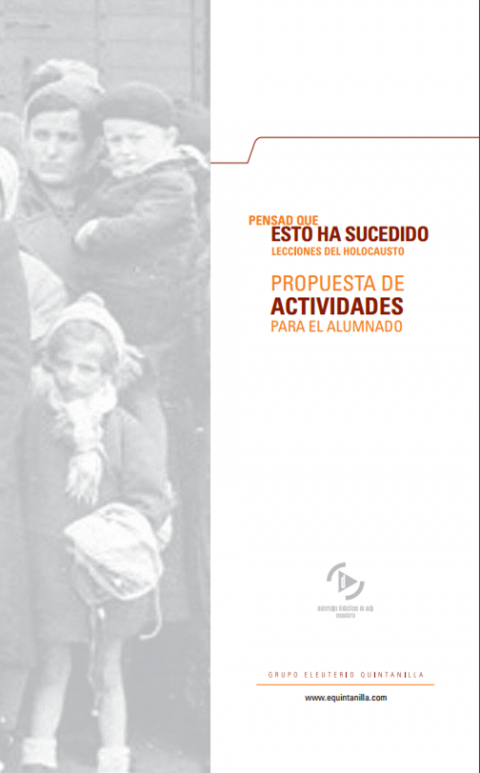 Pensad que esto ha sucedido : lecciones del Holocausto : Propuesta de actividades para el alumnado Año de publicación: 2007 Autor corporativo: Grupo Eleuterio Quintanilla This resource guide published by the Spanish anti-racist association "Grupo Eleuterio quintanilla" was developed for teachers to broach the Holocaust by examining the historical process and its circumstances through legal and historiographical documents.
 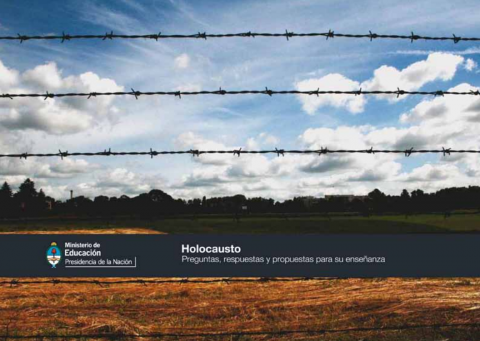 Holocausto : Preguntas, respuestas y propuestas para su ensenanza Año de publicación: 2010 Autor corporativo: Argentina. Ministerio de Educacion This publication, released by the "Education and Memory" department of the Ministry of National Education of Argentina, is a handout to think about, debate and discuss some of the issues relevant to teaching about the Holocaust. Vivir con la controversia: Cómo enseñar temas controvertidos mediante la Educación para la ciudadanía y los derechos humanos (EDC/HRE) Módulo de formación para el profesorado Año de publicación: 2015 Autor corporativo: European Union (EU) Learning how to engage in dialogue with people whose values are different from one’s own and to respect them is central to the democratic process and essential for the protection and strengthening of democracy and fostering a culture of human rights. ■ Yet in Europe young people do not often have an opportunity to discuss controversial issues in school because they are seen as too challenging to teach, e.g., issues to do with extremism, gender violence, child abuse, or sexual orientation. Unable to voice their concerns, unaware of how others feel or left to rely on friends and social media for their information, young people can be frustrated or confused about some of the major issues which affect their communities and European society today. In the absence of help from school, they might have no reliable means of dealing with these issues constructively and no one to guide them. ■ The idea for this Pack came out of a call from policy-makers and practitioners in a number of European countries for more effective training for teachers in the teaching of controversial issues.
  Educación para la Ciudadanía Mundial: Preparar a los Educandos para los Retos del Siglo XXI Año de publicación: 2014 Autor corporativo: Organización de las Naciones Unidas para la Educación, la Ciencia y la Cultura (UNESCO) Esta publicación explora una serie de condiciones favorables para la promoción y la puesta en práctica de la ECM. Entre estos se incluyen: la existencia de un entorno abierto para los valores universales, la aplicación de pedagogía transformativa y el apoyo a las iniciativas dirigidas por los jóvenes. El estudio reconoce que hay una serie de tensiones vigentes para con los conceptos de ciudadanía mundial y educación para la ciudadanía mundial. Si bien estas tensiones varían, todas ellas apuntan a la cuestión fundamental de cómo promover la universalidad (p. ej. la identidad, el interés, la participación, el deber comunes y colectivos), respetando al mismo tiempo la singularidad (es decir, los derechos individuales, la superación personal). Se proponen algunas maneras de avanzar para resolver estas tensiones, a la vez que se mantiene que las dificultades que plantean los elementos teóricos de la ECM no deben socavar su práctica. ¿Color?¿Qué color? Informe sobre la lucha contra el racismo y la discriminación en el fútbol Año de publicación: 2015 Autor: Albrecht Sonntag | David Ranc Football has been shown to be a mirror of society, it may also be viewed as providing a temporary suspension of reality for an interlude of high emotion and idealized hopes and dreams. Football’s public transcends differences of age, gender, culture, religion, and socioeconomic status to unite in support of their team. The broad diversity of backgrounds of football players represents tangible evidence of equal opportunity and meritocracy. The sport itself has team solidarity, fair play and mutual respect among members and for opponents ingrained within its rules and practices. Yet, the ‘beautiful game’ is one with an imbedded paradox. Football is also a game that may in many vaguely resemble war, where opponents face each other in a struggle to win over the other side, with the noisy and emphatic support of the spectators. An ‘us’ and ‘them’ mentality is an integral part of trying to help a team reach the objective, which is to win the game. This setting naturally produces a desire by supporters to intimidate the other side by encouraging their team and expressing both confidence and superiority through their words and actions. When the ‘us’ and ‘them’ mentality turns into symbolic exclusion of others, language of disparagement and insult based on racism or discrimination, or physical confrontation, the ‘beautiful game’ is debased. The existence of racism and discrimination in football is not a secret, but it is a shame on the game. Although much is already being done, both observers and experts feel too many problems persist and measures to tackle them have not been effective enough. This report was commissioned by UNESCO within the framework of UNESCO’s partnership with Juventus. It focuses on discrimination and racism in professional football and to some extent the amateur clubs that funnel into the leagues. It provides an overview of the historic and theoretical background. It reports on the state of affairs on the ground. It summarizes what has been done and is being done to mitigate racism and discrimination in domestic and international football, how the effects of these actions may be evaluated, and which new avenues for further, complementary action are promising. The report is based on a literature review, desk research, regional reports from the Unesco network and a field survey among a purposive sample of experts and actors in a number of countries. The report has a somewhat European focus, in its sources and examples. Europe has a unique position Executive Summary in the world of football, with its leading competitions, championships and clubs. It is the region where racism and discrimination in football has been most intensively researched. A number of civil society organisations from Europe have played a pioneering role in the fight against racism and discrimination in football. Moreover, the pressure that comes with the money invested in and generated by western European football, as well as its exposure in the media, has also made clubs, federations and UEFA particularly sensitive to the negative impact that discrimination can have on the game and its image, within Europe and worldwide. Europe must therefore occupy a central role in a study of the fight against discrimination in professional football and in determined policies to mitigate racism and discrimination related to football wherever they occur. The examples of incidents of discrimination and racism, as well as of existing measures to combat them have been selected to be as wide-ranging as possible. The authors do not, however, claim the report to be a comprehensive listing. Similarly, the examples of best practice have been collected through extensive reading and contacts, but must be looked at as an overview rather than as a directory. They are chosen by the authors to illustrate types of actions and institutions with the potential for greatest impact. The report also does not deal with the methods of allocation of resources to football, with issues of employment, or with womens’ football. While these are significant topics on which concerns can be expressed, the necessary focus of a report of this type means that they are alluded to without being treated in depth.