
Recursos
Exploren una amplia gama de recursos valiosos en GCED para profundizar su comprensión y promover su búsqueda, incidencia, enseñanza y aprendizaje.
8,354 resultados encontrados
 ¿Por qué y cómo Africa debería invertir en las lenguas africanas y la educación plurilingüe? Opúsculo de apoyo activo a una política basada en la práctica y en pruebas Año de publicación: 2010 Autor: Adama Ouane | Christine Glanz Autor corporativo: UNESCO Institute for Lifelong Learning (UIL) | Association for the Development of Education in Africa (ADEA) This advocacy brief seeks to show the pivotal role of languages in achieving such learning. It aims in particular to dispel prejudice and confusion about African languages, and exposes the often hidden attempt to discredit them as being an obstacle to learning. It draws on research and practice to argue what kind of language policy in education would be most appropriate for Africa.
 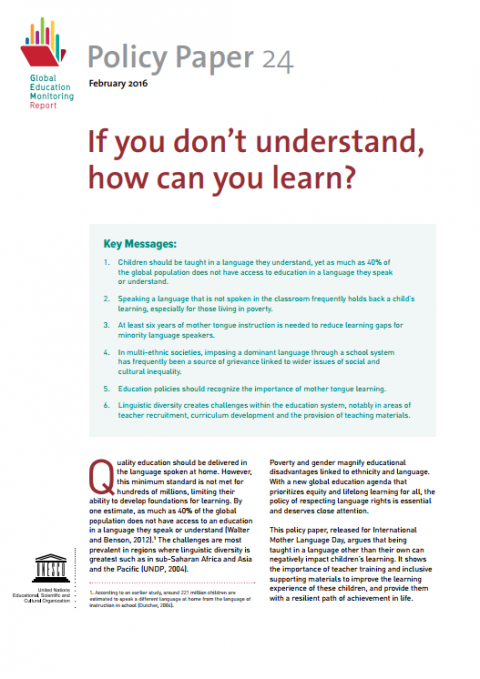 Si no entiendes, ¿cómo puedes aprender? Año de publicación: 2016 Autor corporativo: Organización de las Naciones Unidas para la Educación, la Ciencia y la Cultura (UNESCO) Key Messages:1. Children should be taught in a language they understand, yet as much as 40% of the global population does not have access to education in a language they speak or understand.2. Speaking a language that is not spoken in the classroom frequently holds back a child’s learning, especially for those living in poverty.3. At least six years of mother tongue instruction is needed to reduce learning gaps for minority language speakers.4. In multi-ethnic societies, imposing a dominant language through a school system has frequently been a source of grievance linked to wider issues of social and cultural inequality.5. Education policies should recognize the importance of mother tongue learning. 6. Linguistic diversity creates challenges within the education system, notably in areas of teacher recruitment, curriculum development and the provision of teaching materials.
 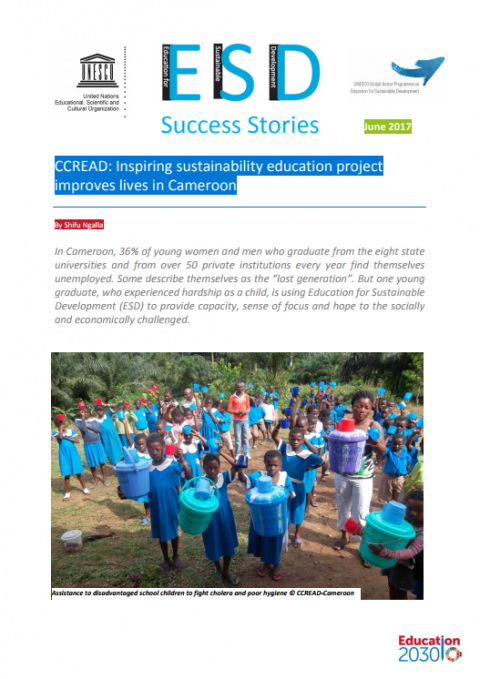 CCREAD: un estimulante proyecto sobre educación para la sostenibilidad mejora la vida en el Camerún Año de publicación: 2017 Autor: Shifu Ngalla Autor corporativo: Organización de las Naciones Unidas para la Educación, la Ciencia y la Cultura (UNESCO) In Cameroon, 36% of young women and men who graduate from the eight state universities and from over 50 private institutions every year find themselves unemployed. Some describe themselves as the “lost generation”. But one young graduate, who experienced hardship as a child, is using Education for Sustainable Development (ESD) to provide capacity, sense of focus and hope to the socially and economically challenged.
 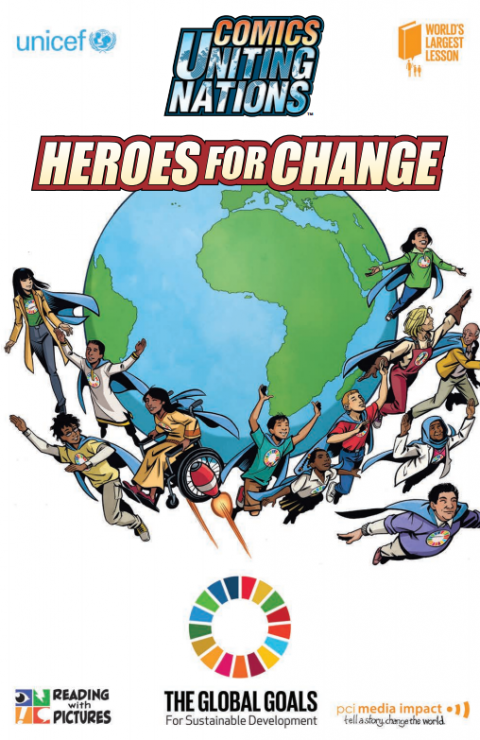 héroes para el cambio Año de publicación: 2015 Autor: Josh Elder | Natabara Rollosson | Sean Southey | Grace Allison | Karl Kesel | Grace Allison Autor corporativo: Project Everyone | PCI Media Impact | Reading With Pictures Heroes for Change has been created for the World's Largest Lesson Initiative to share information on the global goals.
  El camino hacia los Objetivos de Desarrollo Sostenible Año de publicación: 2015 Autor corporativo: United Nations Children's Fund (UNICEF) Animated video to help children learn about important concepts for people and planet as covered in the Sustainable Development Goals (SDGs)
  Integración del ODS 4-Educación 2030 en la formulación de políticas y planeamiento para todo el sector: directrices técnicas para las oficinas de la UNESCO fuera de la Sede Año de publicación: 2016 Autor corporativo: Organización de las Naciones Unidas para la Educación, la Ciencia y la Cultura (UNESCO) Mainstreaming SDG4-Education 2030 in sector-wide policy and planning offers technical guidelines for UNESCO field offices to ensure adequate technical support to national authorities. The guidelines take into account the different profiles of countries’ need and capacities, thus avoiding a one-size-fits-all approach. The document contains resources and pointers that can be combined and tailored to fit the particular context of each country. In all cases, UNESCO is expected to ensure that all the relevant information about SDG4-Education 2030 is properly disseminated in these guidelines. Field staff will adapt the guidelines provided here to the country they are serving to ensure that UNESCO plays its role as the leading United Nations agency in the field.
 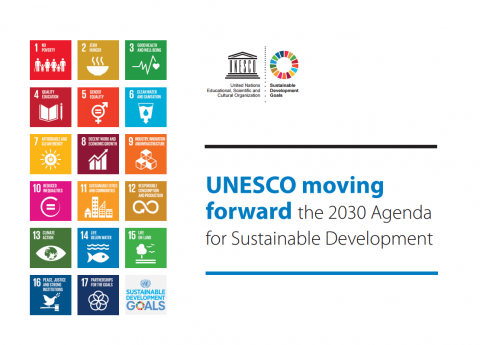 La UNESCO avanza la Agenda 2030 para el Desarrollo Sostenible Año de publicación: 2017 Autor corporativo: Organización de las Naciones Unidas para la Educación, la Ciencia y la Cultura (UNESCO) The United Nations 2030 Agenda for Sustainable Development, with its 17 Sustainable Development Goals, sets forth a bold new framework for development cooperation over the next 15 years. This agenda aspires to ensure prosperity and well-being for all women and men, while protecting our planet and strengthening the foundations for peace.
 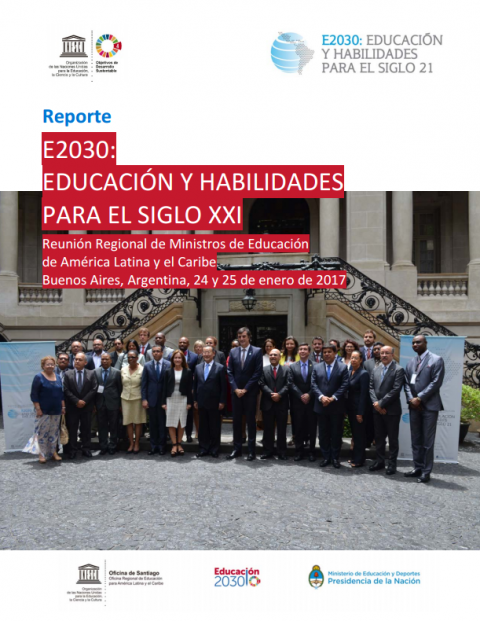 Reporte: Educación y habilidades para el siglo XXI; Reunión Regional de Ministros de Educación de América Latina y el Caribe, Buenos Aires, Argentina, 24 y 25 de enero 2017 Año de publicación: 2017 Autor corporativo: UNESCO Santiago This report provides a systematization of the discussions at the Regional Meeting of Ministers of Education of Latin America and the Caribbean “E2030: Education and skills for the 21st century” held 24‐25 January 2017 in Buenos Aires, Argentina. The objectives of the meeting were to: • adopt a Ministerial Declaration on a joint approach to achieve the SDG4-E2030 Agenda in the region, including means of implementation, technical instruments of support and follow-up mechanisms. • agree on a roadmap for the implementation of E2030, including a contextualized followup mechanism that responds to the region’s educational challenges and expectations.
 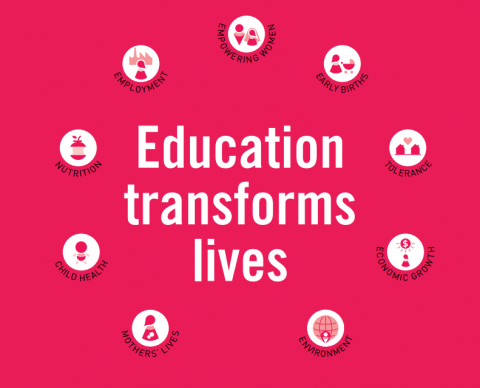 La Educación transforma la vida Año de publicación: 2013 Autor corporativo: Organización de las Naciones Unidas para la Educación, la Ciencia y la Cultura (UNESCO) Education lights every stage of the journey to a better life, especially for the poor and the most vulnerable. Education’s unique power to act as a catalyst for wider development goals can only be fully realized, however, if it is equitable. That means making special efforts to ensure that all children and young people – regardless of their family income, where they live, their gender, their ethnicity, whether they are disabled – can benefit equally from its transformative power. Education empowers girls and young women, in particular, by increasing their chances of getting jobs, staying healthy and participating fully in society – and it boosts their children’s chances of leading healthy lives. To unlock the wider benefits of education, all children need the chance to complete not only primary school but also lower secondary school. And access to schooling is not enough on its own: education needs to be of good quality so that children actually learn. Given education’s transformative power, it needs to be a central part of any post-2015 global development framework.
  Aprender a vivir juntos: Un programa intercultural e interreligioso para la educación ética: Resumen Año de publicación: 2015 Autor corporativo: United Nations Children's Fund (UNICEF) | Interfaith Council on Ethics Education for Children | Arigatou Foundation What is the Learning to Live Together? How was it developed? Where and how can it be used? In the Executive Summary you can find answers to all these questions, as well as information about outstanding projects that show the potential of the programme.