
Recursos
Exploren una amplia gama de recursos valiosos en GCED para profundizar su comprensión y promover su búsqueda, incidencia, enseñanza y aprendizaje.
8,354 resultados encontrados
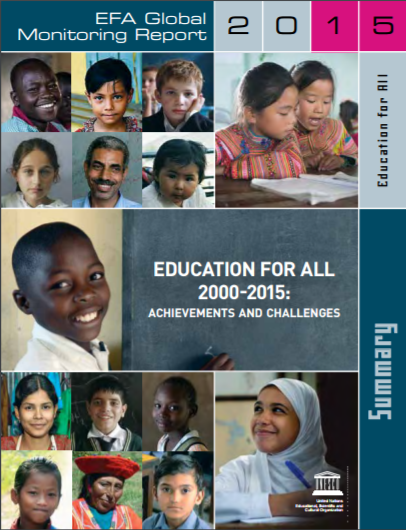 Other lang. title: L'Education pour tous 2000-2015: progrès et enjeux, rapport mondial de suivi sur l'EPT, 2015, résumé; La Educación para Todos, 2000-2015: logros y desafíos, informe de seguimiento de la EPT en el mundo, 2015, resumen Año de publicación: 2015 Autor corporativo: Organización de las Naciones Unidas para la Educación, la Ciencia y la Cultura (UNESCO) At the World Education Forum in Dakar, Senegal, in 2000, governments from 164 countries, together with representatives of regional groups, international organizations, donor agencies, non-government organizations (NGOs) and civil society, adopted a Framework for Action to deliver Education for All (EFA) commitments. The Dakar Framework comprised 6 goals and their associated targets to be achieved by 2015, and 12 strategies to which all stakeholders would contribute. The EFA Global Monitoring Report (GMR) has monitored progress on an almost annual basis towards the EFA goals and the two education-related Millennium Development Goals (MDGs). The 2015 GMR provides a complete assessment of progress since 2000 towards the target date for reaching the Dakar Framework’s goals. It takes stock of whether the world achieved the EFA goals and stakeholders upheld their commitments. It explains possible determinants of the pace of progress. Finally, it identifies key lessons for shaping the post-2015 global education agenda.
 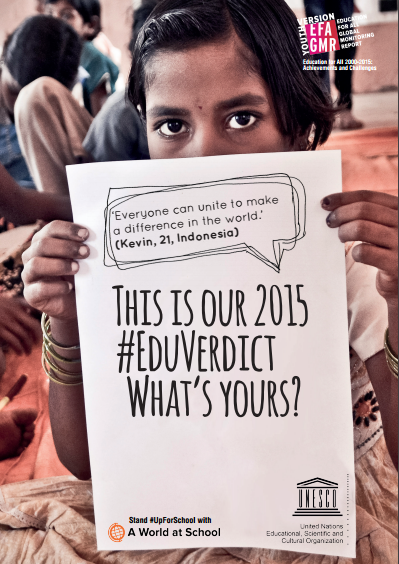 La Educación para Todos, 2000-2015: logros y desafíos, informe de seguimiento de la EPT en el mundo, 2015: youth version Año de publicación: 2015 Autor corporativo: Organización de las Naciones Unidas para la Educación, la Ciencia y la Cultura (UNESCO) This report highlights the progress and challenges that countries have faced over 15 years, brining together the voices of young people to show how Education for All (EFA) has affected their lives.
  Conferencia Mundial de la UNESCO sobre la Educación para el Desarrollo Sostenible: Informe de la Conferencia elaborado por la Relatora General Año de publicación: 2015 Autor: Heila Lotz-Sisitka Bajo el título de “Aprender hoy para un futuro sostenible”, la Conferencia Mundial sobre la Educación para el Desarrollo Sostenible, celebrada en Aichi-Nagoya del 10 al 12 de noviembre de 2014, señaló y celebró el final del Decenio de las Naciones Unidas de la Educación para el Desarrollo Sostenible (DEDS, 2005-2014). Asimismo, en la conferencia se puso en marcha el Programa de acción mundial de Educación para el Desarrollo Sostenible y se adoptó la Declaración de Aichi-Nagoya. El DEDS nació de un acuerdo suscrito por los Estados Miembros en 2002 en la Cumbre Mundial sobre Desarrollo Sostenible encaminado a fortalecer la función que desempeña la educación en el logro del desarrollo sostenible. En 2002, mediante la aprobación de la resolución 57/254, la Asamblea General de las Naciones Unidas proclamó el DEDS, que se extendería de 2005 a 2014, y designó a la UNESCO organismo rector del Decenio. La Conferencia Mundial sobre la Educación para el Desarrollo Sostenible, organizada por la UNESCO y el Gobierno del Japón al final del DEDS, brindó una importante oportunidad para consolidar los resultados del DEDS y marcar el camino a seguir en materia de Educación para el Desarrollo Sostenible (EDS) en el plano mundial.
  Informe de seguimiento de la educatión en el mundo: documento de política Año de publicación: 2016 Autor corporativo: Organización de las Naciones Unidas para la Educación, la Ciencia y la Cultura (UNESCO) This paper’s focus on textbooks is directly related to the global indicator established for Target 4.7, which seeks to measure the extent to which global citizenship education and education for sustainable development, including gender equality and human rights, are mainstreamed in national education policies, curricula, teacher education and student assessments. Textbooks are related mostly to policy implementation and curricular intentions but also to teacher preparation and student assessment.
 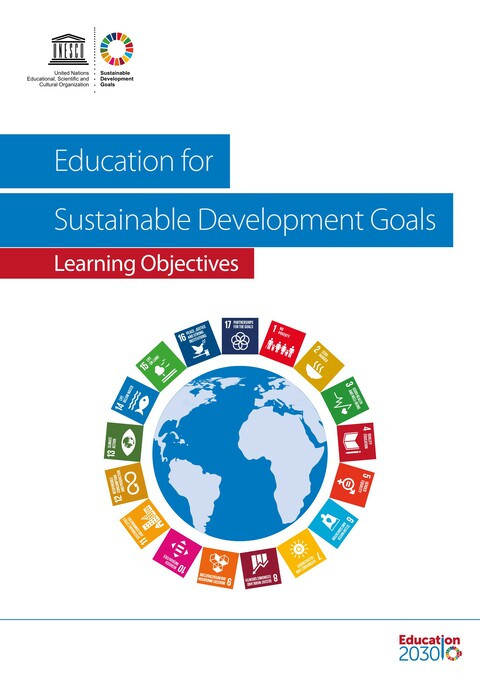 Educación para los Objetivos de Desarrollo Sostenible: Objetivos de aprendizaje Año de publicación: 2017 Autor corporativo: Organización de las Naciones Unidas para la Educación, la Ciencia y la Cultura (UNESCO) Desde 1992, la UNESCO ha promovido la Educación para el Desarrollo Sostenible (EDS). Entre 2005 y 2014, coordinó el Decenio de las Naciones Unidas de la EDS, y ahora está llevando a cabo el programa de seguimiento, el Programa de Acción Mundial sobre la EDS. El impulso de la EDS nunca ha sido más fuerte. Temas mundiales –como el cambio climático- requieren de forma urgente un cambio en nuestros estilos de vida y una transformación en nuestra forma de actuar y pensar. Para lograrlo, necesitamos nuevas competencias, actitudes y conductas que nos conduzcan a sociedades más sostenibles. Los sistemas educativos tienen que responder a esta necesidad a la hora de definir los objetivos y contenidos de aprendizaje pertinentes, introduciendo pedagogías que empoderen a los alumnos e instando a las instituciones a incluir los principios de sostenibilidad en sus estructuras de gestión. La nueva agenda mundial para el desarrollo sostenible 2030 refleja claramente esta visión de la importancia de una respuesta educativa apropiada. La educación está explícitamente formulada como un objetivo independiente en el Objetivo de Desarrollo Sostenible número 4. Metas e indicadores relacionados con la educación también están incluidos en otros ODS. La educación de calidad es tanto una meta en sí misma como un medio para lograr todos los otros ODS, porque es parte integral del desarrollo sostenible y un facilitador clave del mismo. Es por ello que la educación representa una estrategia esencial en la consecución de los ODS. Este documento ha sido diseñado para guiar a los profesionales de la educación en el uso de la EDS en el aprendizaje para los ODS y, en consecuencia, para lograr los ODS. Esta guía identifica objetivos específicos de aprendizaje y sugiere temas y actividades para cada ODS. También presenta métodos de implementación a distintos niveles, desde el diseño de cursos hasta las estrategias nacionales. Este documento no busca de ninguna forma ser prescriptivo, sino servir como una guía y ofrecer sugerencias que los educadores puedan seleccionar y adaptar a contextos específicos de aprendizaje.
 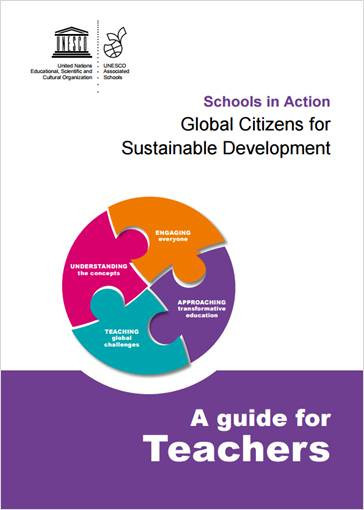 Escuelas en acción, ciudadanos del mundo para el desarrollo sostenible: guía para el profesorado Año de publicación: 2016 Autor corporativo: Organización de las Naciones Unidas para la Educación, la Ciencia y la Cultura (UNESCO) The Global Citizens for Sustainable Development Teachers’ guide aims to introduce teachers to Global Citizenship Education (GCED) and Education for Sustainable Development (ESD). It provides secondary school teachers with ideas and activities to help students become global citizens and sustainable development actors. The Teachers’ guide draws on the discussions and activities of almost 1,100 participants from 104 countries, including ASPnet National Coordinators, school principals, teachers, students and experts who contributed to the Online Collaborative Platform ASPnet in Action: Global Citizens Connected for Sustainable Development in 2014 and 2015 [http://en.unesco. org/aspnet/globalcitizens] with associated activities and initiatives. The Teachers’ guide provides: An overview of what it means for learners to become global citizens and of how learners can contribute to sustainable development. Ideas for classroom activities that can help secondary school students to develop knowledge, skills, values, attitudes and behaviours that promote GCED and ESD. Selected activities on GCED and ESD from ASPnet schools around the world.
  Una reflexión sobre la importancia de la enseñanza de la shoá en Argentina This paper intends to share some dilemmas encountered when drafting a bill for the incorporation of the Holocaust - Shoah in the content of school curricula in the province of Buenos Aires. (By the author) Memoria, trasmissione e verità storica How can we explain the contradiction between, on the one hand, the decline of teaching in contemporary history, which necessarily brings about the decline of the "Shoah" historical event itself, and, on the other hand, the ever growing attention on the memory of the genocide of the Jews? In the past year alone, ten " memory trains" left Italy with more than fifteen thousand students to visit Poland - thereby making our country the third country in the world in terms of the number of visitors to Holocaust sites. Under the banner of the "duty of memory" and an approach to the Shoah, with more and more devotion to human rights and moral education, most teachers prefer to focus on the visit to the places of the massacre and on the testimonies of survivors, rather than on a historical and political reconstruction of the context and the facts. Precisely because the narrator-victims are survivors of the camps, they are the mediators between the darkness of the obscene world they were compelled to see, and the world of the listeners: they are the human faces of a universe of nameless victims, and their stories are the key for us to question our sense of responsibility. However, with no solid historical teaching, their narration elicits only an emotive participation; it provides the impression that we have fulfilled a moral duty, but it remains, in actual fact, incomprehensible. (By the author) Entre generaciones. La experiencia de la transmisión en el relato testimonial. Profesorado. Revista de currículum y formación del profesorado The purpose of this paper is to rethink the relationship between experience and education, when what we face, as readers, learners and educators, is an altogether inconceivable experience: the account of the surviving witness of the concentration camps, a literary genre that is the end of the Bildungsroman or coming-of-age novel. Some questions guide this effort: Is there any way to read and give our young people, within the discourse of the learning society, where the crisis of transmissions is more than evident, some texts suggesting a discontinuous type of transmission? What kind of experience is the experience of reading this literature? What learning experience and transmission does it contain, if any? (By the author) Las actividades nazis en la Argentina: reflexiones en torno a un texto de estudio para EGB 3 y Polimodal This article approaches the question of teaching history through students´ books or school manuals. Recognizing the importance of the role of history as a builder of collective memory, the study analyses specifically the proposal of a manual (designed by the authors of this article) created for teachers and students about the Holocaust problematic and its treatment in Argentinean classrooms. Based on the material elaborated by CEANA (Comisión para el Esclarecimiento de las Actividades Nazis en la Argentina / Commission for the clarification of the Nazi activities in Argentina,) the Manual gives a new meaning to the Shoah´s history and memory and offers a new proposal of transference of this knowledge in the classroom to make it possible to teach a living and critical history that is in a permanent relationship with the present. (By the author)