
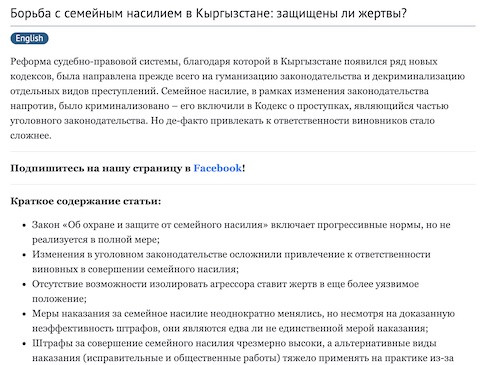
Curbing Domestic Violence in Kyrgyzstan: Are Victims Protected?
- Auteur
- Anna Zubenko
- Auteur institutionnel
- Central Asian Bureau for Analytical Reporting (CABAR)Institute for War and Peace Reporting (IWPR)
- Collation
- html
- Langue de la ressource
- AnglaisRusse
- Année de publication
- 2020
- Thème
- Civisme / Citoyenneté / DémocratieDroits de l'hommePrévention de l'extrémisme violent et du génocide
- Type de ressource
- Research papers / journal articles
- Niveau d’éducation
- Enseignement supérieurApprentissage tout au long de la vieEnseignement et formation techniques et professionnelsÉducation non formelleAutres
- Lieu de publication
- Bishkek
In this article, the author analyzes some of the results of the reforms of the judicial and legal system, thanks to which a number of new codes appeared in Kyrgyzstan, was aimed primarily at the humanization of legislation and decriminalization of certain types of crimes. On the contrary, domestic violence was criminalized as part of the legislative amendments - it was included in the Misdemeanor Code, which is part of the criminal law. However, according to the author, it has become more difficult to prosecute the perpetrators de facto.
Ressources associées
-
 Study on the Historical Impact of the 1974 Recommendation concerning Education for International Understanding, Cooperation and Peace and Education relating to Human Rights and Fundamental Freedoms
 -
 IIEP-UNESCO 12th Medium-Term Strategy: 2026–2029
 -
 More than Welcome: Intercultural Integration of Migrants in and Through Higher Education
 -
 Advancing Intergenerational Learning: Identifying Challenges and Opportunities for Older Adults; Integrated Case Study Report