
Ressources
Explorez une large gamme de ressources sur le GCED afin d’approfondir votre compréhension et de renforcer vos activités de recherche, de plaidoyer, d’enseignement et d’apprentissage.
948 résultats trouvés
 개도국 교육지표 개발·협력 사업(V): 신남·북방국가를 중심으로 Année de publication: 2020 Auteur: 김창환 | 이기준 | 박근영 | 박성호 | 임후남 | 한효정 | 김나영 | 서예원 | 허주 | 이한승 | 오요섭 | 손지혜 | 노상태 | 김효정 Auteur institutionnel: 한국교육개발원 본 연구사업은 정부가 추진 중인 신남ㆍ북방 정책과 밀접한 관련을 맺고 있다. 그동안 한국의 발전은 선진국과 교역하면서 부를 창출하는 방식으로 이루어졌다. 그러나 선진국 시장의 성장이 한계에 도달하면서 새로운 시장 개척이 필요한 상황을 맞고 있다. 더욱이 미ㆍ중 무역전쟁 여파로 탈중국이 현실화 되면서 글로벌 밸류체인이 변하고 있다. 이러한 상황에서 대체시장으로 신남ㆍ북방 국가의 중요성이 부각되고 있는 상황이다. 즉, 미래 한국의 지속가능한 성장을 위해서는 신남ㆍ북방 국가와의 협력이 매우 중요한 것이다.본 연구사업은 정부의 정책에 적극 부응하기 위해 2주기에서 신남ㆍ북방 국가를 중점 협력 국가로 선정하고 사업을 추진하고 있다. 2주기 연구사업이 추진되는 과정 속에서, 연구사업이 종료되었을 때 신남ㆍ북방 국가와의 협력이 더욱 증가하게 될 것으로 전망되고, 이를 통해 국익에도 기여할 것으로 기대되고 있다.본 저작물은 한국교육개발원에서 2020년 작성하여 공공누리 제4유형으로 개방한 ‘개도국 교육지표 개발·협력 사업(V): 신남·북방국가를 중심으로(김창환)’ 를 이용하였으며 해당 저작물은 한국교육개발원 홈페이지(www.kedi.re.kr)에서 무료로 다운받으실 수 있습니다.
  지속가능개발목표(SDGs) 달성을 위한 교육개발협력 연구(Ⅵ): 지속가능발전교육과 세계시민교육을 통한 SDGs 범분야 실천 전략 Année de publication: 2022 Auteur: 윤종혁 | 김소아 | 김현진 | 서예원 | 안해정 | 김신애 | 박환보 | 유성상 Auteur institutionnel: 한국교육개발원 한국교육개발원은 개발도상국의 SDGs 달성을 지원하기 위한 교육개발협력의 실천전략 을 모색하고자 2017년부터 총 6개년 동안 「지속가능개발목표(SDGs) 달성을 위한 교육개발협력연구」를 수행하였습니다. 올해 연구는 최종 마무리하는 연구로서 SDG 4.7에서 강조하고 있는 세계시민교육과 지속가능발전교육을 포함한 환경교육, 평화・비폭력, 국제이해, 문화적 다양성 존중, 젠더 평등, 난민 및 이주민 등 소수집단 인권, 민주주의 등을 촉진시키기 위한 교육개발협력 전략을 마련하였습니다. 본 저작물은 한국교육개발원에서 2022년 작성하여 공공누리 제4유형으로 개방한 ‘지속가능개발목표(SDGs) 달성을 위한 교육개발협력 연구(Ⅵ)(윤종혁 외)’를 이용하였으며 해당 저작물은 한국교육개발원 홈페이지 (www.kedi.re.kr)에서 무료로 다운받으실 수 있습니다.
  Suwon-Osan CONFINTEA VI Mid-Term Review Statement: The Power of Adult Learning and Education; A Vision Towards 2030 Année de publication: 2018 Auteur institutionnel: UNESCO Institute for Lifelong Learning (UIL) The Sixth International Conference on Adult Education (CONFINTEA VI), held in Brazil in December 2009, closed with the adoption of the Belém Framework for Action, which recorded the commitments of Member States and presented a strategic guide for the global development of adult learning and education from a lifelong learning perspective. The third Global Report on Adult Learning and Education (GRALE III), published in 2016, drew on survey data to evaluate progress made by countries in fulfilling the commitments made in Brazil, while also highlighting some of the contributions adult learning and education can make to the 2030 Agenda for Sustainable Development. The CONFINTEA VI Mid-Term Review, held in Suwon, Republic of Korea, in October 2017, took stock of progress made by Member States in the past eight years, looking ahead to GRALE IV in 2019. This statement represents the overall perspective of delegates and their recommendations for the future. Bilan à mi-parcours de la CONFINTEA VI : Déclaration de Suwon-Osan - Le pouvoir de l'apprentissage et de l'éducation des adultes: Vision 2030 Année de publication: 2018 Auteur institutionnel: UNESCO Institute for Lifelong Learning (UIL) La sixième Conférence internationale sur l'éducation des adultes (CONFINTEA VI) qui a eu lieu en décembre 2009 au Brésil, s’est achevée sur l’adoption du Cadre d'action de Belém qui a permis de rassembler les engagements des États membres et de présenter un guide stratégique pour le développement mondial de l’apprentissage et de l’éducation des adultes du point de vue de l’apprentissage tout au long de la vie. Le troisième Rapport mondial sur l'apprentissage et l'éducation des adultes (GRALE III), publié en 2016, s’est appuyé sur les données d'une enquête afin d’évaluer les progrès accomplis par les pays pour tenir leurs engagements pris au Brésil, tout en soulignant certaines des contributions que l’apprentissage et l’éducation des adultes peuvent apporter au Programme de développement durable à l'horizon 2030. Le Bilan à mi-parcours de la CONFINTEA VI qui s’est tenu en octobre 2017 à Suwon en République de Corée a fait l'inventaire des progrès réalisés par les États membres au cours des huit dernières années en vue du GRALE IV de 2019. La présente déclaration exprime les perspectives des délégués au niveau mondial et fait état de leurs recommandations pour l’avenir. Declaración de Suwon-Osan sobre la Revisión a Medio Término de la CONFINTEA VI: el poder del aprendizaje y la educación de adultos: una visión hacia el 2030 Année de publication: 2018 Auteur institutionnel: UNESCO Institute for Lifelong Learning (UIL) La VI Conferencia Internacional de Educación de Adultos (CONFINTEA VI), celebrada en Belém (Brasil), en diciembre de 2009, se clausuró con la aprobación del Marco de acción de Belém que registró los compromisos de los Estados Miembros y presentó una guía estratégica para el desarrollo mundial del aprendizaje y la educación de adultos desde una perspectiva de aprendizaje a lo largo de toda la vida. El tercer Informe mundial sobre el aprendizaje y la educación de adultos (GRALE III), publicado en 2016, se basó en los datos de una encuesta destinada a evaluar el progreso realizado por los países en el cumplimiento de los compromisos formulados en Brasil, al mismo tiempo que hacía hincapié en algunas de las contribuciones que puede hacer el aprendizaje y la educación de adultos a la Agenda 2030 para el Desarrollo Sostenible. La Revisión a Medio Término de la CONFINTEA VI, realizada en Suwon (República de Corea) en octubre de 2017, hizo un balance del progreso realizado por los Estados Miembros en los últimos ocho años, mirando en la perspectiva del GRALE IV para 2019. Este pronunciamiento representa el punto de vista global de los delegados y sus recomendaciones para el futuro. 유네스코 제6차 세계성인교육회의 중간회의 수원-오산 선언문: 성인학습 교육(ALE)의 힘; 2030년을 향한 비전 Année de publication: 2018 Auteur institutionnel: UNESCO Institute for Lifelong Learning (UIL) 2009년 12월 브라질 벨렘에서 개최된 제6차 세계성인교육회의(CONFINTEA VI)에서 벨렘 실행계획(Belém Framework for Action)이 채택되었다. 벨렘 실행계획은 회원국의 성인학습과 교육에 대한 공약을 기록하고, 평생학습 관점에서 성인학습과 교육의 세계적 발전을 위한 전략적 지침을 제시하였다. 2016년 발간된 유네스코의 제3차 성인학습과 교육(ALE)에 관한 글로벌 보고서(GRALE III)에서는 설문조사를 통해 수집된 데이터를 기반으로 2009년 제6차 회의 당시 회원국이 제시한 공약의 이행 현황을 평가하는 한편, 2030 지속가능발전의제(2030 Agenda for Sustainable Development) 이행에 있어 성인학습과 교육이 기여할 수 있는 부분을 강조하였다. 2017년 10월 대한민국 수원시에서 개최된 제6차 세계성인교육회의 중간회의(CONFINTEA VI Mid-Term Review)에서 회원국들은 지난 8년 동안 이행된 활동 현황을 검토하고, 2019년 발간 예정인 제4차 성인학습과 교육(ALE)에 관한 글로벌 보고서(GRALE IV)를 준비하였다. 이 선언문은 성인학습과 교육에 대한 각국 대표의 전반적 관점과 그들이 제시하는 미래에 대한 권고안이다.
 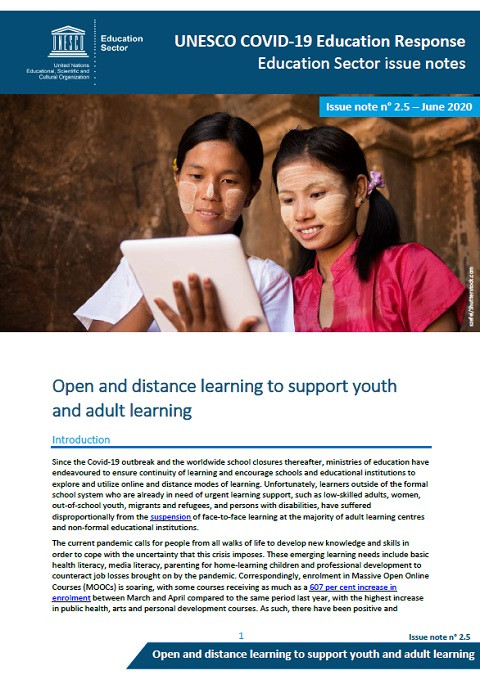 UNESCO COVID-19 Education Response: Open and Distance Learning to Support Youth and Adult Learning (Education Sector Issue Note; No. 2.5 – June 2020) Année de publication: 2020 Auteur institutionnel: UNESCO Institute for Lifelong Learning (UIL) A new UNESCO issue note, produced by the UNESCO Institute for Lifelong Learning (UIL), aims to support education policy-makers and planners in ensuring open and distance learning to support youth and adult learning in the context of the current pandemic, now and in its aftermath.Since the COVID-19 outbreak and the worldwide school closures that followed, ministries of education have endeavoured to ensure continuity of learning and encourage schools and educational institutions to explore and utilize online and distance modes of learning. Unfortunately, learners outside of the formal school system who are already in need of urgent learning support, such as low-skilled adults, women, out-of-school youth, migrants and refugees, and persons with disabilities, have suffered disproportionally from the suspension of face-to-face learning at the majority of adult learning centres and non-formal educational institutions.The current pandemic calls for people from people from all socio-economic backgrounds, wherever they live in the world, to develop new knowledge and skills in order to cope with the uncertainty that this crisis imposes. These learning needs include basic health literacy, media literacy, parenting for home-schooling children and professional development to counteract job losses brought on by the pandemic. Correspondingly, enrolment in massive open online courses (MOOCs) is soaring. As such, there have been positive and demand-driven trends in exploring alternative options, such as open and distance learning (ODL), to ensure the continuity and expansion of non-formal education and adult learning.This issue note takes stock of opportunities and challenges in using ODL, both online and offline as defined in the UNESCO Issue Note on Distance Learning Strategies, for youth and adult learners outside the formal education system. After examining key issues and illustrating promising cases from public and private sectors, it provides key messages for policy interventions to support inclusive lifelong learning for youth and adults during and after the current pandemic.UNESCO Education Sector’s issue notes cover key topics related to the COVID-19 education response.
  Towards CONFINTEA VII: adult learning and education and the 2030 Agenda Année de publication: 2019 Auteur institutionnel: UNESCO Institute for Lifelong Learning (UIL) The CONFINTEA VI Mid-Term Review (MTR) Conference took place in Suwon and Osan, Republic of Korea, in October 2017. Stakeholders from 95 UNESCO Member States assessed progress in implementing the Belém Framework for Action (BFA) and discussed the next steps. The BFA, which was adopted by delegates at the Sixth International Conference on Adult Education (CONFINTEA VI) in Belém, Brazil, in December 2009, records the commitments of Member States and presents a strategic guide for the future development of adult learning and education (ALE) within the perspective of lifelong learning. This publication constitutes the third outcome document of the conference. It provides an overview of the main thematic debates. The chapters follow the conference themes and aim to illustrate or underpin the main arguments and way forward set out in the Suwon-Osan Statement.
  유네스코 1974 국제이해교육 권고 개정안 검토 포럼 자료집 Année de publication: 2022 Auteur institutionnel: 한국국제이해교육학회 | 유네스코 아시아태평양 국제이해교육원 | 유네스코한국위원회 2022년 10월 5일 유네스코 아태교육원과 유네스코한국위원회, 한국국제이해교육학회가 공동으로 개최한 <유네스코 1974 국제이해교육 권고 개정안 검토 포럼> 자료집 입니다. 본 포럼은 유네스코의 「국제이해, 협력, 평화를 위한 교육과 인권, 기본 자유에 관한 교육 권고( 1974 국제이해교육 권고)」가 오늘날 변화된 시대 상황과 지구촌의 새로운 과제 등을 반영할 수 있도록 개정안 초안에 대한 전문적 검토 요지 발표와 토론을 실시한 후, 참가자들의 의견을 수렴하였습니다. <목차> I. 인사말 한경구 (유네스코한국위원회 사무총장) 임현묵 (유네스코 아시아태평양 국제이해교육원장) 박순용 (한국국제이해교육학회장) II. [1부] 1974 국제이해교육 권고 개정 배경 및 현황 1974 국제이해교육 권고 개요와 개정 추진 현황 - 유네스코 아시아태평양 국제이해교육원 / 유네스코한국위원회 국제전문가그룹의 주요 활동 및 1974 국제이해교육 권고 개정안 초안의 주요 내용 / 강순원 (한신대학교 교수) III. [2부] 1974 국제이해교육 권고 개정안 초안 검토 조대훈 (성신여자대학교 교수) 김병연 (양재고등학교 교사) 권혁장 (국가인권위원회 인권교육기획과장) 이선경 (청주교육대학교 교수) 변순용 (서울교육대학교 교수) 이동연 (한국예술종합학교 교수) 손동빈/장경희 (서울시교육청 민주시민생활교육과 과장/장학사) 부록 Recommendation concerning Education for International Understanding, Co-operation and Peace and Education relating to Human Rights and Fundamental Freedoms 국제이해, 협력, 평화를 위한 교육과 인권, 기본 자유에 관한 교육 권고 REVISED RECOMMENDATION CONCERNING EDUCATION FOR INTERNATIONAL UNDERSTANDING, CO-OPERATION AND PEACE AND EDUCATION RELATING TO HUMAN RIGHTS AND FUNDAMENTAL FREEDOMS (‘1974 RECOMMENDATION’)
 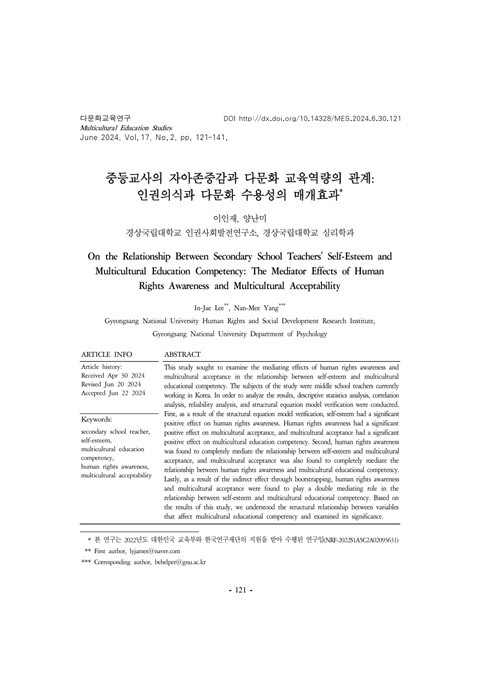 중등교사의 자아존중감과 다문화 교육역량의 관계: 인권의식과 다문화 수용성의 매개효과 (다문화교육연구; Vol. 17, No. 2) Année de publication: 2024 Auteur: 이인재 | 양난미 Auteur institutionnel: 한국다문화교육학회 본 연구는 자아존중감과 다문화 교육역량의 관계에서 인권의식과 다문화 수용성의 매개 효과를 살펴보고자 하였다. 연구대상은 국내 재직 중인 중등교사를 대상으로 하였다. 결과 분석을 위해 기술 통계 분석, 상관 분석, 신뢰도 분석, 구조 방정식 모형검증을 실시하였다. 연구결과는 첫째, 구조방정식 모형 검증 결과, 자아존중감은 인권의식에 유의한 정적인 영향을 미쳤다 인권의식은 다문화 수용성에 유의한 정적인 영향을 미쳤고 다문화 수용성은 다문화 교육역량에 유의한 정적 영향을 미쳤다. 둘째, 인권의식은 자아존중감과 다문화 수용성의 관계에서 완전매개하는 것으로 나타났고 다문화 수용성 또한 인권의식과 다문화 교육역량의 관계를 완전매개하는 것으로 나타났다. 마지막으로, 부트스트랩을 통해 간접효과를 본 결과 인권의식과 다문화 수용성은 자아존중감과 다문화 교육역량의 관계에서 이중매개를 하는 것으로 나타났다. 본 연구의 결과를 바탕으로 다문화 교육역량에 영향을 미치는 변인들의 구조적 관계를 이해하고 의의를 살펴보았다.