
Resources
Explore a wide range of valuable resources on GCED to deepen your understanding and enhance your research, advocacy, teaching, and learning.
8,364 Results found
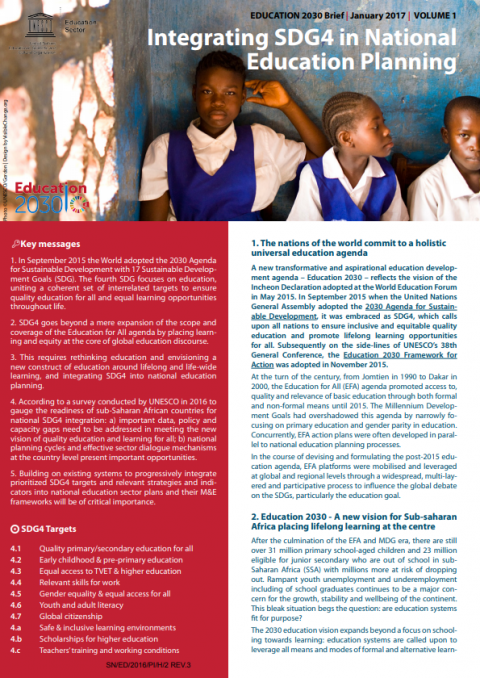 Online programme and meeting document Integrating SDG4 in National Education Planning Year of publication: 2016 Author: Neyestani-Hailu, Lily Corporate author: UNESCO Dakar Key messages1. In September 2015 the World adopted the 2030 Agenda for Sustainable Development with 17 Sustainable Develop-ment Goals (SDG). The fourth SDG focuses on education, uniting a coherent set of interrelated targets to ensure quality education for all and equal learning opportunities throughout life. 2. SDG4 goes beyond a mere expansion of the scope and coverage of the Education for All agenda by placing learn-ing and equity at the core of global education discourse. 3. This requires rethinking education and envisioning a new construct of education around lifelong and life-wide learning, and integrating SDG4 into national education planning. 4. According to a survey conducted by UNESCO in 2016 to gauge the readiness of sub-Saharan African countries for national SDG4 integration: a) important data, policy and capacity gaps need to be addressed in meeting the new vision of quality education and learning for all; b) national planning cycles and effective sector dialogue mechanisms at the country level present important opportunities. 5. Building on existing systems to progressively integrate prioritized SDG4 targets and relevant strategies and indi-cators into national education sector plans and their M&E frameworks will be of critical importance.
  Improving early-grade performance for 2030: measurement and estimation options for innovative policy dialogue Year of publication: 2019 Author: Helen Abadzi Corporate author: UNESCO International Bureau of Education (IBE) Governments and donors are faced with the challenge of attaining the 2030 Sustainable Development Goals (SDGs). One of the challenges for education is to measure and set benchmarks that indicate whether people have developed sufficient core literacy and numeracy skills to function in the complex literate environments of the 21st century. Benchmark setting has proved difficult in education because stakeholders find it hard to define which variables really matter and how they can be measured. Measurement of skills particularly in grades 1‐3 is highly relevant for policy dialogue, because this is when many students fall behind. Donors use existing national, regional, and international assessments, for which longitudinal data are available. However, assessments require reading fluency and do not focus on the lowest literacy and numeracy levels, so they may overestimate or underestimate learners’ skills in grades 1‐3. Governments need specific feedback as soon as possible of likely student performance by 2030 so that they can take measures to improve performance by then. This monograph aims to publicize options for measuring early literacy and numeracy skills, using neuroscientific insights. These may help develop interventions that could accelerate early learning, facilitate monitoring and promote policy interventions to accelerate the achievement of the SDG 4.1 goals in various countries by 2030. The research evidence presented indicates that: Performance benchmarks can be set using reading and math fluency research;The performance of lower grades worldwide could be monitored through brief tests, measuring concepts that have high predictive validity, derived from cognitive science;If these test results were linked to international and national assessments, statistical models could be developing to estimate roughly how populations of various countries are likely to score in 2030;Clear feedback, along with recommendations for appropriate interventions, would allow countries and donors to engage in targeted policy dialogue to close the gap;Improved performance in grade 1 would improve performance in subsequent grades;With sufficient emphasis, funding, and space logistics, illiteracy among low‐income students could be eliminated in about 7 years and near‐universal and sustainable literacy could be attained by 2030.
  Asia and the Pacific SDG Progress Report 2019 Year of publication: 2019 Author: Arman Bidarbakht Nia | Eric Hermouet | Dayyan Shayani | Phuong Tran Corporate author: United Nations (UN) This report analyses Sustainable Development Goals (SDGs) trends as well as data availability for monitoring progress in Asia and the Pacific and its five subregions. It assesses progress towards the SDGs and the gaps which must be closed for these to be achieved by 2030. This assessment is designed to ensure the region’s actions remain on target, shortcomings are addressed as they arise, and all interested parties remain engaged. It is an invaluable resource for all stakeholders involved in prioritisation, planning, implementation and follow-up of the 2030 Agenda for Sustainable Development in Asia and the Pacific.
 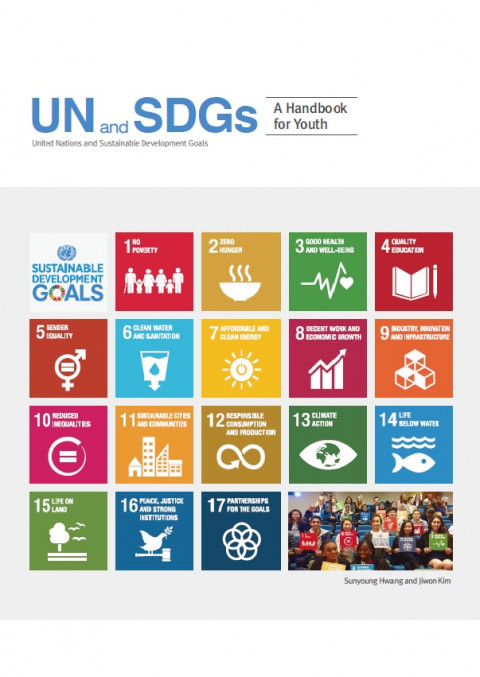 UN and SDGs: A Handbook for Youth Year of publication: 2017 Author: Sunyoung Hwang | Jiwon Kim Corporate author: UN. Economic and Social Commission for Asia and the Pacific (UN. ESCAP) | Asian Development Bank (ADB) | United Nations Development Programme (UNDP) "UN and SDGs: A Handbook for Youth" is an outcome of ESCAP East and North-East Asia’s internship program that brings young people closer to the work of the United Nations, as well as to the achievement of the ambitious set of Sustainable Development Goals (SDGs). As young leaders of tomorrow, it is pivotal that youth are informed and engaged with the global vision for the future. Over the next fifteen years, youth will not only directly experience the outcome of SDGs and plans, but will also be the key driver for their successful implementation. For this reason, it is vital to raise awareness about the recently adopted 17 SDGs and the 2030 Agenda for Sustainable Development among youth, build a platform for discussion, and create the conditions for active engagement. This Handbook explores SDGs and the 2030 Agenda from a youth perspective. In the first chapter, it introduces the concept of sustainable development and outlines its historical development through the transition from Millennium Development Goals (MDGs) to SDGs. The second chapter discusses how youth can be harnessed as a major agent of change in achieving sustainable development, focusing on several pertinent youth issues in Asia and the Pacific. The final chapter introduces the UN system and its regional arm, ESCAP, explaining their role in the successful implementation of SDGs.
 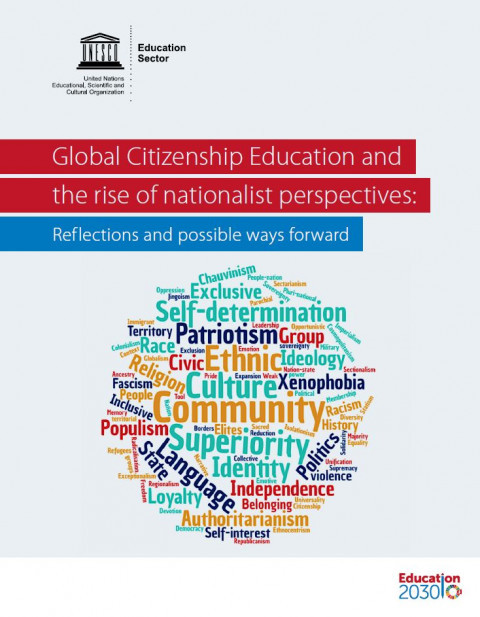 Global Citizenship Education and the Rise of Nationalist Perspectives: Reflections and Possible Ways Forward Year of publication: 2018 Corporate author: UNESCO | APCEIU Over the past few years, many have observed a rise in nationalist perspectives across the world. These trends raise questions about the role of education and, in particular, one of UNESCO’s key areas of work in the field of education, namely Global Citizenship Education (GCED), which seeks to equip learners with the skills, values and attitudes needed to contribute to the development of peaceful and just societies. This paper seeks to clarify the evidence of the rise of nationalist perspectives and its causes, and to lay out how GCED is challenged by this phenomenon. It recommends ways forward for education stakeholders in promoting GCED, in order to strengthen ‘learning to live together’ by embedding GCED meaningfully in local and country contexts.
  Toward one world or many? A comparative analysis of OECD and UNESCO global education policy documents Year of publication: 2019 Author: Vaccari, Victoria | Gardinier, Meg P. Education policymaking has gone global. The 2030 Agenda for Sustainable Development aims to galvanize efforts to promote sustainable development, decrease global inequalities, and realize universal quality education. Supporting these efforts, two leading international organizations, UNESCO and the OECD, have set out normative frameworks for their vision of global education. This paper examines the policy discourses of these organizations in light of SDG 4–Education. Specifically, through a comparative analysis of selected terms and underlying concepts in key policy documents, the paper distinguishes between UNESCO's notion of global citizenship and the OECD's framework for global competence. Ultimately, the authors discuss whether the organizations' agendas are aimed at a common global vision, or, alternatively, towards two distinct and divergent conceptualizations of an imagined future.
  The Mandate of UNESCO for Peace in the era of 「The Rise of Exclusionism」 Year of publication: 2019 Author: 한경구 | 유성상 | 성지은 | 조동준 | 강인욱 | 김성해 | 루츠 묄러 | 최동주 Corporate author: 대한민국 외교부 | Korean National Commission for UNESCO Multilateralism has gradually been losing ground in the international community recently, owing to rapid changes in ideology, exemplified by the America First policy, Brexit, and the rise of many right wing parties. The growth of such ideologies in the hearts and minds of people, implies that diplomacy, a form of high politics between government bureaucrats, is no longer sufficient to guard the current order.To respond to this challenge, the United Nations, the greatest symbol of postwar multilateralism, has set the reaffirmation of the UN‟s values worldwide as one of its priorities for 2019. UNESCO has a leading role to play in leading this effort, as the UN specialist organization mandated to build the defenses of peace in the minds of men and women through intellectual cooperation in the field of education, science, and culture. The aim of this session is to discuss various ways in which UNESCO can help to heal the divisions in people‟s thinking and contribute to peace-building in the current global context.
 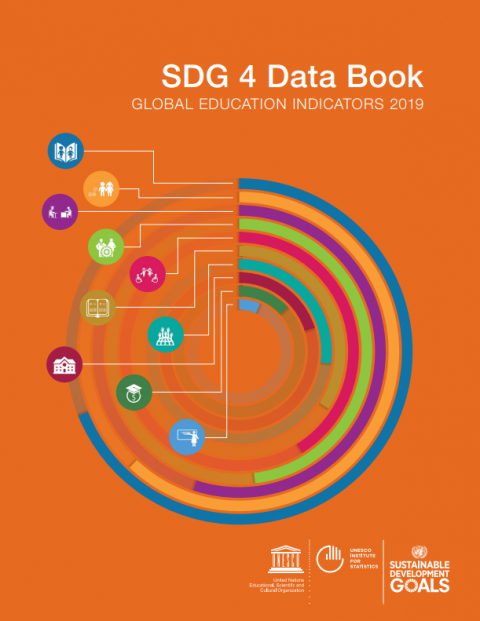 SDG 4 Data Book 2019 Year of publication: 2019 Corporate author: UNESCO Institute for Statistics (UIS) This publication presents the global monitoring indicators used by countries and the international development community to monitor progress towards Sustainable Development Goal 4 (SDG 4) on education. The indicators were produced by the UNESCO Institute for Statistics (UIS), based on the latest available data.The UIS is the official source of internationally-comparable education data and the custodian agency for SDG 4 data. This mandate reflects the trust of the international community in UIS data and its proven track record in methodological work and standard-setting with national statistical offices, line ministries and technical partners in every region.
 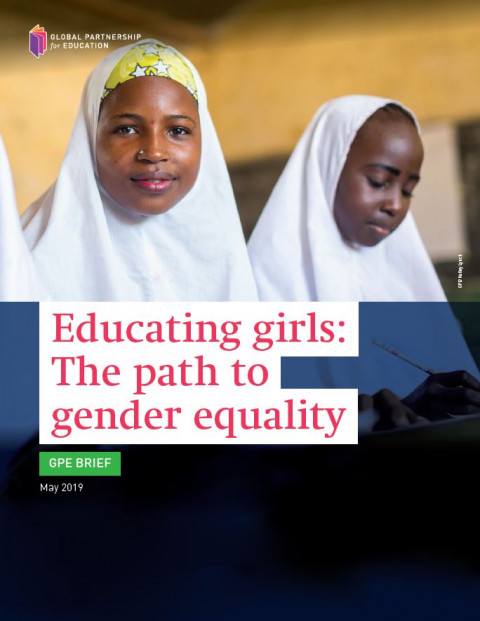 Educating Girls: The Path to Gender Equality; GPE Brief Year of publication: 2019 Corporate author: GPE Despite significant gains in recent years, education outcomes for girls in developing countries continue to lag behind those of boys. Adolescence is a particularly critical stage for girls, marked by rapid biological and psychological changes as well as powerful social expectations of how their lives should unfold. For many girls in developing countries, adolescence also marks a time of extreme vulnerability: to child marriage, teenage pregnancy, sexual violence, nutritional deficiency and exposure to HIV/AIDS. It also marks a time when pressures of social norms and cultural practices place new restrictions on what girls can do and who they can be. Lack of access to education increases vulnerability to these risks and constraints. Conversely, being in education acts as a powerful protective factor as well as a route to empowerment for girls to determine their own destiny. Achieving gender equality means delivering on three interlinked areas for girls: health, education and safety. GPE uses its results-based partnership model to work with developing countries to prioritize planning and spending on girls’ education throughout the education cycle, to achieve gender equality. Ensuring girls and boys have equal access to inclusive, quality education is a core principle of GPE’s strategic plan, GPE 2020, and GPE’s Gender Equality Policy and Strategy 2016-2020. At the advocacy level and in conjunction with its partners, GPE is also promoting working across sectors to meet the holistic needs of girls, from a gender equality perspective.
  Results Report 2019 Year of publication: 2019 Corporate author: GPE The Global Partnership for Education (GPE) is a multi-stakeholder partnership and fund dedicated to improving education in the world’s poorest countries, and those with the most children out of school. Founded in 2002, the partnership is designed to harness the power of collaboration among developing countries, donor countries, civil society, foundations, the private sector and youth (represented through civil society organizations) to support inclusive and quality education for all.The partnership is now implementing GPE 2020, its strategic plan for the 2016-2020 period that outlines an ambitious course of action to achieve three strategic goals:Strategic Goal 1: Improved and more equitable student learning outcomes through quality teaching and learningStrategic Goal 2: Increased equity, gender equality and inclusion for all in a full cycle of quality education, targeting the poorest and most marginalized, including by gender, disability, ethnicity and conflict or fragilityStrategic Goal 3: Effective and efficient education systems delivering equitable, quality educational services for allThese efforts are aligned with and support Sustainable Development Goal 4, the world’s commitment to inclusive and equitable quality education for all.