
Resources
Explore a wide range of valuable resources on GCED to deepen your understanding and enhance your research, advocacy, teaching, and learning.
8,364 Results found
 Mecca Document Year of publication: 2019 Author: Muslim World League The Mecca document is a document issued by the leading Islamic scholars of the Muslim Ummah. It was issued in Mecca, which is considered the capital of the Islamic Ummah. It was signed in the vicinity of the Sacred House in Mecca. The document establishes the values of coexistence and peace between the components of human society, resulting in a sustainable and problem-free world. The document affirms that Muslims are part of the larger world in its cultural interaction and Muslims seek to connect with its various components in order. According to the Document, this connection with others will lead to achieving the benefit of humanity and promote its noble values, build bridges of love and human harmony. It will also help in addressing the practices of injustice, clash of civilizations and causes of hatred. This document contains 29 principles of peace, the rejection of hatred and international understanding.
  Achieving gender equality in and through education Year of publication: 2019 Corporate author: GPE The purpose of this paper is to describe the current landscape in gender equality in education and spark discussion and debate around potential areas for Knowledge and Innovation Exchange (KIX) investment. The paper is part of a series of discussion papers, drafted to support the engagement and consultation of developing country partners and technical experts in the initial design of the GPE Knowledge and Innovation Exchange.
  Quick guide to education indicators for SDG 4 Year of publication: 2018 Corporate author: UNESCO Institute for Statistics (UIS) This guide serves as a quick reference on how to monitor progress towards Sustainable Development Goal 4 (SDG 4) on quality education. It provides basic explanations of SDG 4 targets, their indicators, how they are created and where to find the information needed for these indicators.
  The Effect of a Training Program on Developing the Global Citizenship Principles of the History Teachers in Jordan Year of publication: 2013 Author: Zaid Suleiman M. Al-Edwan | Fadyieh Mohmoud A. Bani Mustafa Corporate author: Deanship of Scientific Research, University of Jordan This study aimed at building a training program for the history teachers in the light of the global citizenship principles and testing its effect on their knowledge level of those principles in Jordan. Study sample consisted of (26) male and female teachers randomly selected from the history teachers for the high Basic stage in the Education Directorate in Ma'daba Governorate. To achieve the study goals, a training program was build in the light of the global citizenship principles, which are: the global peace, democracy, human rights, human and the environment, scientific thinking, technology, and multi-cultures.and a cognitive test of the global citizenship's principles was prepared. After performing the relevant statistical analysis the results revealed that the pre-knowledge level of the history teachers for the basic stage of the global citizenship principles was lower than the educational accepted level (80%), and the presence of differences with statistical significance (α=0.01) between the post-knowledge level of the history teachers at the higher basic stage about the global citizenship principles and the educational accepted level (80%), in favor of the training program in each domain of the global citizenship's principles and for the domains collectively. The study recommended the inclusion of the global citizenship principles and concepts in the teachers training programs to increase their awareness in the global issues.
 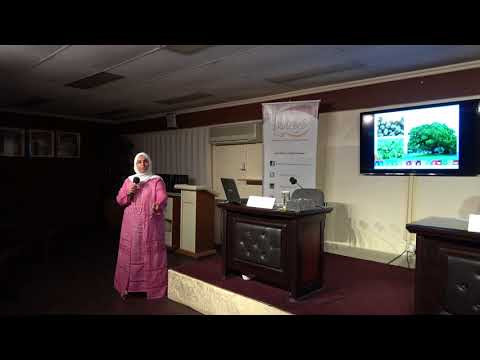 [Video] Contextualizing Sustainable Development Goals Year of publication: 2018 Corporate author: Akanoo cc The Video is about a lecture talking about how contextualizing Sustainable Development Goals in Bahrain. To make the context, the lecturer started by describing how the Un reached to articulate the SDGs after the last MDGs. Then, the 17 goals were presented in details. In terms of localizing these SDGs, the lecturer gave some strategies on how individuals, companies and the government can implement these SDGs in their context. It is recommended that all members of the Bahraini society should participate in achieving the SDGs to reach to sustainable development. The lecturer also draw attention to some challenges facing Bahrain to achieve SDGs. To overcome these challenges, the lecturer suggested a number of activities to raise awareness among Bahraini people about the importance of participating in achieving SDGs. Finally, how Bahrain can contextualize SDGs is presented.
 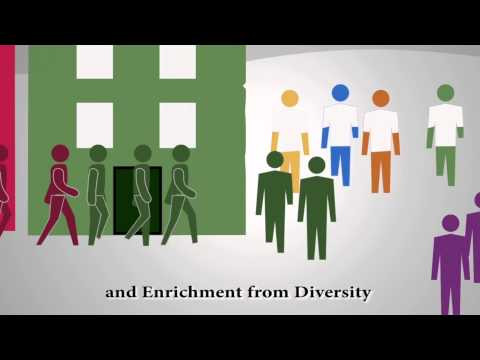 [Video] Education for citizenship and cultural diversity Year of publication: 2014 Corporate author: Adyan Foundation The video talks about citizenship and its foundations. It narrates at the introduction that citizenship is based on the respect of common human values and serving of common goods. The video also talks about the issue and challenge of marginalization of certain groups and religions in societies. How such issue is also leading to the collapse of citizenship is presented. It is argued that all citizens in a society have to participate in public life activities in which everyone respect each other. The society should benefit from diversity not get harmed by it. As a solution, it is mentioned that dialogue and interaction between citizens enriches individuals lives and their groups. At the end, it highly emphasized that citizenship is the way to prosperity and sustainable development. Includes English Subtitles
  Sexual and Gender-based Violence Prevention and Response In Refugee Situations in the Middle East and North Africa Year of publication: 2015 Corporate author: UN. Office of the United Nations High Commissioner for Refugees (UNHCR) The Middle East and North Africa (MENA) region is facing humanitarian crises and forced displacement on an unprecedented scale. These conflicts and the resulting displacement disproportionately burden women and children, who now comprise 78 per cent of Syrian refugees. Sexual and gender-based violence (SGBV) is becoming increasingly widespread in these conflict-affected countries, and is often one of the causes of flight. In support for multi-sectorial and coordinated SGBV prevention and response, this report outlines strategies, in line with international standards, that UNHCR uses in coordination with national authorities, non-governmental organizations (NGOs), and other partners across the region, to bring tangible results in preventing and responding to SGBV in refugee situations, as well as in the inter-agency response in situations of internal displacement.
  Achieving SDG4 for Children and Youth Affected by Crisis Year of publication: 2019 Corporate author: Inter-agency Network for Education in Emergencies (INEE) With the Sustainable Development Goal 4 (SDG4), the global community committed to ensuring a quality education for all children and youth. Despite this promise, children and youth in crisis contexts continue to be neglected. We will never achieve SDG4 unless all children and youth affected by conflict and crisis are able to access and attend school and learn in a quality, safe, relevant and inclusive education environment. There is an urgent need for governments and the international community to make and adhere to political, financial and legal commitments if we truly are to leave no child behind. This brief offers recommendations for addressing the disparities in safe, quality, inclusive education for children affected by crisis. It begins by highlighting key areas for policy and practice, and looks at ways to use the various tools developed by the Inter-agency Network of Education in Emergencies (INEE). It takes a look at overall themes and trends, as well as the specific issues of gender disparities, the importance of supporting teachers, children’s psycho-social wellbeing and the protection and safety of education in conflict.
  Enforcing the right to education of refugees: a policy perspective Year of publication: 2019 Corporate author: UNESCO This paper, aimed at education policymakers, provides analysis and insights on how the right to education for refugees could be ensured from a policy perspective. It does so by reviewing the current status of access to education of refugees, using the scant data that is available in this area. It also outlines some of the extensive barriers to education that refugees face, with recognition of the multifaceted, interlinked and complex nature of exclusion. It provides an overview of the international normative frameworks and global agendas on education that can be applied to refugees to ensure their right to education and achieve SDG 4. Additionally, this document presents practical examples, good practices, and promising measures taken by countries in order to ensure the inclusion of refugees in their national systems and better guarantee the fulfilment of their right to education. As a result of this research, collaboration and the invaluable contributions from the participants in a dedicated Expert Meeting in Barcelona (2018), a set of policy recommendations are provided in the last chapter which aims to guide policymakers to ensure equal access to good quality education for refugees.
 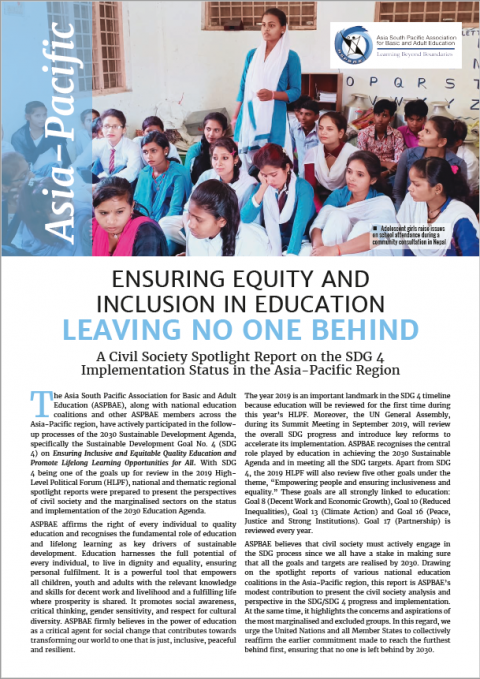 Asia-Pacific Spotlight Report on SDG 4 Year of publication: 2019 Corporate author: Asia South Pacific Association for Basic and Adult Education (ASPBAE) ASPBAE believes that civil society must actively engage in the SDG process since we all have a stake in making sure that all the goals and targets are realised by 2030. Drawing on the spotlight reports of various national education coalitions in the Asia-Pacific region, this report is ASPBAE’s modest contribution to present the civil society analysis and perspective in the SDG/SDG 4 progress and implementation. At the same time, it highlights the concerns and aspirations of the most marginalised and excluded groups. In this regard, we urge the United Nations and all Member States to collectively reaffirm the earlier commitment made to reach the furthest behind first, ensuring that no one is left behind by 2030.