
Resources
Explore a wide range of valuable resources on GCED to deepen your understanding and enhance your research, advocacy, teaching, and learning.
8,364 Results found
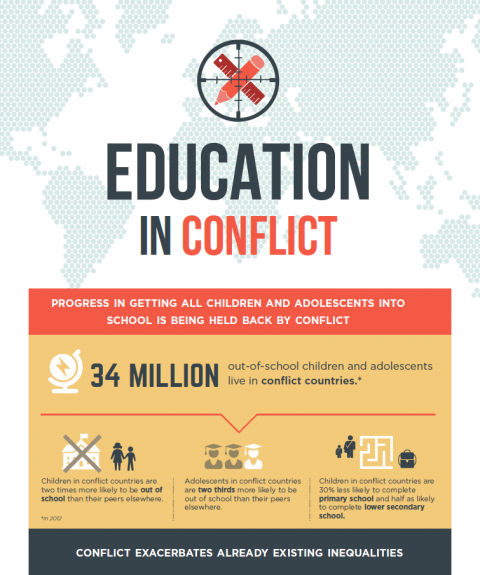 EDUCATION IN CONFLICT Corporate author: EFA Global Monitoring Report Team | UNESCO PROGRESS IN GETTING ALL CHILDREN AND ADOLESCENTS INTO SCHOOL IS BEING HELD BACK BY CONFLICT - 34 million out-of-school children and adolescents live in conflict countries. - Children in conflict countries are two times more likely to be out of school than their peers elsewhere.- Adolescents in conflict countries are two thirds more likely to be out of school than their peers elsewhere.- Children in conflict countries are 30% less likely to complete primary school and half as likely to complete lower secondary school.- Girls are almost two and a half times more likely to be out of school if they live in a conflict country than those elsewhere.- Adolescent girls are almost 90% more likely to be out of secondary school than young women elsewhere.- The poorest children in conflict countries are twice as likely to be out of school as the poorest elsewhere.
 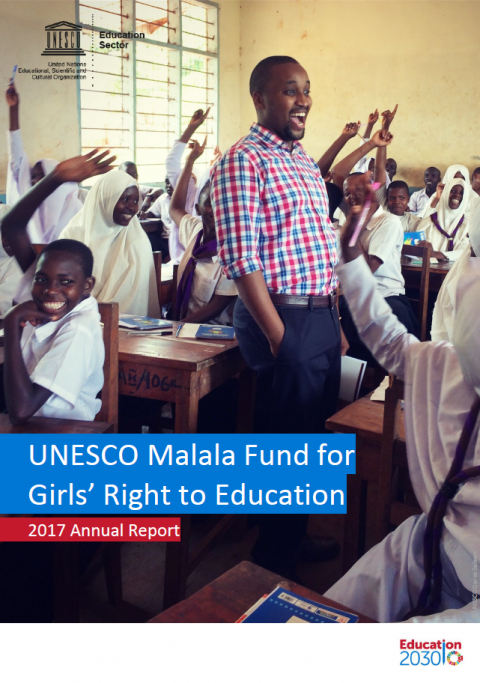 UNESCO Malala Fund for Girls' Right to Education: 2017 annual report Year of publication: 2018 Corporate author: UNESCO The brutal assassination attempt made against Pakistani teenager and activist for girls’ education Malala Yousafzai gave birth to the UNESCO Malala Fund for Girls’ Right to Education. Part of the “Better Life, Better Future” Global Partnership for Girls’ and Women’s Education, the fund was established in 2012 to expand girls’ access to quality and gender-responsive education and ensure safe learning environments, especially in countries affected by conflict and disaster. The Islamic Republic of Pakistan initially committed 10 million USD to the Fund, and since 2014 the CJ Group is another major contributor to the Fund, along with other supporters.Fund objectivesThe Fund supports the implementation of holistic programmes which aim to: Expand access to education for girls and women, especially those hardest to reach and affected by conflict and disaster Improve the quality and relevance of education, ensuring that content, teaching practices, learning processes and environments are gender-sensitive Strengthen policy and capacity to ensure safe learning environments
 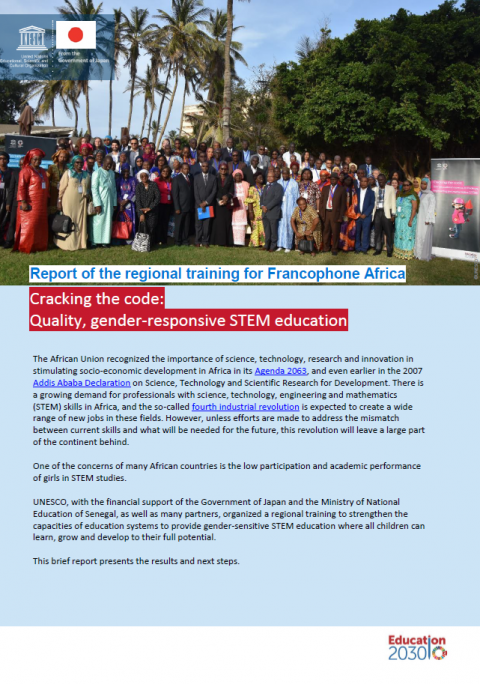 Report of the regional training for Francophone Africa, cracking the code: quality, gender-responsive STEM education Year of publication: 2019 Corporate author: UNESCO The African Union recognized the importance of science, technology, research and innovation in stimulating socio-economic development in Africa in its Agenda 2063, and even earlier in the 2007 Addis Ababa Declaration on Science, Technology and Scientific Research for Development.There is a growing demand for professionals with science, technology, engineering and mathematics (STEM) skills in Africa, and the so-called fourth industrial revolution is expected to create a wide range of new jobs in these fields. However, unless efforts are made to address the mismatch between current skills and what will be needed for the future, this revolution will leave a large part of the continent behind.One of the concerns of many African countries is the low participation and academic performance of girls in STEM studies. UNESCO, with the financial support of the Government of Japan and the Ministry of National Education of Senegal, as well as many partners, organized a regional training to strengthen the capacities of education systems to provide gender-sensitive STEM education where all children can learn, grow and develop to their full potential. This brief report presents the results and next steps.
  Monitoring the implementation of the Lisbon Recognition Convention - Council of Europe Higher Education Series No. 23 Year of publication: 2019 Corporate author: UNESCO | Council of Europe In accordance with the Lisbon Recognition Convention, the Committee of the Convention shall oversee its implementation and guide the competent authorities in implementing the convention and in their consideration of applications for the recognition of foreign qualifications. The Rules of procedure (adopted by the Committee in Vilnius in 1999) reiterate this role – the function of the Committee is to promote the application of the convention and oversee its implementation. Article II. of the convention states that where the central authorities of a party are competent to make decisions in recognition cases, that party shall be immediately bound by the provisions of the convention and shall take the necessary measures to ensure the implementation of its provisions on its territory. Where the competence to make decisions in recognition matters lies with individual higher education institutions or other entities, each party, according to its constitutional situation or structure, shall transmit the text of this convention to those institutions or entities and shall take all possible steps to encourage the favourable consideration and application of its provisions. The provisions of Article II. are central to determining the obligations of the parties to the convention. This article places upon these parties an obligation to make sure that information on the provisions is disseminated to all competent recognition authorities, and that these institutions are encouraged to abide by the convention (Explanatory report to the convention). The objective of this monitoring exercise has been to oversee the implementation of the main provisions of the convention and to report to parties on the outcome of this monitoring, presenting the main findings and recommendations. This monitoring report is also a contribution to the commitment set out in the Yerevan Communiqué (2015) to review national legislation to ensure full compliance with the convention, and to ask the Convention Committee, in co-operation with the ENIC (Council of Europe and UNESCO European Network of National Information Centres on academic recognition and mobility) and NARIC (EU Network of National Academic Recognition Information Centres) networks, to prepare an analysis of the national legislation reports by the end of 2017, taking due account of this monitoring report. This is the first monitoring of implementation of the Lisbon Recognition Convention (LRC) since its signature in 1997. The questionnaire used for the monitoring exercise was drawn up by the Bureau of the Convention Committee, namely Gunnar Vaht, President of the Committee, Gayane Harutyunyan, Vice-President, Allan Bruun Pedersen, Vice-President, and Baiba Ramina, Rapporteur, together with the joint Council of Europe/UNESCO Secretariat. The monitoring covers the 10 main provisions of the convention and comprises 22 questions relating to implementation of the main principles. The questions focus primarily on how the convention requirements are regulated at national level and to what extent the rules are reflected in national legislation. In cases where some or all of the provisions are not regulated at national level and where the higher education institutions have total autonomy in establishing the principles of the convention, the aim has been to discover how national authorities oversee implementation of the principles of the convention at institutional level. As stated above, the objective of this monitoring report is to monitor implementation of the convention by the parties to the convention. The executive summary focuses on the key findings and the conclusions focus on the recommendations made by the Convention Committee Bureau, which will require political decisions from the Convention Committee and from national authorities for follow-up action. The various chapters of the report elaborate further on both the key findings and the recommendations. The questionnaire was sent to 53 states parties to the LRC, and replies were received from 50 countries. The initial deadline given was 15 February 2015, but this was extended to June 2015. The analysis by the members of the Convention Committee Bureau took place from June to November 2015 and was assisted and reviewed by the Council of Europe and UNESCO, the joint Secretariat of the LRCC Bureau.
 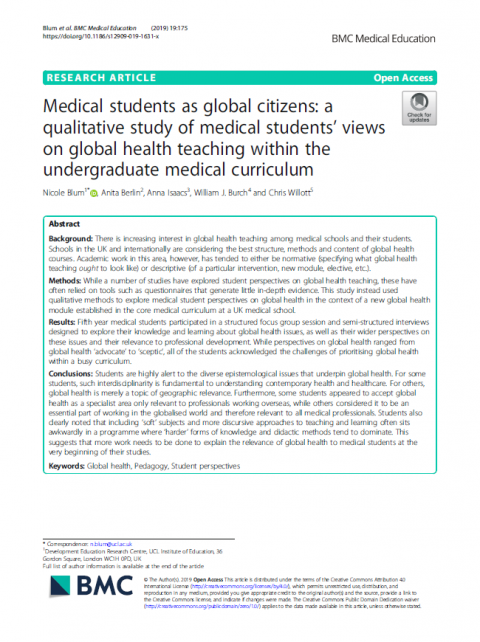 Medical students as global citizens: a qualitative study of medical students’ views on global health teaching within the undergraduate medical curriculum Year of publication: 2019 Author: Nicole Blum | Anita Berlin | Anna Isaacs | William J. Burch | Chris Willott The paper, entitled "Medical students as global citizens: a qualitative study of medical students’ views on global health teaching within the undergraduate medical curriculum", is based on a small-scale qualitative study with UCL(University College London) medical students. It aimed to explore Year 5 medical students’ knowledge and learning about global health issues, as well as their wider perspectives on its relevance to their professional development. The work builds on DERC(Development Education Research Centre)’s long-term interest in global issues within the initial training and professional development of a number of key global professions, such as teaching, medicine and engineering.
  Trends Shaping Education 2019 Year of publication: 2019 Corporate author: Organisation for Economic Co-operation and Development (OECD) This book, published every two to three years, is designed to give policy makers, researchers, educational leaders, administrators and teachers a robust, non-specialist source to inform strategic thinking and stimulate reflection on the challenges facing education, whether in schools, universities or programmes for older adults. Trends Shaping Education 2019 is designed to support long-term strategic thinking in education. It provides an overview of key economic, social, demographic and technological trends and raises pertinent questions about their impact on education. This book fills an important need: decision makers and practitioners in education often have only anecdotal or local information on the megatrends that play out in their context; too often they do not have solid facts in front of them, especially about trends.`
  HARNESSING THE POWER OF DATA FOR GENDER EQUALITY: Introducing the 2019 EM2030 SDG Gender Index Year of publication: 2019 Corporate author: Equal Measures 2030 In the 2019 Global Report “Harnessing the power of data for gender equality: Introducing the 2019 EM2030 SDG Gender Index”, the Equal Measures 2030 (EM2030) introduces the 2019 SDG Gender Index. The index is a comprehensive tool available to explore the state of gender equality across 129 countries (covering 95% of the world’s girls and women), 14 of the 17 Sustainable Development Goals (SDGs), and 51 targets linked to issues inherent in the SDGs. The 2019 SDG Gender Index finds that, with just 11 years to go until 2030, nearly 40% of the world’s girls and women – 1.4 billion – live in countries failing on gender equality. Another 1.4 billion live in countries that “barely pass”. Even the highest-scoring countries have more to do, particularly on complex issues such as climate change, gender budgeting and public services, equal representation in powerful positions, gender pay gaps, and gender-based violence. No country in the world has reached the “last mile” on gender equality. 2019 Global Report overview: Section 1: A foreword from Equal Measures 2030’s partners: The African Women’s Development and Communication Network (FEMNET), The Asian-Pacific Resource & Research Centre for Women (ARROW), Bill & Melinda Gates Foundation, the Committee for Latin America and the Caribbean for the Defense of Women’s Rights (CLADEM), Data2X, International Women’s Health Coalition (IWHC), KPMG, ONE Campaign, Plan International, Women Deliver. Section 2: Key findings from the 2019 SDG Gender Index. Section 3: Introducing the 2019 SDG Gender Index, the approach, what makes this index unique and how the findings should be interpreted. Section 4: Key global findings, patterns and comparisons of index scores between and within the different regions: Asia and the Pacific, Europe and North America, Latin America and the Caribbean, the Middle East and North Africa, Sub-Saharan Africa. Section 5: Regional overviews of index scores and gender equality context, and thematic deep drives on 1) inequalities in girls’ education, 2) women in science and technology research positions, 3) girls’ and women’s physical safety, 4) legal barriers for women, 5) women in government. Section 6: Leaving no one behind: multiple and intersecting forms of discrimination of girls and women. Section 7: Recommendations for action.
  [Policy Brief] YOUTH WAGING PEACE: A Youth Led Guide on Prevention of Violent Extremism through Education Year of publication: 2019 Corporate author: Mahatma Gandhi Institute of Education for Peace and Sustainable Development (MGIEP) The #YouthWagingPeace guidebook is a document for anyone interested in understanding Violent Extremism and exploring the relationship between Education and Prevention of Violent Extremism (PVE). Led by 2 dynamic Coordinating Lead Authors and 5 Lead/Chapter Authors, the guide garnered over 2000 youth submissions/case studies, and finally integrated over 150 case study submissions from young educators and practitioners from 50+ countries. #YouthWagingPeace guidebook provides a set of actionable guidelines for PVE to teachers, school administrators, policy makers, family, religious leaders and other informal influencers.
 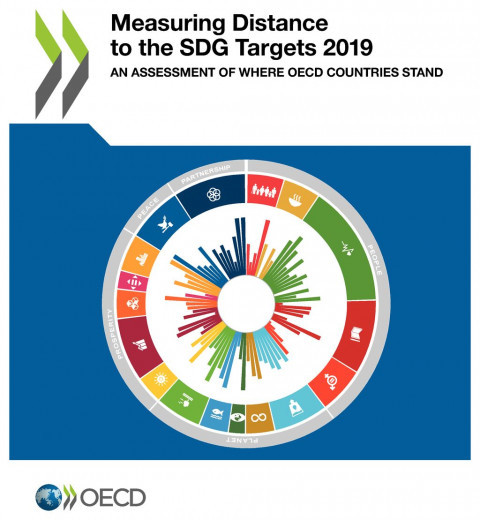 Measuring Distance to the SDG Targets 2019 - An Assessment of Where OECD Countries Stand Year of publication: 2019 Corporate author: Organisation for Economic Co-operation and Development (OECD) The Sustainable Development Goals (SDGs) set a broad and ambitious programme for the world to achieve by 2030. With 17 Goals, underpinned by 169 Targets, the complex and integrated nature of the 2030 Agenda presents national governments with huge challenges for implementation. To assist countries, the OECD has developed a unique methodology allowing comparison of progress across SDG goals and targets. Based on the UN Global List of 244 indicators, this study evaluates the distance that OECD countries need to travel to meet SDG targets for which data is currently available. This 2019 edition of the study presents the latest results for OECD countries, both on average and individually, as well as new exploratory approaches to assessing progress over time and transboundary aspects of the SDGs. By providing a high-level overview of countries’ strengths and weaknesses in performance across the SDGs, this study aims to support member countries in navigating the SDGs and in setting their own priorities for action within the broad 2030 Agenda.
  I'd blush if I could: closing gender divides in digital skills through education Year of publication: 2019 Author: Mark West | Rebecca Kraut | Han Ei Chew Corporate author: UNESCO | EQUALS Skills Coalition This publication seeks to expose some of these biases and put forward ideas to begin closing a digital skills gender gap that is, in most parts of the world, wide and growing. Today, women and girls are 25 per cent less likely than men to know how to leverage digital technology for basic purposes, 4 times less likely to know how to programme computers and 13 times less likely to file for a technology patent. Ata moment when every sector is becoming a technology sector, these gaps should make policy-makers, educators and everyday citizens ‘blush’ in alarm. The publication explains the role gender-responsive education can play to help reset gendered views of technology and ensure equality for women and girls. This publication was prepared by UNESCO for the EQUALS Skills Coalition, one of three coalitions that comprise the EQUALS partnership. EQUALS is a global partnership of governments and organizations dedicated topromoting gender balance in the technology sector by championing equality of access, skills and leadership for women and men alike. The Skills Coalition, Access Coalition, Leadership Coalition and a transversal Research Group release knowledge products periodically, organize competitions and funds, and take actions in countries and internationally to advance EQUALS’smission. The German Federal Ministry for Economic Cooperation and Development (BMZ) generously supported this publication financially and co-leads the EQUALS Skills Coalition with UNESCO. A dedicated working group composed of digital skills and gender experts guided the development of the content.