
Resources
Explore a wide range of valuable resources on GCED to deepen your understanding and enhance your research, advocacy, teaching, and learning.
8,365 Results found
 The Effect of a Training Program on Developing the Global Citizenship Principles of the History Teachers in Jordan Year of publication: 2015 Author: Zaid Suleiman Corporate author: University of Jordan This study aimed at building a training program for the history teachers in the light of the global citizenship principles and at testing its effect on their knowledge level of those principles, in Jordan. Study sample consisted of (26) male and female teachers randomly selected from the history teachers for the higher of Basic Education, in the education Directorate of the Ma'daba Governorate.To achieve the study goals, a training program was developed in the light of the global citizenship principles, which are: global peace, democracy, human rights, humans and the environment, scientific thinking, technology, and multicultures. and a cognitive test of the global citizenship's principles was prepared. After performing the relevant statistical analysis, the results revealed that the pre-knowledge level of the history among those teachers of the global citizenship principles was lower than the educationally accepted level (80%), and the presence of differences with statistical significance (α=0.01) between the post-knowledge level among the history teachers at the higher stage of basic education about the global citizenship principles and the educationalyl accepted level (80%), in favor of the training program in each domain of the global citizenship's principles and the domains collectively. The study recommended the inclusion of the global citizenship principles and concepts in the teachers training programs in order to increase their awareness in the global issues.
  The Role of School in the Development of Citizenship Values from Middle School Teachers’ Point of View Year of publication: 2015 Author: Ahmed A. Zegaoua Corporate author: American Arabic Academy of Science and Technology The purpose of this study was to investigate the schools’ role in teaching pupils the citizenship values from the middle school teachers’ point of view, according to gender, professional experience and the object of teaching. The researcher developed a questionnaire of 49 items which was applied on a sample of 180 teachers (males and females) from the Relizane Wilaya (Algeria). The results revealed that the level of the school’s role in the development of citizenship values was medium. The teacher’s role was came first playing a high level role; however the remaining fields were classified in the following following order: the school climate, the curriculum, and the school activities, all of which were considered to play an average level role. The study also shows that there were no significant differences attributed to gender, professional or the teaching material. The researcher discussed those results and presented a number of relevant suggestions.
  Towards a New Methodology for Teaching History Year of publication: 2012 Corporate author: International College This paper rests on the idea that the teaching of history has goals beyond that of building a collective memory and that education, in its broader context, aims at building citizenship and preparing the learner to live, integrate within a community, interact with others and adapt to a challenging to a rapidly changing world. Many of our students say that History makes no sense to them. They complain that, in history classes, they are not urged to think actively or to form opinions and that they are not given the chance to self-development. This paper proposes a new active methodology that renders the teaching of History more attractive to students and better received by them. It enhances the role of the “History class” as a partner in building learners’ skills and stimulating fundamental dispositions. The goal is to nurture a responsible citizen capable of critical thinking, taking initiatives, collaboration, working positively within one’s community, and is a life-long learner. Based on hands-on activities, this paper suggests a comprehensive model of instruction that transforms the History classroom into a gateway for building citizenship by equipping the learner with the necessary skills and dispositions. This methodology is based on three theories that had a great impact on the teaching – learning process in the last two decades: Brain-based learning, constructivism, and problem-based learning. Hence, these theories are briefly presented. Seen as one of many possible teaching methodologies in a History classroom, this model is presented and its impact on the teaching of History is highlighted. As we plan for a new History curriculum in Lebanon, it is crucial that we look ahead to the 21st century instead of looking back.
 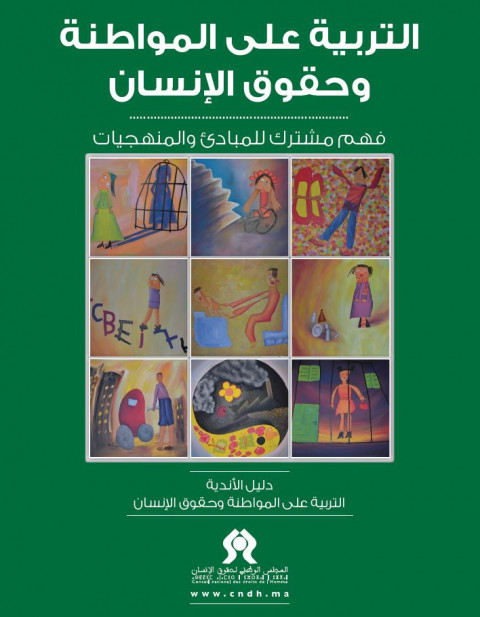 Education on Citizenship and Human Rights: A Common Understanding of Principles and Methodologies; A Guide for Clubs Year of publication: 2014 Corporate author: National Council for Human Rights This guide responds to an urgent need that was identified and diagnosed during practical experience and consultative meetings with the education on citizenship and human rights clubs in the educational institutions. The guide aims at: developing a reference framework for the education on human rights clubs regarding their objectives, references, principles and approaches, on one side, and for the regulations, tools and techniques of the activities on the other; streamlining and approaching visions and facilitating understanding and communication among the different components of the clubs and partners; providing the ground for the institutionalization and activation of the clubs.The project remains open to different perspectives, enriching and adaptation according to the characteristics of the different regions, institutions and target categories relevant to the project’s objectives. Thus the guide is to streamline efforts, coordinate visions and capitalize on the accumulations, creativeness and perspectives of the different relevant parties and to open up wider horizons for the establishing and the clubs. Contents include: why the education on citizenship and human rights, concepts, definitions, roles of the institutions for social and educational nurturing, democratic rights and active actors in the school, the principles, objectives, structures, operating, efficiency, funding and techniques of clubs, among others.
  Teaching/Learning the History of a Land with Diverse Socio-religious Groups: A Socio-constructivist Approach Year of publication: 2012 Corporate author: University of Balamand A survey of the opinions of some students indicated that they viewed the teaching/learning of history they had undergone in pre-university levels of education as a wasted effort. The teaching consisted of narration, while the learning took the form of memorization of contents to be recited at the time of the examination. The majority considered a revision of the method of teaching history to be a national and cultural necessity. Given that the teaching of history has in view the acquisition by the student of basic skills, such as analysis, synthesis and composition, there is a need to change the teaching/learning process from narration to a targeted development of civic consciousness and critical thinking. The problem is posed within three frameworks: The geographic-demographic framework relating to the composition of the Lebanon; the psychological-educative framework relating to the understanding of history and how it is constructed. through the utilization of critical thinking; the social-educational framework relating to the educational paradigm to be used in the teaching of history and the intellectual activity of the student. This requires the intertwining of several educational elements such as the utilization of the various historical sources, discussing the sequence of events therein and reading them critically, while at the same time studying the thinking of the personalities who influenced the historical developments, and their cultural backgrounds. The main questions here is: Why do we teach history in schools? At which level do we start? What are the targets in each level? The answers to these questions can be many: Defining the national identity; strengthening civic thinking; developing a national culture; making the student aware of what ties the Lebanon to the surrounding region; acquainting ourselves with the cultural heritage of the people; strengthening the attachment with the land; teaching to learn to accept the other. Following an investigation of the Lebanese directives for the teaching of history, as well as the international ones, a hypothesis was proposed: the development of objective critical thinking through the study of history would consolidate the concept of the acceptance of the other. Indeed, the religious and sectarian pluralism of the Lebanon constitutes a source of cultural wealth. It is a factor of national cohesion. The history is a history of a land of many peoples with differing religious persuasions.
  The Availability of the Values of Citizenship and It’s Concepts in the Books of National Education, Saudi Arabia, from the Teachers’ Perspective Year of publication: 2014 Corporate author: Assiut University The purpose of the study was to investigate valuesand concepts included in Civil Education books in Saudi Arabia, and teacher evaluation of the availability of values and concepts. To achieve the study the researcher analyize the contents of the civil education books (fourth grade - third year secondary), a sample has been selected consisting of 180 teachers of civil education, who taught during (2009/2010), in Alqasim schools. Two instruments were developed. The first one was used to analyize the contents of national education books, while the second one was used to evaluate teachers of books' content. The result showed that there is no balance in social values distribution (honesty, trust and co-opration) for (sixth grade –first secondary). The result showed a large number of social values are included in the national education books compared to international and personal values. The results showed that teachers' evaluation of values and concepts included in the national education books in personal field was high.Teachers' evaluation of the values and concepts in the national and social field was medium. Teachers evaluation for values and concepts in the global field was medium.The study presents a group of relevant recommendations.
  Education and the Laying the Foundations of Citizenship for Arab Humans Year of publication: 2014 Author: مدكور، علي أحمد Corporate author: Cairo University This article deals with the issue of citizenship and its variations focusing on its relation to democracy being a mechanism to achieve social justice. Real democracy has three determinants: people’s participation in taking the decisions, in implementing them and in benefiting from their effects. The paper also tried to focus on the fundamentals of citizenship from the perspective of effective participation in all aspects of social, economic and cultural life, on one side, and on the determinants of citizenship such as human rights -the right to life, freedom, equality, justice, work, thinking, expression and belief… from the other - all those rights represent the main determinants of the strength of the homeland and citizenship. Among the human rights conventions: The Universal Islamic Declaration of Human Rights, The Universal Declaration of Human Rights of 1948, The European Convention on Human Rights.
  A Proposed Strategy for Educational Institutions of Political Socialization in Jordan to Promote National Unity Concepts Year of publication: 2016 Corporate author: University of Jordan This study aimed to develop an educational proposed strategy for the institutions of political socialization in Jordan to promote national unity concepts from the perspective of Jordanian university students. The study sample consisted of 350 male and female students, were chosen in a stratified random students way from Jordanian public universities for undergraduate for the academic year 2013/2014...the three universities were selected for the study were spread over three regions: southern Region (Muta University), the central Region (The University of Jordan) and the North Region (Yarmouk University)... The study found the following results: -The overall appreciation of the reality of the role of political education institutions in the promotion of national unity concepts from the perspective of Jordanian university students came moderate. -The overall appreciation of the reality of the challenges facing political education institutions in the promotion of national unity concepts from the point of Jordanian university students was moderate...Of the most important recommendations: the introduction of the proposed strategy for developing the role of the political education institutions in the promotion of national unity concepts.
 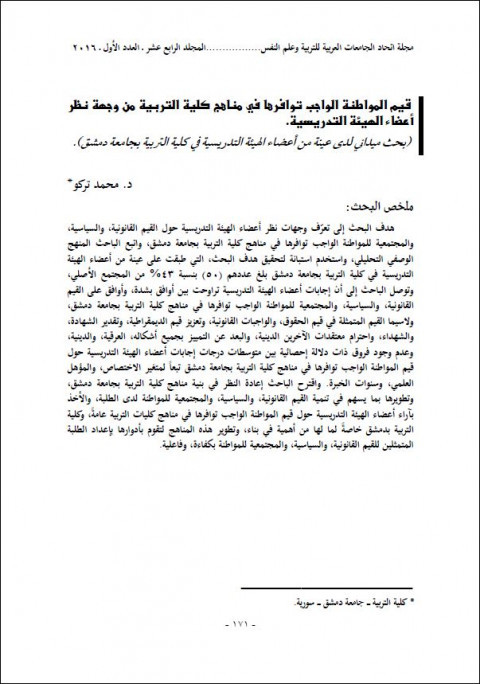 The Citizenship Values That Should Be Available in the Curricula of Faculty of Education from the Academic Staff Viewpoint : A Field Study on a Sample from the Academic Staff in Faculty of Education at Damascus University Year of publication: 2016 Author: Mohammad Turko Corporate author: Damascus University. Faculty of Education This study aimed at at identifying the views of the teaching staff regarding the legal, political, and the community values of citizenship that must to be available in the curriculla of the Education Faculty at Damascus University. The researcher used the anaalytical method and a questionnaire that was applied to a sample of 50 teachers making 43% of the original community.The responses varied between 'I strongly agree' and 'I agree to legal, political, and the community values of citizenship that must be available'...especially values of rights and legal obligations and social values of citizenship that must be available, promoting democratic values, valuing martyrdom and martyrs, respecting the religous beliefs of others and staying away from racial and religous discrimation. There were no differences of statistical significance between the mean degrees of responses as per the variables of specializatiop, scientific degrees or years of experience. the researcher suggested that the curriclla of the Education Faculty be rewied and developed in order for them to contribute to the development of the legal, political and social values of citizenship among students, and that the views of the teaching staff are taken into consideration regarding the citizenship values that must be available in order for them to prepare the students to assimilate the values efficiently and effectively.
 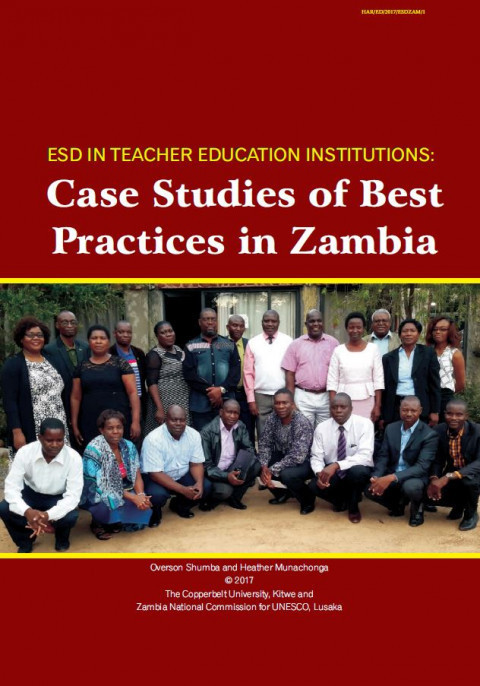 ESD in Teacher Education Institutions: Case Studies of Best Practices in Zambia Year of publication: 2017 Author: Overson Shumba | Heather Munachonga Corporate author: Zambia National Commission for UNESCO | Copperbelt University This book is a compilation of case studies on best practices in education for sustainable development in teacher education institutions in Zambia. It contributes to the dissemination of the best practices among the institutions and the wider society. It adds to examples of practices that are relevant to the UNESCO Global Action Programme on Education for Sustainable Development (GAP). The project was coordinated by Professor Overson Shumba at the Copperbelt university in Kitwe and Heather Munachonga, Programme Officer at the Zambia National Commission for UNESCO in Lusaka. The book was made possible with funding and support from UNESCO, Paris, the Ministry of General Education, the Copperbelt University, and the Zambia National Commission for UNESCO. All the institutions were supported by the teacher education institutions and their partners. The book illustrates some of the actions undertaken consistent with pursuit of the education SDG4 target 7. It is expected that this book will lead teacher educators and teachers to come up with further innovations and to integrate them in their professional work. Whole institution actions are encouraged so that best practices as found in this book can permeate and transform all aspects of the institution: the curriculum, teaching, assessment, research, extra-curricular activities, and operations, and must involve everyone, students, workers, lecturers, and the surrounding community.