
Resources
Explore a wide range of valuable resources on GCED to deepen your understanding and enhance your research, advocacy, teaching, and learning.
8,365 Results found
 [Summary] Investing in Cultural Diversity and Intercultural Dialogue: UNESCO World Report; Executive Summary Year of publication: 2009 Corporate author: UNESCO Cultural diversity has emerged as a key concern at the turn of a new century. Yet the meanings attached to this catch-all term are as varied as they are shifting. Some see cultural diversity as inherently positive, insofar as it points to a sharing of the wealth embodied in each of the world’s cultures and, accordingly, to the links uniting us all in processes of exchange and dialogue. For others, cultural differences are what cause us to lose sight of our common humanity and are therefore at the root of numerous conflicts.This second diagnosis is today all the more plausible since globalization has increased the points of interaction and friction between cultures, giving rise to identity-linked tensions, withdrawals and claims, particularly of a religious nature, which can become potential sources of dispute. The essential challenge, therefore, would be to propose a coherent vision of cultural diversity and thereby to clarify how, far from being a threat, it can become beneficial to the action of the international community. This is the essential purpose of the present report.
  Investing in Cultural Diversity and Intercultural Dialogue: UNESCO World Report Year of publication: 2009 Corporate author: UNESCO This report analyzes all aspects of cultural diversity, which has emerged as a key concern of the international community in recent decades, and maps out new approaches to monitoring and shaping the changes that are taking place. It highlights, in particular, the interrelated challenges of cultural diversity and intercultural dialogue and the way in which strong homogenizing forces are matched by persistent diversifying trends. The report proposes a series of ten policy-oriented recommendations, to the attention of States, intergovernmental and non-governmental organizations, international and regional bodies, national institutions and the private sector on how to invest in cultural diversity.Emphasizing the importance of cultural diversity in different areas (languages, education, communication and new media development, and creativity and the marketplace) based on data and examples collected from around the world, the report is also intended for the general public. It proposes a coherent vision of cultural diversity and clarifies how, far from being a threat, it can become beneficial to the action of the international community.
  [Video] Global Citizenship Education to Prevent Violent Extremism Year of publication: 2016 Corporate author: UNESCO The UNESCO video on “Global Citizenship Education to prevent violent extremism” explains how education can prevent violent extremism through equipping young people with the skills to dialogue and think critically, and engage meaningfully with others and their communities in order to build peaceful societies.
  Global Inventory of Regional and National Qualifications Frameworks 2017, Vol. II: National and Regional Cases Year of publication: 2017 Corporate author: European Centre for the Development of Vocational Training (CEDEFOP) | European Training Foundation (ETF) | UNESCO | UNESCO Institute for Lifelong Learning (UIL) The global inventory 2017 further strengthens the knowledge base on developments in national and regional qualifications frameworks, as implemented by countries and regions, by end of 2016. It acts as an observatory of progress in establishing NQFs, as well as the challenges and success factors in implementation. The thematic chapters (Volume I) discuss key trends and policy issues emerging from qualifications frameworks and learning outcomes reforms and developments. Volume II consists of NQF case studies of 100 countries from all continents and seven regional qualifications frameworks (RQF). The case studies look at the educational, social, economic and political context in which an NQF is embedded, main policy objectives, implementation of learning outcomes, stakeholder involvement and institutional arrangements. They also show how NQFs open for and link to validation arrangements, support recognition and learning pathways. They conclude with important lessons and future plans.The global inventory draws on inventories from four agencies: the European Centre for the Development of Vocational Training (Cedefop), the European Training Foundation (ETF), the United Nations Educational, Scientific and Cultural Organisation (UNESCO) and the UNESCO Institute for Lifelong Learning (UIL), working and communicating with country officials and experts. It also draws on extensive international research in qualifications reforms, comparability of qualifications, and use of learning outcomes.
  Global Inventory of Regional and National Qualifications Frameworks 2017, Vol. I: Thematic Chapters Year of publication: 2017 Corporate author: European Centre for the Development of Vocational Training (CEDEFOP) | European Training Foundation (ETF) | UNESCO | UNESCO Institute for Lifelong Learning (UIL) The global inventory 2017 further strengthens the knowledge base on developments in national and regional qualifications frameworks, as implemented by countries and regions, by end of 2016. It acts as an observatory of progress in establishing NQFs, as well as the challenges and success factors in implementation. The thematic chapters (Volume I) discuss key trends and policy issues emerging from qualifications frameworks and learning outcomes reforms and developments. Volume II consists of NQF case studies of 100 countries from all continents and seven regional qualifications frameworks (RQF). The case studies look at the educational, social, economic and political context in which an NQF is embedded, main policy objectives, implementation of learning outcomes, stakeholder involvement and institutional arrangements. They also show how NQFs open for and link to validation arrangements, support recognition and learning pathways. They conclude with important lessons and future plans.The global inventory draws on inventories from four agencies: the European Centre for the Development of Vocational Training (Cedefop), the European Training Foundation (ETF), the United Nations Educational, Scientific and Cultural Organisation (UNESCO) and the UNESCO Institute for Lifelong Learning (UIL), working and communicating with country officials and experts. It also draws on extensive international research in qualifications reforms, comparability of qualifications, and use of learning outcomes.
  Zwischen Vermittlungsanspruch und emotionaler Wahrnehmung: Die Gestaltung neuer Dauerausstellungen in Gedenkstätten für NS-Opfer in Deutschland und deren Bildungsanspruch Year of publication: 2009 Author: Thomas Lutz Over the last decade, as part of the federal concept for memorial sites, twenty new permanent exhibitions were developed. This dissertation undertakes to examine exhibitions created at memorial sites for victims of the Nazi regime from an educational and museological viewpoint. Expert interviews with exhibition curators serve as the basis for the empirical study. The author has worked for many years in the field of memorial museums education. He applied “action research,” developed in German-speaking countries under the term “Handlungsforschung.” The study analyzes the specific characteristics of the work conducted in museums, memorial sites and educational centres and also addresses the strained connection between commemoration and learning in the educational work of the memorial museums for the Nazi victims. The study also evaluates the practical impact of these aims. The very intense form of commemorative work that is conducted in Germany is justified by the nature of its subject matter: the stigmatization of specific victim groups during the Nazi era according to a system of political, racist-biological and social characteristics and the vast dimensions of the genocide. The socially and politically explosive nature of this task is manifested by the commemoration of the “other” victims as well as by the responsibility that Germany bears for addressing its “own” perpetrators in society. The central findings of the study show that the new exhibitions embrace a much more comprehensive foundation of historical material (historical knowledge, building history and archeological significance of the crime sites, written and audio-visual survival testimony and artifacts) as was previously the case. The professionalization of the “field of memorial museums” has led to a more intensively reflected and sensitive approach to handling documents, illustrations and objects on display in a museum. In particular, the significance of the relationship between the artifacts and their location, their sources, an appreciation for their origins and a critical reflection of what it is they convey is achieved. This also applies to photography. (Written by author) The above abstract is taken from the International Holocaust Remembrance Alliance Education Research Project. Please also consult the full list of abstracts in 15 languages and the accompanying publication Research in Teaching and Learning about the Holocaust: A Dialogue Beyond Borders.Ed: IHRA, Monique Eckmann, Doyle Stevick, Jolanta Ambrosewicz-Jacobs, 2017, Metropol Verlag at http://www.holocaustremembrance.com/publications.
  Nationalsozialismus im Geschichtsunterricht: Beobachtungen unterrichtlicher Kommunikation Year of publication: 2002 Corporate author: Johann Wolfgang Goethe University This is a pilot study about the potential of history education about Nazism and the Holocaust. The aim is, 1) to establish whether it is possible to conduct empirical analysis about “Education after Auschwitz,” and 2) based on empircal observation improve the theoretical assumptions about the relationship between education and the specific theme of Nazism and the Holocaust. The empirical part consists of five case studies about different aspects of “Holocaust education” in two Upper Secondary schools in Frankfurt.The above abstract is taken from the International Holocaust Remembrance Alliance Education Research Project. Please also consult the full list of abstracts in 15 languages and the accompanying publication Research in Teaching and Learning about the Holocaust: A Dialogue Beyond Borders.Ed: IHRA, Monique Eckmann, Doyle Stevick, Jolanta Ambrosewicz-Jacobs, 2017, Metropol Verlag at http://www.holocaustremembrance.com/publications.
  Transforming Education Conference for Humanity: TECH 2017, December 16-18, 2017; Post Event Report Year of publication: 2018 Corporate author: Mahatma Gandhi Institute of Education for Peace and Sustainable Development (MGIEP) The three-day Transforming Education Conference for Humanity (TECH) 2017 organised by UNESCO Mahatma Gandhi Institute of Education for Peace and Sustainable Development (MGIEP) was held at Novotel Varun Beach, Visakhapatnam City, State of Andhra Pradesh, India from December 16 – 18, 2017. The first edition of TECH focused on digital pedagogies for building peaceful and sustainable societies through 21st century skills, schools and policies, towards achieving the United Nations Sustainable Development Goal 4, Target 7.TECH 2017 was attended by over 1,700 registered participants (including teachers, educators, learners, policy-makers, technology and gaming experts, amongst others) from 75 countries and witnessed highly engaging deliberations on the future of education, particularly on the innovative methods of teaching using technology.The Conference was generously supported by the State Government of Andhra Pradesh, India and the Ministry of Human Resource Development, Government of India and sponsored by Microsoft India (Education Technology Partner), Samsung India, Dassault Systems, Veative (Immersive Learning Partner) and McGraw Hill (Learning Science Partner). The Knowledge Partners of the Conference included NMIMS, Ubisoft, Quebec Government, ISTE, Social Alpha, EDB and IYC.TECH will be held annually over the next five years with a long term aim of affecting global policy change on the usage of digital pedagogies to render quality and inclusive education for all.
  [Video] How Many Languages Can You Recognize? Year of publication: 2018 Corporate author: UNESCO How many languages can you recognize in the video? People have the right to receive education in their mother language!More languages will be added to the SDG4 video!So don't forget to have a look at our playlist (link below) and let us know your mother tongue on our social media channels!SDG4 PLAYLIST: http://bit.ly/UNESCO-SDG4International Mother Language Day webpage: https://en.unesco.org/international-days/international-mother-language-day
 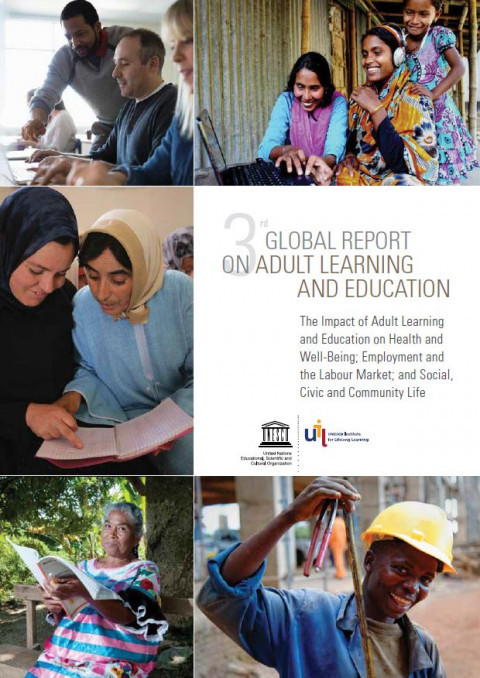 3rd Global Report on Adult Learning and Education: The Impact of Adult Learning and Education on Health and Well-being, Employment and the Labour Market, and Social, Civic and Community Life Year of publication: 2016 Corporate author: UNESCO Institute for Lifelong Learning (UIL) The Global Reports on Adult Learning and Education (GRALE) play a key role in meeting UNESCO’s commitment to monitor and report on countries’ implementation of the Belém Framework for Action. This Framework was adopted by 144 UNESCO Member States at the Sixth International Conference on Adult Learning and Education (CONFINTEAVI), which was held in Belém, Brazil, in 2009. In the Belém Framework for Action, countries agreed to improve ALE across five areas of action: policy; governance; financing; participation, inclusion and equity; and quality (UNESCO Institute for Lifelong Learning, 2010b).GRALE III appears as the ALE community prepares for an important global conference: the 2017 Mid-Term Review of CONFINTEA VI. GRALE III will help high-level decision makers take stock of progress in delivering their Belém promises since 2009. It will also help them look ahead to 2030. Policymakers are now considering how to put into practice the ALE promises made in the 2030 Agenda for Sustainable Development (United Nations, 2015) and the Recommendation on Adult Learning and Education (2015) (UNESCO, 2015). GRALE III will support their deliberations by showing how ALE can help achieve broader health, economic and social outcomes. It will identify major challenges for ALE and examine the implications for ALE of major global trends like migration and demographic shifts.GRALE III brings together the latest data, policy analysis and case studies on ALE. Government leaders will find high quality evidence to inform their policies, strategies and budgets. Proponents of change will find compelling arguments showing how ALE promotes sustainable development, healthier societies, better jobs and more active citizenship. Policy analysts will find entry points and ideas for future research and policy.