
Resources
Explore a wide range of valuable resources on GCED to deepen your understanding and enhance your research, advocacy, teaching, and learning.
8,364 Results found
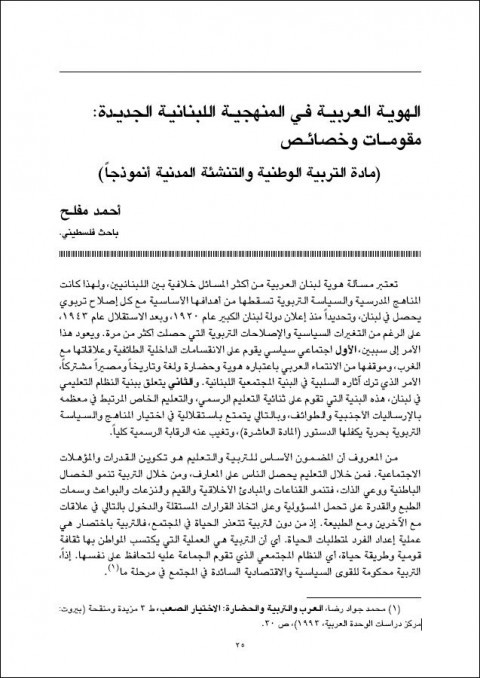 Arab Identity in the New Lebanese Curriculum: Determinants and Characteristics of the National and Civic Education as an Example Year of publication: 2007 Author: مفلح، أحمد Corporate author: Centre for Arab Unity Studies This study deals with Lebanon’s Arab Identity issue in the new Lebanese curriculum through the unification of the contents of the National and Civic education subject. The study researched how this subject is presented and how to crystallize the concept of Arab Belonging, in addition to dealing with the aspects of communicating the concepts and subjects of identity and belonging. The study reveals the contents of this subject and its ability to be sustained and utilized given the changes in Lebanon following the Taef Agreement and the National Conciliation Document of 1989, and it tests the ability of this subject to withstand the other factors in bringing up the new generation - such as the effects of the family, media, environment, health and others. The analysis showed that despite that the new education curriculum calls for rallying around the fact of Lebanon’s Arab identity and that this identity is sometimes presented in a conspicuous, emotional and self-interest way, in harmony with the political changes following Taef, nevertheless, the changes in the new contents remain very advanced compared to how the identity and belonging were ignored and even fought in the old curriculum.
 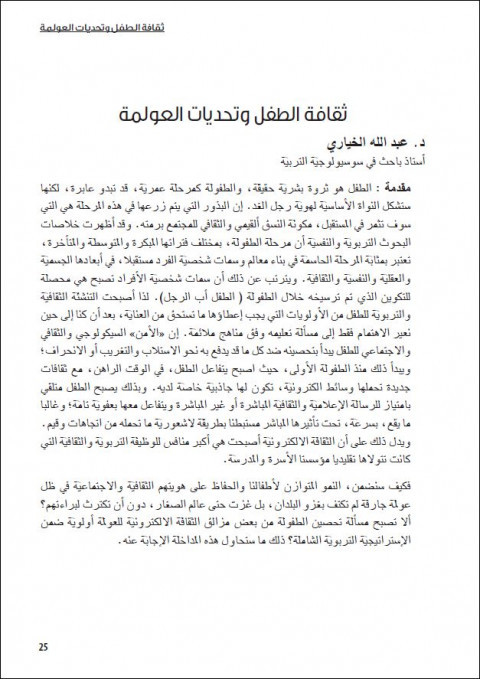 The Child's Culture and Globalization Challenges Year of publication: 2013 Author: الخياري، عبدالله Corporate author: Mohammed V University This article deals with the early childhood stage being the basic core for the identity of tomorrow’s man. It focuses on the importance of ensuring balanced development for children and on maintaining their cultural and social identity in the shadow of globalization and technological development.Because of the big role played by media of the globalization culture, such as the information technology and communication, in informing the child’s culture in all its aspects, sensory, mobility, skills and values, the article underlines the necessity to analyze the contents of the mobile culture that is being transmitted via TV, video, electronic games or the Internet in order to show their references and analyze their operating mechanisms. It also presented the mechanisms of stereotyping and absorbing into the electronic and media culture at the levels of visual media, children electronic media and entertainment material. The negative impact resulting from unbalanced use of the electronic culture were indicated. Those include potential physical harm, injecting aggressive behavior and the distortion of the scale of values and ethics. The study concludes that it is necessary to make the immunization of children against some pitfalls of globalized electronic culture a priority in the holistic educational strategies with a concentration on the role of parents and specialists and producers of the national culture for children in protecting the child from the risks of globalization.
 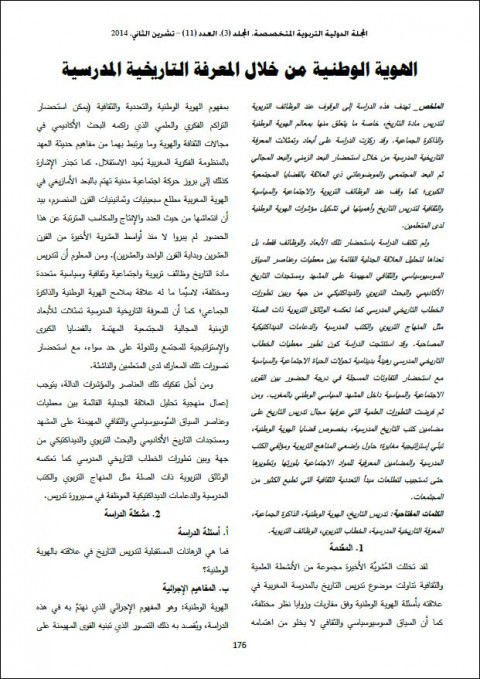 National Identity through Historical Knowledge of School Year of publication: 2014 Author: وريف، علي Corporate author: International Group for Consulting and Training (IGCT) The aim of this article is to shed light on educational functions of teaching history, especially with regard to the features of national identity and collective memory. The article focuses on the dimensions and representations of historical knowledge related to history presented in school. It makes use of time and space dimensions. It continues to cover dimensions of community and issues related to its main questions. It also tackles the educational, social, poltitical and cultural functions of teaching history and its importance in constructing learners indicators of national identity. The article tries also to analyse the dialectical relationship between two main aspects: the first one is the elements of sociopolitical and cultural context that dominate the scene, and the developments in academic history and educational and didactic research. The second one is the developments in the speech of school history declared in the educational documents, such as educational curriculum, textbooks and didactic supports. The study concluded that the school's historic speech data hostage dynamic transformations of social and political view with evoke disparities recorded in the degree of attendance between the social and political forces within the national political scene in Morocco. The scientific developments that the teaching of history field has known impose on the contents of history textbook, specifically the national identity issues, to adopt a different strategy; the curriculum makers, the textbook and cognitive contents writers of social materials have tried to elaborate and develop it to respond to the aspirations of the principle of cultural pluralism, which is printed a lot of communities.
 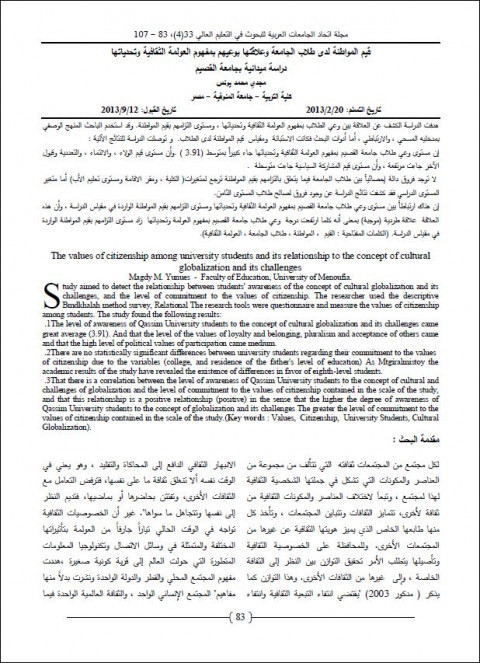 The Values of Citizenship among University Students and Its Relationship to the Concept of Cultural Globalization and Its Challenges Year of publication: 2013 Author: يونس، مجدي محمد Corporate author: Association of Arab Universities This study aimed to detect the relationship between students' awareness of the concept of cultural globalization and its challenges and the level of commitment to the values of citizenship. The researcher used the descriptive and relational method in both its survey and relational aspects. The research tools were a questionnaire and measure of the values of citizenship among students. The study found the following: 1) The level of awareness of Qassim University students of the concept of cultural globalization and its challenges came at a high average of 3.91. The level of the values of loyalty, belonging, pluralism and acceptance of others came at a high level. Political values of participation came at a medium. 2) There are no statistically significant differences between university students regarding their commitment to the values of citizenship as per the variables: college, and residence of the father's level of education. The academic results of the study have revealed the existence of differences in favor of eighth-level students. 3) There is a correlation between the level of awareness of Qassim University students of the concept of globalization (and its challenges) and the level of commitment to the values of citizenship. This relationship is positive, in the sense that the higher the degree of awareness of Qassim University students to the concept of globalization.
 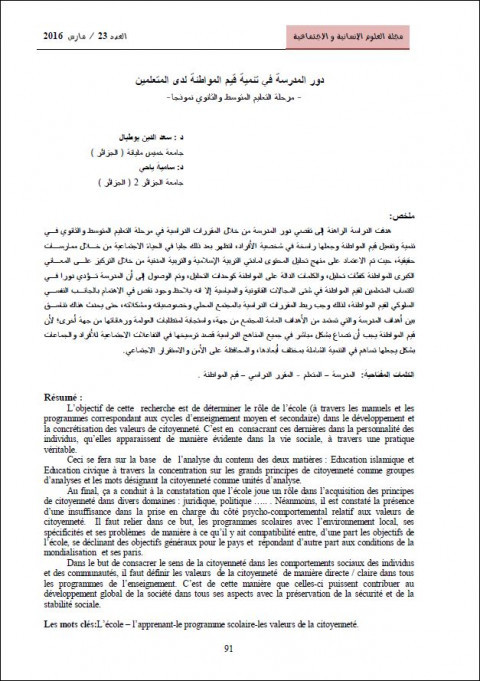 The Role of the Secondary School in the Development of Citizenship Values of the Learners Year of publication: 2016 Author: بوطبال، سعد الدين Corporate author: University of Ouargla This study aims at determining the role of school (dea the manuals and the programs of secondary school)in the development and the consolidation of citizenship values in individuals personalities,so,as to be clear in the social life by implementing real policy.This will be achieved all the bases of content analysis of two subjects: Islamic education and physical education by focusing all the grat principles of citizenship as group of analysis and on words referring to citizenship as units of analysis.To conclude, this has lead to observe that the school plays a role in the acquisitions of citizenship principles in different areas (legal, politics,..).However, it has interest of been observed a lack in psycho behavior aspects relating to citizenship values.To achieve this goal, the school programs should be linked to the social environment (with all its specifities problems) so, as to be in harmony with school goals and to respond to globalization requirements in order to consolidate the sense of citizenship in the behavior of individuals and communities. Citizenship values school be clearly defined in all teaching programs for global development of society, with the preservation of social security and stability.
 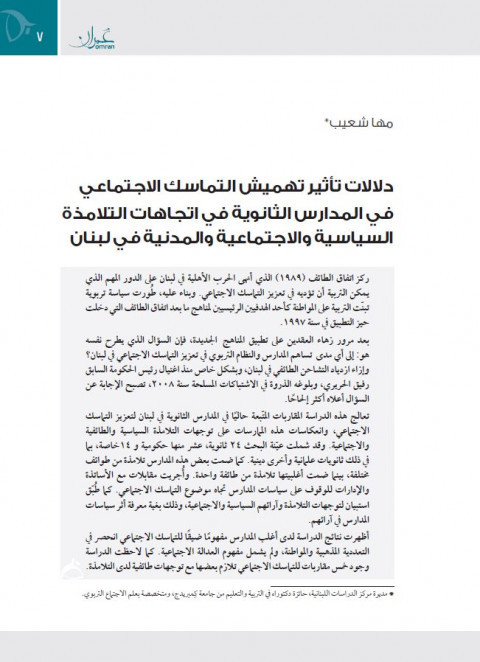 The Implications of the Impact of the Marginalization of Social Cohesion on the Political, Social and Civic Attitudes of in Secondary Schools in Lebanon Year of publication: 2014 Author: شعيب، مهى Corporate author: Arab Center for Research and Policy Studies The Taef Agreement (1989) which put an end to the civil war in Lebanon focused on the role that education could play in consolidating social cohesion. Thus, following the Taef Agreement, the education policy developed adopted education on citizenship as one of the two main objectives of the curricula and which entered into implementation in 1997. Nearly two decades later today, the question is: to what extend do schools and the education system contribute to social cohesion in Lebanon? Considering the escalation in sectarian agitation, especially since the assassination of prime minister Rafiq Hariri, which peaked in the armed clashes in 2008, the answer to this question becomes even more urgent.This study examines the approaches currently practiced in the secondary schools in Lebanon to promote social cohesion and their reflections on the students’ political, sectarian and social attitudes. The sample consisted of 24 secondary schools, 10 public and 14 private, both secular and religious. Some of the schools had students from different sects whereas most of them included student majorities from one and the same sect. Interviews were done with teachers and administrations in order to explore the school policies regarding social cohesion. In addition, a questionnaire was used to explore the of students, their political and social views and to identify the impact of school policies on informing them. The results showed that most schools had a narrow concept of social cohesion that is limited sectarian pluralism and citizenship while social justice was not included. The study also identified five approaches to social cohesion some of which were coupled with sectarian attitudes of students.
 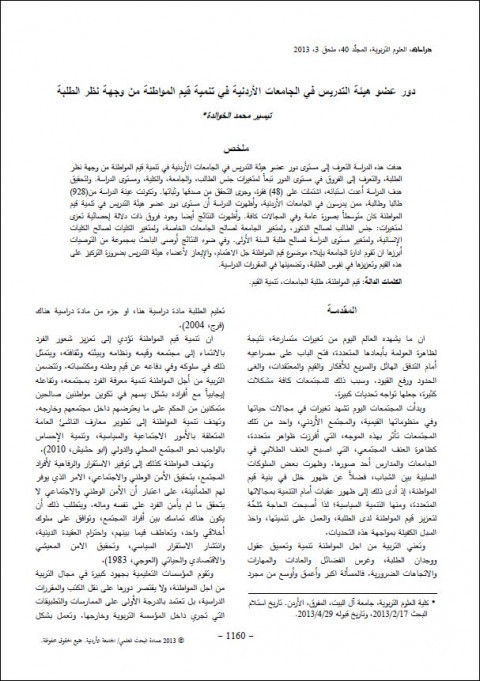 The Role of Jordanian Faculty Members in Promoting Citizenship Values from Students' Perspectives Year of publication: 2013 Author: الخوالدة، تيسير محم Corporate author: Al-Bayt University This study aimed at identifying the levels of roles played by Jordanian faculty members in promoting citizenship values from the students' perspective. The Study also aimed at identifying differences in the levels of roles played in relationship to the following variables: gender, university type, faculty, and level of study…The researcher developed a 48 item questionnaire whose reliability and validity were tested. The study sample consisted of 928 female and male students who were randomly selected from different Jordanian universities. The study results showed that the level of role played by Jordanian faculty members in promoting citizenship values was moderate in general and in all aspects. In addition, the study found statistically significant differences associated with the measured variables in favor of females (gender), private universities (university type), humanities majors (faculty), first year students (study level)... the researcher presented a set of recommendations; one of the main recommendations is that the university administration should pay more attention to the subject of citizenship values and should ask faculty members to play a bigger role in addressing these values and promoting them among students in addition to integrating citizenship education into university curricula.
 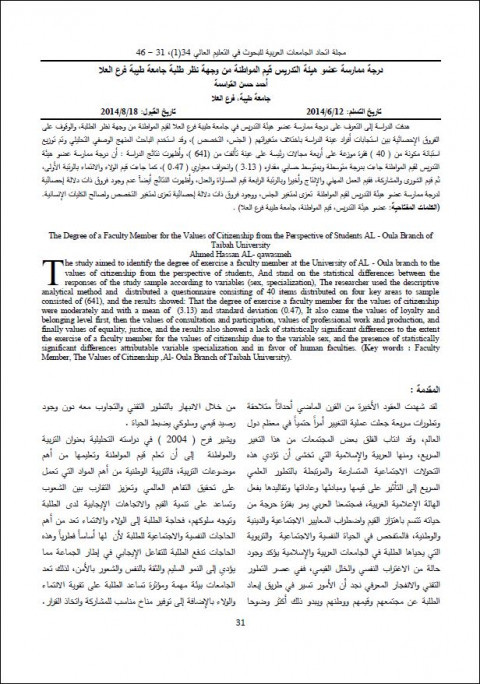 The Degree of a Faculty Member for the Values of Citizenship from the Perspective of Students Year of publication: 2014 Author: أحمد حسن Corporate author: Taibah University The study aimed to identify the degree to which a faculty member at the University of AL - Oula branch practices the values of citizenship - as seen from the perspective of students.It also aims to identify the statistical differences between the responses from the study sample according to variables (sex, specialization). The researcher used the descriptive analytical method and a questionnaire consisting of 40 items in four key areas distributed to a sample of 641 persons. The results showed that the degree of a faculty member for the values of citizenship were moderate with a mean of 3.13 and standard deviation of 0.47. The values of loyalty and belonging came first, followed by the values of consultation and participation, values of professional work and production, and finally by the values of equality and justice. The results also showed: a lack of statistically significant differences in the exercise by a faculty member of the values of citizenship due to the sex variable, and the presence of statistically significant differences attributed to the variable of specialization in favor of humanities faculties.
 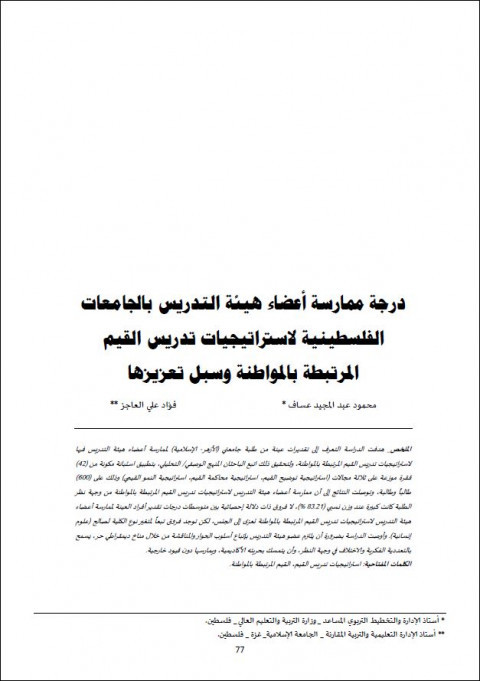 The Degree of Practice the Faculty Members in Palestinian Universities for Strategies of Teaching Values Related to Citizenship and Ways to Enhance It Year of publication: 2017 Author: Fuad Ali Corporate author: Islamic University of Gaza The study aimed to identify the estimates of a sample of the students of the two universities (Al-Azhar - Islamic) to practice the members of the teaching staff to the strategies of teaching the values associated with citizenship, and to achieve this followed the researcher’s descriptive / analytical approach. A questionnaire consisting of (42) items were distributed in three areas (the strategy of clarifying the values, the strategy for the trial of values, the strategy of value growth), on (600) students. The results showed that the practice of the teaching staff to the strategies of teaching values related to citizenship from the students'' perspective was significant at a relative weight (83.21%). There were no statistically significant differences between the average scores of the sample members for practicing the teaching strategies of the values related to citizenship attributed to sex, but there are differences depending on the variable type of college in favor of (human sciences). The study recommended that the member of the faculty should adhere to the method of dialogue and discussion through a free democratic environment, which allows for intellectual pluralism and differences of opinion, and that he upholds his academic freedom and practices it without external restrictions.
 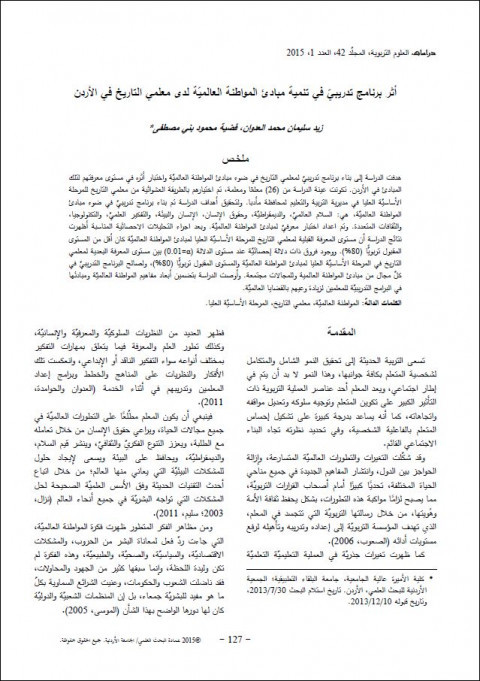 The Effect of a Training Program on Developing the Global Citizenship Principles of the History Teachers in Jordan Year of publication: 2015 Author: Zaid Suleiman Corporate author: University of Jordan This study aimed at building a training program for the history teachers in the light of the global citizenship principles and at testing its effect on their knowledge level of those principles, in Jordan. Study sample consisted of (26) male and female teachers randomly selected from the history teachers for the higher of Basic Education, in the education Directorate of the Ma'daba Governorate.To achieve the study goals, a training program was developed in the light of the global citizenship principles, which are: global peace, democracy, human rights, humans and the environment, scientific thinking, technology, and multicultures. and a cognitive test of the global citizenship's principles was prepared. After performing the relevant statistical analysis, the results revealed that the pre-knowledge level of the history among those teachers of the global citizenship principles was lower than the educationally accepted level (80%), and the presence of differences with statistical significance (α=0.01) between the post-knowledge level among the history teachers at the higher stage of basic education about the global citizenship principles and the educationalyl accepted level (80%), in favor of the training program in each domain of the global citizenship's principles and the domains collectively. The study recommended the inclusion of the global citizenship principles and concepts in the teachers training programs in order to increase their awareness in the global issues.