
Resources
Explore a wide range of valuable resources on GCED to deepen your understanding and enhance your research, advocacy, teaching, and learning.
8,370 Results found
 Between Distanced Textual Analysis and Moral Judgment – an Excerpt from Mein Kampf in History Class Year of publication: 2002 Author: Oliver Hollstein The original title: Zwischen Distanzierter Textanalyse und Moralischer Verurteilung – ein Auszug aus Mein Kampf im Geschichtsunterricht(Pädagogische Korrespondenz, 29, pp. 70–87)This case study analyses how students in a German Upper Secondary class works with an excerpt from Mein Kampf in a thematic block about the Nazi state’s racist ideology and propaganda.The above abstract is taken from the International Holocaust Remembrance Alliance Education Research Project. Please also consult the full list of abstracts in 15 languages and the accompanying publication Research in Teaching and Learning about the Holocaust: A Dialogue Beyond Borders. Ed: IHRA, Monique Eckmann, Doyle Stevick, Jolanta Ambrosewicz-Jacobs, 2017, Metropol Verlag at www.holocaustremembrance.com/resources/publications.
  Before the Fire is Extinguished: The Commemoration Work at Nazi Memorial Sites as a Project of Political Learning Year of publication: 2003 Author: Peter Gstettner The original title: Bevor die Glut verlöscht: Die Erinnerungsarbeit an NS-Tatorten als ein Politisches Lernprojekt(In Jahrbuch für Pädagogik 2003)The author reflects upon his experience of reconstructing Nazi history in Germany. All efforts to spread light upon the dark sides of this history end up in the attempt to break the collective silence and to retune the song from “the good old times.” Memorial sites pedagogy and educational policies must decide the relevance of the past for the present, expose local Nazi history, and set the gaze, across the wall of silence, on the future. Tangible memory work and personal experiences of pain are steps towards makingxsubmerged memories, obliterated traces and forgotten places useful again for an education for democracy and tolerance. (Written by publisher) The above abstract is taken from the International Holocaust Remembrance Alliance Education Research Project. Please also consult the full list of abstracts in 15 languages and the accompanying publication Research in Teaching and Learning about the Holocaust: A Dialogue Beyond Borders. Ed: IHRA, Monique Eckmann, Doyle Stevick, Jolanta Ambrosewicz-Jacobs, 2017, Metropol Verlag at www.holocaustremembrance.com/resources/publications.
  Anthropology of Citizenship? ... Ethnic. Under Construction from Latin America Year of publication: 2007 Author: Xochitl Leyva Solano The main argument of this article develops around the concept of citizenship which I will examine taking as a starting point contributions made in the fields of law studies, philosophy and anthropology. There have been considerable advances in the social sciences with the proposition and discussion of new composite concepts such as “multicultural citizenship”, “intercultural citizenship”, and “ethnic citizenship”. With “ethnic citizenship” in particular, scholars have been trying to respond to the history and nature of the demands, claims and struggles that indigenous organizations and communities, movements and their leaders have made in Latin America over the past three decades. ¿Who proposed this concept, and when, where and for what purposes was it developed? What are the advantages and limits of “ethnic citizenship”? Who is using this concept now and in what social and political contexts? This discussion leads me to ask whether it is possible to speak of an emerging, alternative Latin American model of interpretation.
  Education for Democratic Citizenship in Secondary Schools in Latin America Year of publication: 2005 Author: Fernando Reimers, Eleonora Villegas Reimers Corporate author: Banco InterAmericano de Desarrollo (BID) This document was commissioned by the Educational Network of the Regional Policy Dialogue for the VII Hemispheric Meeting held on February 17 and 18, 2005. This report is a contribution to the discussion of the Dialogue on Formation for Democracy and Secondary Education in Latin America. In this text, we present an analysis of the results of a survey on education for democracy carried out as part of the activities of the Education Network, which was sent by the Bank to the member countries of the Dialogue2. We frame these results in a conceptualization of what it means to educate for democracy. We complement the discussion with information from additional sources that illuminate different aspects of the conceptual framework proposed here.
 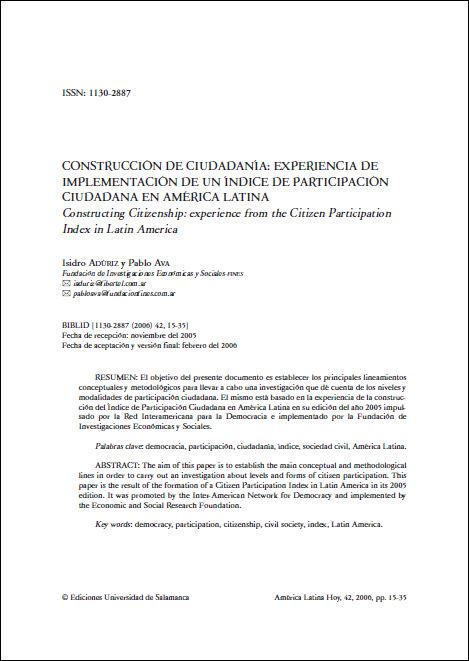 Construction of Citizenship: Experience of Implementing an Index of Citizen Participation in Latin America Year of publication: 2006 Author: Isidro Adúriz | Pablo Ava Corporate author: Universidad de Salamanca The aim of this paper is to establish the main conceptual and methodological lines in order to carry out an investigation about levels and forms of citizen participation. This paper is the result of the formation of a Citizen Participation Index in Latin America in its 2005 edition. It was promoted by the Inter-American Network for Democracy and implemented by the Economic and Social Research Foundation.
 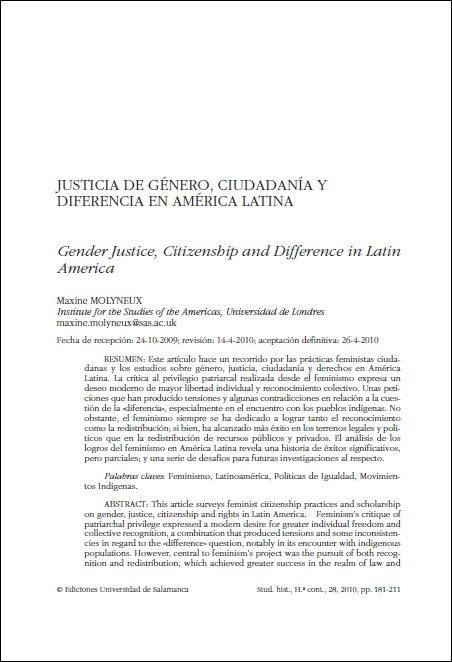 Gender Justice, Citizenship and Difference in Latin America Year of publication: 2010 Author: Maxine Molyneux This article surveys feminist citizenship practices and scholarship on gender, justice, citizenship and rights in Latin America. Feminism’s critique of patriarchal privilege expressed a modern desire for greater individual freedom and collective recognition, a combination that produced tensions and some inconsistencies in regard to the «difference» question, notably in its encounter with indigenous populations. However, central to feminism’s project was the pursuit of both recognition and redistribution, which achieved greater success in the realm of law and politics than in the distribution of public and private goods. A review of Latin American feminism’s achievements reveals a history of substantial advances but a striking persistence of gender inequality, which provides a rich agenda for further investigation.
 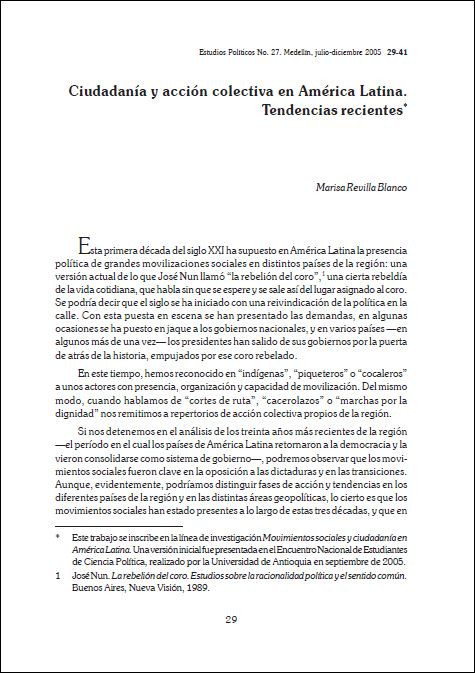 Citizenship and Collective Action in Latin America. Recent Trends Year of publication: 2005 Author: Marisa Revilla Blanco The following text intends to analyze those forms of collective action through which citizens have been present in the streets of the region during the last thirty years. It seeks to understand the actors and the conditions of their appearance and continuity; In this way, it is also intended to make a small contribution to the theoretical development of the analysis of social movements in Latin America.
 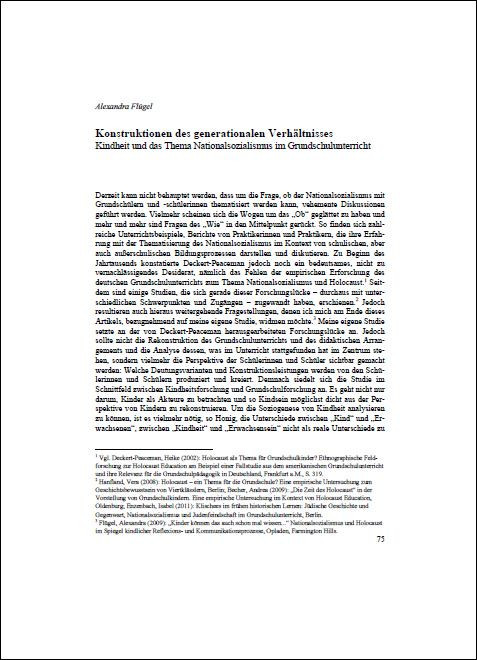 Constructions of Generational Relations: Childhood and the Theme of National Socialism in Primary-School Education Year of publication: 2012 Author: Alexandra Flügel The original title: Konstruktionen des Generationalen Verhältnisses: Kindheit und das Thema Nationalsozialismus im Grundschulunterricht(Kinder und Zeitgeschichte: Jüdische Geschichte und Gegenwart, Nationalsozialismus und Antisemitismus, Supplement 8, pp. 75–84) This is a qualitative study, based on the results in Fügel 2009, of German primary school children’s communication about Nazism and the Holocaust. It demonstrates how interwoven these exchanges are with general German memory discourses about these topics, but also how the children already at the age of 9–10 reflect upon their need to learn about this dark side of German history.The above abstract is taken from the International Holocaust Remembrance Alliance Education Research Project. Please also consult the full list of abstracts in 15 languages and the accompanying publication Research in Teaching and Learning about the Holocaust: A Dialogue Beyond Borders. Ed: IHRA, Monique Eckmann, Doyle Stevick, Jolanta Ambrosewicz-Jacobs, 2017, Metropol Verlag at www.holocaustremembrance.com/resources/publications.
 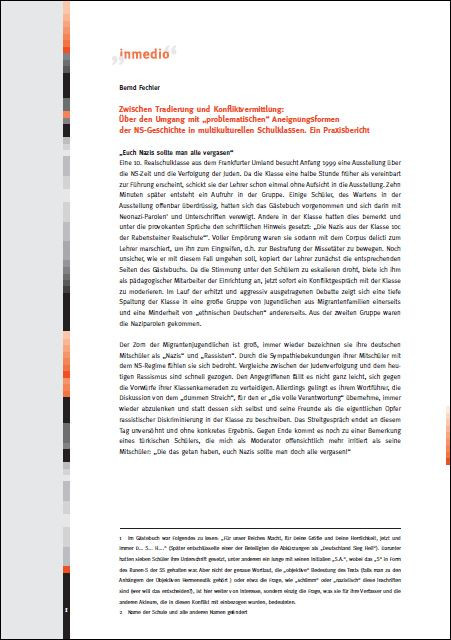 Between Transmission and Conflict Mediation: On the Handling of “Problematic” Forms of Appropriation of Nazi History in Multicultural School Classes Year of publication: 2000 Author: Bernd Fechler The original title: Zwischen Tradierung und Konfliktvermittlung: Über den Umgang mit “Problematischen” Aneignungsformen der NS-Geschichte in Multikulturellen Schulklassen(Erziehung nach Auschwitz” in der multikulturellen Gesellschaft: Pädagogische und soziologische Annäherungen, pp.1-18) Discussion of the challenges of Holocaust education a multicultural setting, based on a case when a German 10th grade class visited an exhibition about the Nazi period, something which led to an intense conflict between “German” and “immigrant” students.The above abstract is taken from the International Holocaust Remembrance Alliance Education Research Project. Please also consult the full list of abstracts in 15 languages and the accompanying publication Research in Teaching and Learning about the Holocaust: A Dialogue Beyond Borders. Ed: IHRA, Monique Eckmann, Doyle Stevick, Jolanta Ambrosewicz-Jacobs, 2017, Metropol Verlag at www.holocaustremembrance.com/resources/publications
 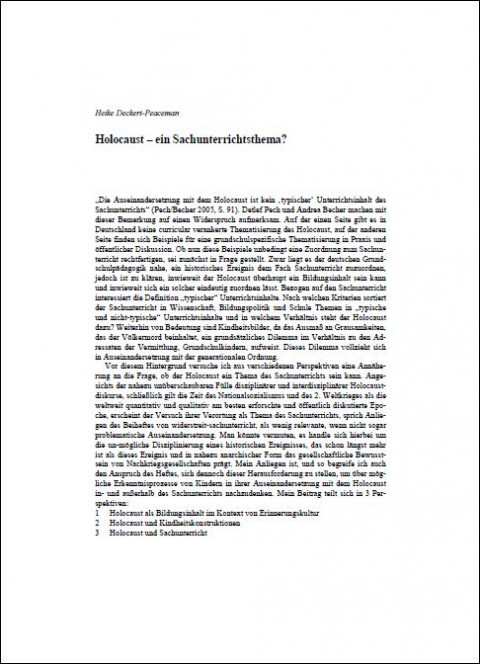 The Holocaust – A Theme for Instruction in General Subjects? Year of publication: 2006 Author: H. Deckert-Peaceman The original title: Holocaust – ein Sachunterrichtsthema?(Möglichkeiten und Relevanz der Auseinandersetzung mit dem Holocaust im Sachunterricht der Grundschule. Supplement, 3, pp. 35–50) An interesting discussion about the Holocaust as a topic for younger children, and especially about the use of youth literature in Holocaust education, but not an empirical analysis.The above abstract is taken from the International Holocaust Remembrance Alliance Education Research Project. Please also consult the full list of abstracts in 15 languages and the accompanying publication Research in Teaching and Learning about the Holocaust: A Dialogue Beyond Borders. Ed: IHRA, Monique Eckmann, Doyle Stevick, Jolanta Ambrosewicz-Jacobs, 2017, Metropol Verlag.