
Resources
Explore a wide range of valuable resources on GCED to deepen your understanding and enhance your research, advocacy, teaching, and learning.
8,370 Results found
 “Just Don’t Moralize!” Emotional Processes in the Pedagogical Engagement with National Socialism Year of publication: 2008 Author: Gudrun Brockhaus The original title: “Bloß nicht moralisieren!” Emotionale Prozesse in der pädagogischen Auseinandersetzung mit dem Nationalsozialismus(Einsichten und Perspektiven, Bayerische Zeitschrift für Politik und Geschichte, 1(8), pp. 28–33.) The article is a critical reflection on the outcomes of an empirical study (Kühner 2008; Kühner et al. 2008), based on a psychological/psychoanalytical perspective: how should we deal with emotions when dealing with the Holocaust? The author highlights the teachers’ very high expectations regarding the emotional Betroffenheit, the pressure on consensus, and the tabooisation of “political incorrectness” in the classroom, tendencies that can lead to a problematic teacher-student relationship. Thus, teachers encounter specific didactical difficulties and show a certain lack of self-assertion. Brockhaus assumes that this is based on how the teacher relates, as a person and as a pedagogue, to the heritage of National Socialism. Brockhaus concludes by insisting on the necessity to reflect openly, as students and as teachers, on the emotional processes and the reluctance caused by the topic of the Holocaust in this society. The above abstract is taken from the International Holocaust Remembrance Alliance Education Research Project. Please also consult the full list of abstracts in 15 languages and the accompanying publication Research in Teaching and Learning about the Holocaust: A Dialogue Beyond Borders. Ed: IHRA, Monique Eckmann, Doyle Stevick, Jolanta Ambrosewicz-Jacobs, 2017, Metropol Verlag at www.holocaustremembrance.com/resources/publications
  The Time Period of the Holocaust in the Beliefs of Primary School Children – Children’s Perspectives and the Thematization of the Holocaust and National Socialism in Primary-School Instruction (in General Subjects) Year of publication: 2012 Author: Andrea Becher The original title: Die Zeit des Holocaust in Vorstellungen von Grundschulkindern – Perspektiven von Kindern und die Thematisierung von Holocaust und Nationalsozialismus im (Sach-)Unterricht der Grundschule(In I. Enzenbach, C. Klätte, & D. Pech, (Eds.). Kinder und Zeitgeschichte: Jüdische Geschichte und Gegenwart, Nationalsozialismus und Antisemitismus, Supplement, 8, pp. 101–120) This is a summary of a study of German primary school children’s beliefs about the Holocaust, based on interviews conducted in two classes in 2005. The author finds that the children almost exclusively focus on Hitler; that one can find “latent anti-Semitic fragments” in their statements; that, even without formal education, the pupils still possess knowledge about the Holocaust; and their main source of information about Nazi Germany seems to be family members. However, the family narratives mainly touch upon everyday-life and avoid the topic of the Holocaust. From these findings, the author argues that one could and should teach the Holocaust already in the German primary school. The above abstract is taken from the International Holocaust Remembrance Alliance Education Research Project. Please also consult the full list of abstracts in 15 languages and the accompanying publication Research in Teaching and Learning about the Holocaust: A Dialogue Beyond Borders. Ed: IHRA, Monique Eckmann, Doyle Stevick, Jolanta Ambrosewicz-Jacobs, 2017, Metropol Verlag.
  Collected: Educational Project about “Learning from Biographies” in General Sciences in Primary School Year of publication: 2006 Author: A. Becher Original Title: Eingesammelt: Ein Unterrichtsprojekt zum‚ “Lernen an Biographien” im Sachunterricht der Grundschule(In D. Pech, M. Rauterberg, & K. Stocklas, (Eds.). Möglichkeiten und Relevanz der Auseinandersetzung mit dem Holocaust im Sachunterricht der Grundschule, Supplement 3, pp. 17–34) The article presents a project aimed at developing suitable methods for Holocaust Education already in the German primary school. Based on Ido Abram’s three-step-program as well as Wolfgang Klafki’s critical didactics, the project has developed a biographical approach to create possibilities for identification among the students. This is tested in a 3rd grade class and is thereafter evaluated.The above abstract is taken from the International Holocaust Remembrance Alliance Education Research Project. Please also consult the full list of abstracts in 15 languages and the accompanying publication Research in Teaching and Learning about the Holocaust: A Dialogue Beyond Borders. Ed: IHRA, Monique Eckmann, Doyle Stevick, Jolanta Ambrosewicz-Jacobs, 2017, Metropol Verlag at www.holocaustremembrance.com/resources/publications.
  Education, Development and Citizenship in Latin America: Proposals for the Debate Year of publication: 2011 Author: Alicia Barcena | Narcis Serra Corporate author: Naciones Unidas. Comisión Económica para América Latina y el Caribe (CEPAL) | Centro de Estudios y Documentación Internacionales de Barcelona (CIDOB) Through ADI, an initiative promoted by CIDOB, the Ibero-American General Secretariat (SEGIB) and the Economic Commission for Latin America and the Caribbean (ECLAC), with the support of various sponsoring companies, it is intended to encourage academic debate along with the political debate on diverse issues crucial for the region. Through a rigorous analysis of the social, economic and political reality carried out by academics, public policymakers and other key actors in the development process in Latin America, the aim is to offer recommendations that make economic growth compatible with well-being of the majorities. This publication constitutes the fifth volume of the series and is the result of the willingness of the participating institutions to disseminate, as much as possible, the ideas and discussions that emerged in the seminar. Its reading is a fundamental element to understand the current state of education in the region, as well as the possibilities that exist in this area to continue advancing in inclusion and development.
 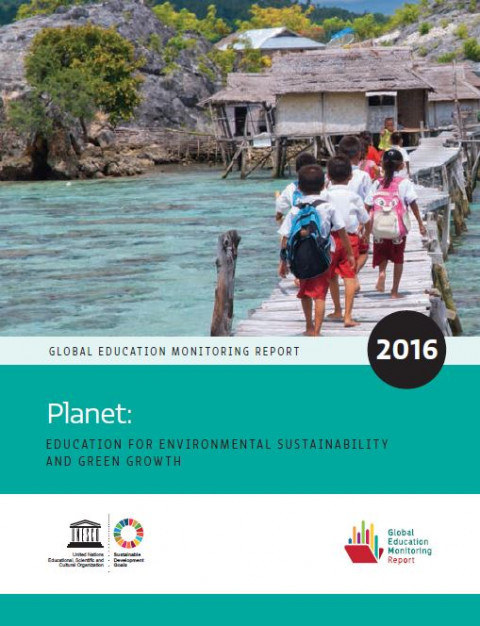 Global Education Monitoring Report, 2016: Planet: Education for Environmental Sustainability and Green Growth Year of publication: 2016 Corporate author: UNESCO PLANET: Education for environmental sustainability and green growth, a publication taken from the full 2016 Global Education Monitoring Report, explores the knowledge and skills needed for sustainable and inclusive economic growth that does not damage our planet.This publication demonstrates how education can help people understand and respond to environmental issues and climate change. Environmental education can increase green knowledge and build sustainability practices. The publication warns that while education contributes to economic growth, education systems must be careful not to encourage unsustainable lifestyles and all learners must acquire the knowledge and skills needed to promote sustainable development.It also argues that we must continue to learn throughout our lives in order to make production and consumption sustainable, and to provide green skills for green industries. Creating green industries relies on high-skill workers with specific training, yet by 2020 there could be 40 million too few workers with tertiary education relative to demand. Higher education and research should also be oriented towards green innovation and growth; innovation depends on cooperation in higher education and investment in research and development to transform production in vast swaths of the economy.It also recognises that education must change in order to keep up with the changing face of work. Green and transferable skills should be taught in both school and the workplace. The greening of industries requires not only the production of more high-skill workers, but the continued training and education for low and medium skill workers, often on the job. “To ensure the Sustainable Development Goals are implemented, everyone involved needs to think, to work, to organise, to communicate and to report in ways that are completely different from what has been done up till now. Education truly is key to a wide appreciation not just of the SDGs but the new ways of thinking and working that are going to be necessary to fulfil them. So the challenge to all of us is to re-learn, and that does not just apply to educators, but it applies to all of us.”
  Participatory Planning to Achieve Structural Change with Equality: Citizen Participation Strategies in Multi-scale Planning Processes Year of publication: 2015 Author: Alicia Williner | Andrea Sanhueza | Carlos Sandoval Corporate author: United Nations (UN) This manual that ILPES places at the disposal of public officials and non-governmental agents working in the community, has the purpose of sharing a brief theoretical reflection on the current socio-political context through which this manual becomes important; and a set of methodological instruments that will bring the user closer to the social practice of a citizen participation process in the construction of a public management instrument. The manual is divided into two chapters: The first conceptualizes participatory multiscale planning, while also briefly introducing three topics of great importance to be incorporated into any participatory planning process and construction of public management instruments: the perspective of gender, the use of Convention 169 and Principle 10. The second chapter systematizes a set of methodological instruments that describe the stages of a citizen participation strategy to incorporate the multiscale public management instruments. The manual closes with two annexes, the last of which incorporates a set of tools that can be used in the stages of the construction of a citizen participation strategy.
  Inclusive Education Year of publication: 2008 Corporate author: UNESCO International Bureau of Education (IBE) Inclusive education: the road to the future is the subject of the forty-eighth meeting of the International Conference on Education (CIE) to be held in Geneva from November 25 to 28, 2008. I believe that a genuine dialogue and a frank debate between Ministers and other education actors on this central theme and on the four related sub-themes: approaches, scope and content; public politics; systems, interfaces and transitions, and students and teachers, will be both timely and appropriate.
  Human Right and Encryption Year of publication: 2016 Author: Wolfgang Schulz | Joris van Hoboken Corporate author: UNESCO This publication follows UNESCO’s new approach to Internet issues, as endorsed in November 2015 on the occasion of its 38th General Conference. Our 195 Member States have adopted the CONNECTing the Dots Outcome Document, in which 38 options for future action from UNESCO are set out; and the Internet Universality principles (R.O.A.M.),which advocates for a Human-rights-based, Open and Accessible Internet, governed by Multi-stakeholder participation.Encryption is a hot topic in the current global discussion on Internet governance. This research delves into the subject, to outline a global overview of the various means of encryption, their availability and their potential applications in the media and communications landscape. The research explains how the deployment of encryption is affected by different areas of law and policy, and it offers detailed case studies of encryption in selected jurisdictions.It analyzes in-depth the role of encryption in the media and communications landscape, and the impact on different services, entities and end users. Built on this exploration and analysis, the research provides recommendations on encryption policy that are useful for various stakeholders. These include signaling the need to counter the lack of gender sensitivity in the current debate, and also highlighting ideas for enhancing “encryption literacy”.
  Education for a Democratic Citizenship in the Countries of Latin America: A Critical Look Year of publication: 2007 Author: Bradley A.U. Levinson | Juan G. Berumen This report is a contribution to the discussion of the Regional Policy Dialogue on training for democracy and secondary education in Latin America. In this text, we present an analysis of the results of a survey on education for democracy carried out as part of the activities of the Education Network, which was sent by the Bank to the member countries of the Dialogue. We frame these results in a conceptualization of what it means to educate for democracy. We complement the discussion with information from additional sources that illuminate different aspects of the conceptual framework proposed here.
 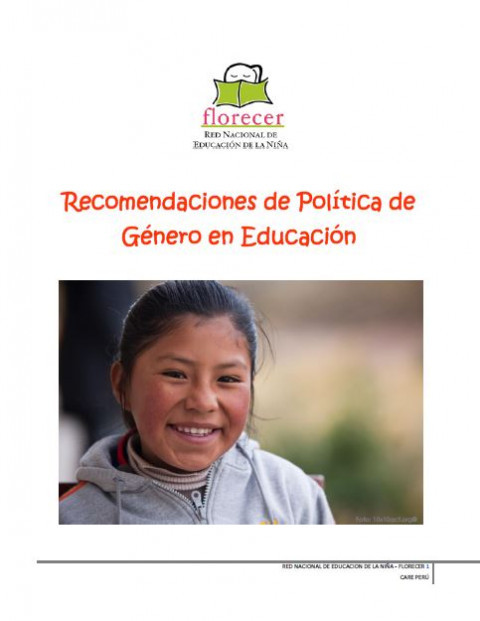 Gender Policy Recommendations in Education Year of publication: 2015 Corporate author: Red Nacional de Educación de la Niña This document synthesizes the proposals of the Florecer Network to advance in gender equality, convinced that the commitment to a more just and more human world necessarily involves the assumption of equality between men and women. The principle that the rights of women and girls are an integral, inalienable and indivisible part of universal human rights has been reaffirmed from the various international forums. Greater equity between men and women is also beneficial for the development of the country. A country with educated girls and women has a lower birth rate, improves their health and productivity conditions. This document synthesizes the main proposals of the Gender and Citizenship Forum: imperative for a quality education, organized by Red Florecer in May 2013 year. We want to put them in the hands of decision-makers and citizens in general to help concretize the mandates of equality between men and women in education. It is time not to give up dreams because they have become possible.