
Resources
Explore a wide range of valuable resources on GCED to deepen your understanding and enhance your research, advocacy, teaching, and learning.
8,370 Results found
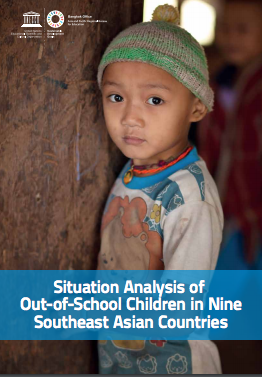 Situation analysis of out-of-school children in nine southeast Asian countries Year of publication: 2017 Corporate author: UNESCO Bangkok In a world that continually aspires for every child and youth to have access to education, there are still large numbers of out-of-school children (OOSC) who are yet to claim their right to basic education. In 2013, the number of children who are not in school, who have dropped out, and who have never been to school have risen to 124 million after seeing the numbers continuously drop for much of the first decade of the 21st century. In much of Southeast Asia, close to seven million children of both primary and lower secondary school-age find themselves in the same situation. In an effort to assist the countries in Southeast Asia to develop more robust policies and programmes for OOSC in their respective countries, this report was commissioned to map out the current legislations, policies, characteristics, and interventions on out-of-school children in nine countries across the region, which include Cambodia, Indonesia, Lao PDR, Malaysia, Myanmar, the Philippines, Thailand, Timor-Leste and Vietnam. Using a desk review of available and relevant secondary data, the study covered OOSC of primary and lower secondary school-age.
  UNESCO’s GLOBAL/REGIONAL COORDINATION OF AND SUPPORT FOR THE IMPLEMENTATION OF SDG 4 – EDUCATION 2030 Year of publication: 2017 Corporate author: UNESCO
 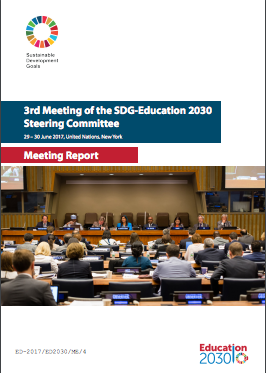 3rd Meeting of the SDG-Education 2030 Steering Committee, 29-30 June 2017, United Nations, New York: meeting report Year of publication: 2017 Corporate author: UNESCO An inclusive high-level multi-stakeholder partnership, the SDG-Education 2030 Steering Committee (SC) provides a global forum for consultation and a mechanism to coordinate and harmonize global education efforts. It is mandated to provide strategic guidance to Member States and the education community, make recommendations for catalytic action, advocate for adequate financing, and monitor progress toward SDG4 targets through the UNESCO Institute for Statistics and the Global Educational Monitoring (GEM) Report. The 3 rd meeting of the SC was organized in New York on 29-30 June 2017 back to back with the HighLevel Action SDG Action Event on Education convened by the President of the UN General Assembly, Peter Thompson, in partnership with key SDG 4 stakeholders, to drive a new push for inclusive and equitable quality education and lifelong learning opportunities. At this meeting the SC examined successes and challenges in the implementation of SDG4 since the adoption of the 2030 Agenda. After highlighting the critical role of regional organizations as policy peer learning mechanisms in enhancing effective implementation of SDG4-Education 2030, the SC endorsed a set of recommendations for improved implementation in 2018 and 2019.
  A Decade of progress on education for sustainable development: reflections from the UNESCO Chairs Programme Year of publication: 2017 Author: Michelsen, Gerd | Wells, Peter J. Corporate author: UNESCO The UNITWIN/UNESCO Chairs Programme, launched in 1992, today forms an extensive network of inter-university cooperation involving more than 700 higher education institutions in 128 countries worldwide. Through knowledge sharing and collaborative research in the priority areas of UNESCO’s work in education, the natural and social sciences, culture, communication and information, the Chairs provide a vital contribution to the Organization’s mission. The current volume focuses on the activities undertaken by UNESCO Chairs dedicated to the field of Education for Sustainable Development (ESD) within the context of the UN Decade of ESD which culminated in the UNESCO World Conference on ESD, held in AichiNagoya, Japan, 2014. The case studies included, showcase the good practices, applied research and curricula innovations pioneered by the individual UNESCO Chairs, as well as highlighting the challenges and lessons learned both for the new follow-up Global Action Programme (GAP) on ESD and the wider Education 2030 Agenda.
 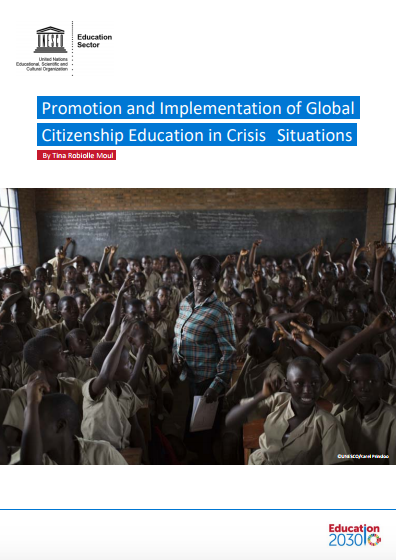 Promotion and implementation of global citizenship education in crisis situations Year of publication: 2017 Author: Robiolle Moul, Tina Corporate author: UNESCO Crisis situations affect the realization of human rights of many people and communities across all regions of the world. Within UNESCO’s relevant areas of work, GCED is a powerful approach to education that can empower people to recover from crises and transform their communities into peaceful and sustainable societies. UNESCO commissioned a desk study that aimed at reviewing existing research on the promotion and implementation of GCED and related programs in countries affected by crisis situations, with particular attention to initiatives benefiting the refugee population. This study unveils the key challenges these programs encounter in such contexts, as well as promising practices that can guide the design and implementation of future GCED in crisis situations.This report is a synthesis of this desk study and supports the evidence that, after analyzing the context and the available means, GCED and related programs can and should be systematically adapted and implemented in crisis situations, including in response to refugee crises.
 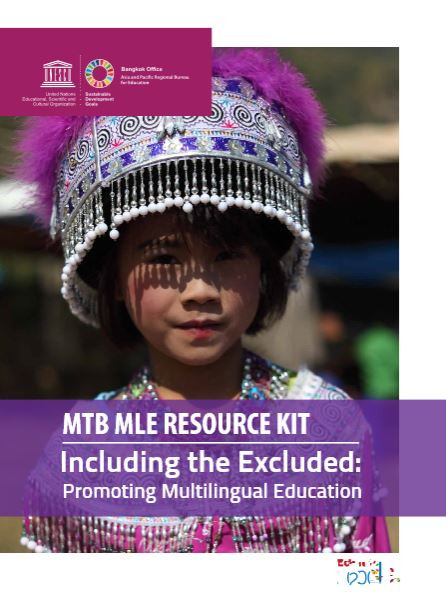 MTB MLE resource kit: Including the excluded: promoting multilingual education Year of publication: 2016 Author: Susan Malone Corporate author: UNESCO Bangkok Who Can Use this Resource Kit?This MTB MLE Resource Kit is for people who are committed to the idea that all children have the right to quality education in a language they speak and understand. MTB MLE programmes that are sustained within the formal education system require contributions from all stakeholders, working together and supporting one another. The next three booklets were developed for three specific stakeholder groups: policy makers, programme implementers and community members. These three booklets, with the case studies, provide a “big picture” of successful MTB MLE programmes and suggestions for the roles each group can take as they plan, implement and maintain their programmes. How Can You Use this Resource Kit?Each booklet is organized around key questions about MTB MLE that are frequently asked by policy makers, implementers and community members. Responses to each question include examples of specific activities that are part of successful MTB MLE programmes in a variety of contexts. Working together, stakeholders can identify the specific activities that are best suited for their own situation and make the best use of all available resources.
 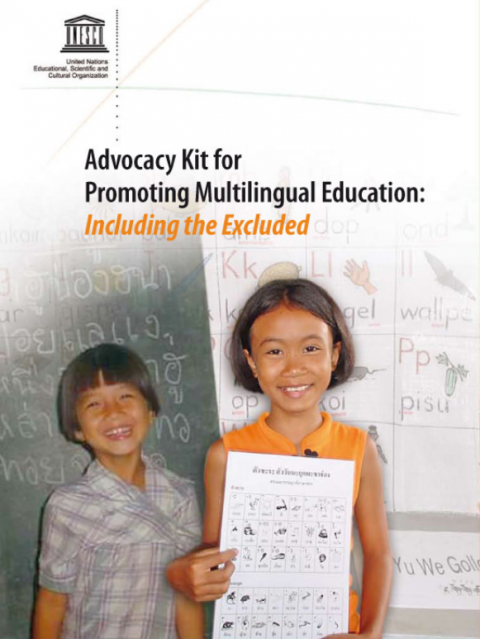 Advocacy kit for promoting multilingual education: including the excluded Year of publication: 2007 Corporate author: UNESCO Bangkok Who Can Use This Kit? This kit was prepared for all of those who want to ensure that “Education for All” does, indeed, include everyone! The kit will be especially valuable for policy makers, education practitioners and specialists who want to improve access to and quality of education for those excluded by language. It will also be helpful for speakers of ethnic minority languages who want to improve the education situation in their own communities.This kit is designed to raise awareness on the importance of mother tongue-based multilingual education (MLE). It presents key arguments and facts about MLE and provides important insights about the value and benefits of providing education in learners’ mother tongue. The kit also presents ideas, research findings and concrete examples that you can use to think about your own situation and suggests steps for taking actions to make your school system more responsive to linguistic diversity.The kit is not a definitive textbook, and it will not have an answer for every problem that you might face. To help you as much as possible, at the end of each booklet we have included lists of references. In addition, each booklet contains a glossary of terms and, at the front of each booklet is a one-page summary of its contents.How Can You Use This Kit? This kit contains three main booklets. Each booklet has a designated audience: 1) policy makers, 2) education programme planners and practitioners and 3) community members. Please remember that developing MLE requires contributions from everyone at all levels. For that reason, we encourage you to use all three booklets along with other available resources as you work together to plan, implement and sustain your MLE programmes.This kit can be used in many different ways. For those who are already involved in MLE programmes, you might use these ideas to help you to promote mother tongue instruction and strengthen your programme. Those who are not familiar with multilingual education but want to improve educational access for minority language students might use these booklets to identify specific points that they can investigate and discuss in their own contexts.
  Why and how Africa should invest in African languages and multilingual education: an evidence- and practice-based policy advocacy brief Year of publication: 2010 Author: Adama Ouane | Christine Glanz Corporate author: UNESCO Institute for Lifelong Learning (UIL) | Association for the Development of Education in Africa (ADEA) This advocacy brief seeks to show the pivotal role of languages in achieving such learning. It aims in particular to dispel prejudice and confusion about African languages, and exposes the often hidden attempt to discredit them as being an obstacle to learning. It draws on research and practice to argue what kind of language policy in education would be most appropriate for Africa.
  Optimising learning, education and publishing in Africa: the language factor; a review and analysis of theory and practice in mother-tongue and bilingual education in sub-Saharan Africa Year of publication: 2011 Author: Adama Ouane | Christine Glanz Corporate author: UNESCO Institute for Lifelong Learning (UIL) | Association for the Development of Education in Africa (ADEA) This analytical review consists of three sections. The first section lays the theoretical foundations and is covered by Ekkehard Wolff and Kathleen Heugh: 1) language politics and planning in the light of development and 2) theories of bi- and multilingual education models and their implementation in the African context. A second section analyses teaching practices and classroom interaction in schools in two chapters by Birgit Brock-Utne and Hassana Alidou. This is followed by a review of the use of African languages in literacy and non-formal education by Hassana Alidou1 . Next, a review study by Kathleen Heugh addresses the critical issue of costs by assessing the costs related to implementing mother tongue and strong bilingual education programmes. Finally, the third section explores the role of locally-based multilingual publishing in supporting and promoting African languages and developing the language industries and the creative sector. Here, Yaya Satina Diallo from Guinea and Peter Reiner2 from Namibia shed light on the promise and pitfalls of publishing in African languages.Each of these sections focuses on theoretical frameworks and specific strategies designed to optimise learning and education in multilingual Africa. The language issue is dealt with at the levels of: policy and development; costing and financing; educational reform and governance; education models; classroom interaction; formal and non-formal education settings; literacy and publishing.
 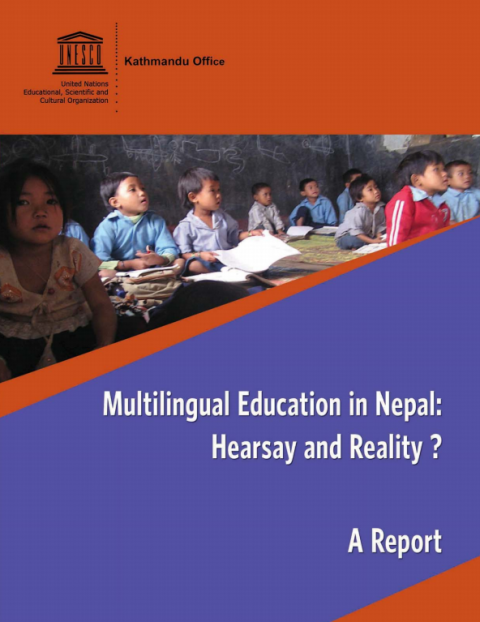 Multilingual education in Nepal: hearsay and reality? A report Year of publication: 2011 Author: Vishnu S. Rai | Maya Rai | Prem Phyak | Nabina Rai Corporate author: UNESCO Kathmandu The present study entitled “Multilingual Education in Nepal: Hearsay and Reality?” was started in April 2011 and completed on 25th May 2011. The main aim of the study was to explore and analyze the realities of the Multilingual Education (MLE) programme being practiced in seven schools from six different districts. The MLE programme was launched by the Department of Education (DOE) with the technical assistance of the Government of Finland in 2007. Nepal Government has planned to implement MLE in 300 schools in the coming years but there have been no comprehensive studies conducted to give an accurate picture of the MLE programme. In this context, the present study was carried out.