
Resources
Explore a wide range of valuable resources on GCED to deepen your understanding and enhance your research, advocacy, teaching, and learning.
8,370 Results found
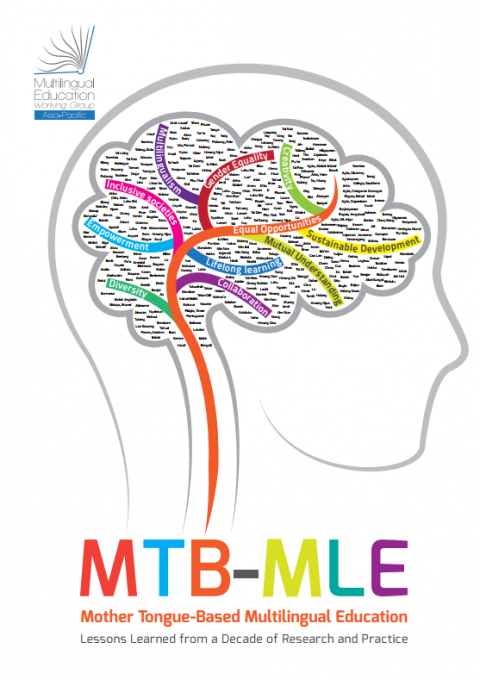 MTB-MLE: mother tongue-based multilingual education;lessons learned from a decade of research and practice Year of publication: 2014 Corporate author: Asia Multilingual Education Working Group This information is based on presentations and discussions at the 4th International Conference on Language and Education, ‘Multilingual Education for All in Asia and the Pacific: Policies, Practices and Processes’, held in Bangkok, Thailand in November 2013.
  Languages in adult literacy: policies and practices during the 15 years of EFA (2000-2015) Year of publication: 2015 Author: Clinton Robinson Linguistic diversity characterises many countries with large literacy needs. Meeting these needs will require a multilingual approach based on learning initial literacy in the learner’s mother tongue, with other languages used subsequently. This paper identifies five major challenges in implementing multilingual programmes, and traces the international policy developments over the 15 years of the EFA period. Four case studies – Mexico, Morocco, Papua New Guinea and Senegal – illustrate a range of policies, showing differing approaches and levels of commitment in providing literacy acquisition based on the mother tongue. The paper concludes with six policy orientations to guide action as part of the post- 2015 agenda.
  If you don't understand, how can you learn? Year of publication: 2016 Corporate author: UNESCO Key Messages:1. Children should be taught in a language they understand, yet as much as 40% of the global population does not have access to education in a language they speak or understand.2. Speaking a language that is not spoken in the classroom frequently holds back a child’s learning, especially for those living in poverty.3. At least six years of mother tongue instruction is needed to reduce learning gaps for minority language speakers.4. In multi-ethnic societies, imposing a dominant language through a school system has frequently been a source of grievance linked to wider issues of social and cultural inequality.5. Education policies should recognize the importance of mother tongue learning. 6. Linguistic diversity creates challenges within the education system, notably in areas of teacher recruitment, curriculum development and the provision of teaching materials.
  Addressing language of instruction issues in education: recommendations for documenting progress Year of publication: 2016 Author: Carol Benson Corporate author: Columbia University (USA). Teachers College This paper offers evidence-based recommendations for documenting international progress towards addressing language issues in education. The focus is on adapting the school language(s) of instruction to the home language(s) of learners. The paper begins by defining terms like L1 and explaining the concepts underlying multilingual education (MLE). Next there is a discussion of how to capture relevant linguistic and educational information from policy documents and linguistic sources, with examples from lowincome countries. This is followed by a set of questions that can and should be asked of any program to evaluate progress in addressing instructional language issues, focusing on the approach/methodology, teacher languages and skills, learner assessment, and program management, monitoring and evaluation. The paper concludes with some possible global indicators and suggestions for further research.
 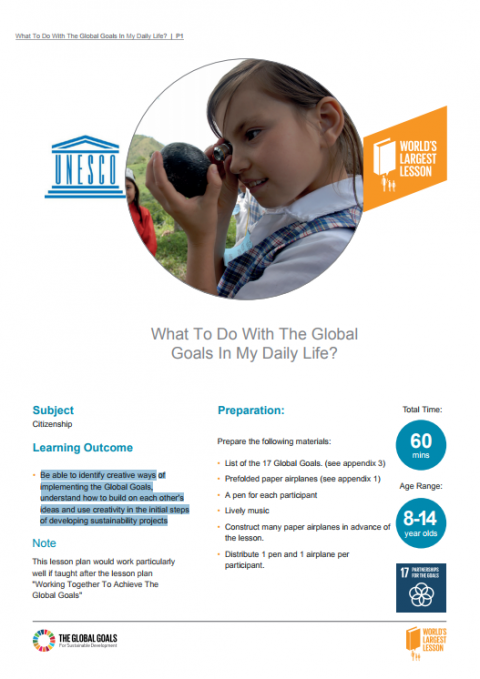 What To Do With The Global Goals In My Daily Life? Corporate author: United Nations Children's Fund (UNICEF) Learning outcomes: Be able to identify creative ways of implementing the Global Goals, understand how to build on each other’s ideas and use creativity in the initial steps of developing sustainability projects
  The global goals debate Corporate author: United Nations Children's Fund (UNICEF) Learning outcomes: To encourage critical debate about the Global Goals for Sustainable Development, so that young people are aware of the Goals, have critically evaluated them in their own minds and have drawn their own conclusions
  Introducing the Global Goals Corporate author: United Nations Children's Fund (UNICEF) Learners can explain what the Global Goals for Sustainable Development are, why they are important and how they relate to the learner her/himself.
  School for all: experiences of municipal public schools with inclusion of students with disabilities, ASD, GDD and high ability/giftedness Year of publication: 2017 Author: Carla Mauch | Wagner Santana Corporate author: UNESCO Brasilia This publication is the result of a research project entitled Good Practices in Inclusive Education: the experience of Brazilian municipalities with the inclusion of students with disabilities, Autism Spectrum Disorder (ASD), Global Developmental Disorder (GDD) and of high ability/giftedness students (Boas Práticas em Educação Inclusiva: a experiência de municípios brasileiros na inclusão de alunos com deficiência, transtornos do espectro autista (TEA), transtorno global do desenvolvimento (TGD) e altas habilidades/superdotação). The study set out to identify and analyse the practices of municipal public-school networks in Brazil concerning the educational inclusion of students with disabilities, ASD and GDD, as well as gifted/talented students. The initiative arose out of a will to subsidise and strengthen processes for the formulation and implementation of policies, programmes and projects aligned with the principles of the Convention on the Rights of Persons with Disabilities (United Nations, 2006; Brazil, 2009) and the National Special Education Policy in the Perspective of Inclusive Education (Política Nacional de Educação Especial na Perspectiva da Educação Inclusiva) (Brasil. MEC/SEESP, 2008c). It is important to point out that those normative frameworks bring principles and presuppositions that have been reaffirmed in more recent documents such as the Incheon Declaration (World Education Forum, UNESCO, 2015) and the Sustainable Development Goals (SDG) (United Nations, 2015).
  Ensuring the right to equitable and inclusive quality Education: results of the ninth consultation of Member States on the implementation of the UNESCO Convention and Recommendation against Discrimination in Education Year of publication: 2017 Corporate author: UNESCO The Convention and Recommendation against Discrimination in Education reflect UNESCO’s constitutional mission of instituting collaboration among nations to ‘advance the ideal of equality of educational opportunities without regard to race, sex, or any distinctions, economic or social.’ The purpose of these instruments, recently recognized as a cornerstone of the Education 2030 Agenda, is not only the elimination of discrimination in education, but also the adoption of concrete measures aimed at promoting equality of opportunities and treatment in this field. They cover the right to education comprehensively. The purpose of reporting is to illustrate the steps taken to implement the instruments, the progress made and the difficulties encountered by Member States. Eight Member State consultations have been conducted on the measures taken for the implementation of the 1960 Convention and Recommendation since the adoption of these instruments by the General Conference of UNESCO. Each of the consultations led to a global report containing the results of the consultation for submission to the UNESCO Executive Board’s Committee on Conventions and Recommendations and for consideration by the General Conference.
 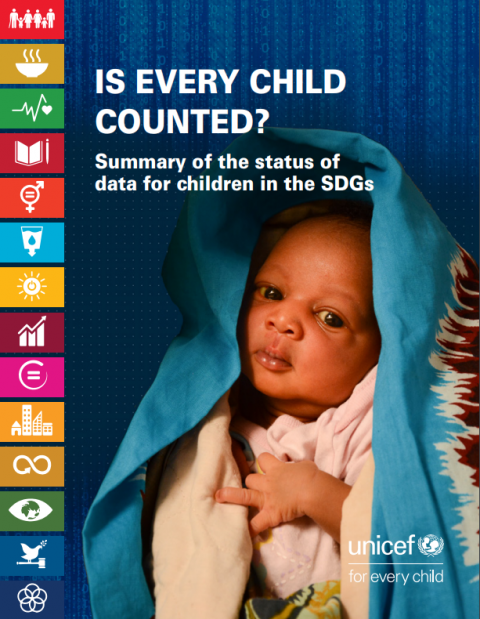 Is every child counted? Summary of the status of data for children in the SDGs Year of publication: 2017 Corporate author: United Nations Children's Fund (UNICEF) “Is every child counted”, a recent status report by UNICEF, shows that sufficient data are available for less than half of child-related SDG indicators. Many indicators, such as those on poverty and violence, are not comparable across countries, and are either too limited or of poor quality, leaving governments without the information they need to accurately address challenges facing millions of children, or to track progress towards achieving the Goals. Data are also very limited on the situation of the most disadvantaged populations within each country. Better disaggregated data on these populations is necessary. The report also identifies priorities for enhancing the collection, analysis and use of data for children.