
Resources
Explore a wide range of valuable resources on GCED to deepen your understanding and enhance your research, advocacy, teaching, and learning.
8,370 Results found
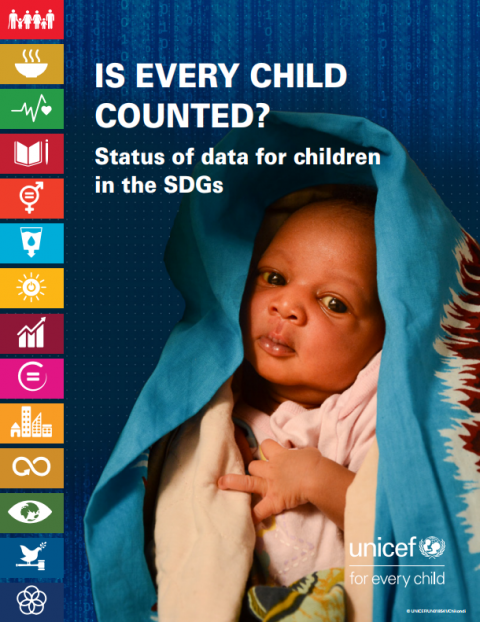 Is every child counted? Status of data for children in the SDGs Year of publication: 2017 Corporate author: United Nations Children's Fund (UNICEF) “Is every child counted”, a recent status report by UNICEF, shows that sufficient data are available for less than half of child-related SDG indicators. Many indicators, such as those on poverty and violence, are not comparable across countries, and are either too limited or of poor quality, leaving governments without the information they need to accurately address challenges facing millions of children, or to track progress towards achieving the Goals. Data are also very limited on the situation of the most disadvantaged populations within each country. Better disaggregated data on these populations is necessary. The report also identifies priorities for enhancing the collection, analysis and use of data for children.
  Address by Irina Bokova, Director-General of UNESCO on the occasion of the opening of the PGA High-Level SDG Action Event on Education SDG4 Year of publication: 2017 Corporate author: UNESCO. Director-General, 2009-2017 (Bokova, I.G.) This address was given by Irina Bokova, Director-General of UNESCO on the occasion of the opening of the PGA High-Level SDG Action Event on Education SDG4.
 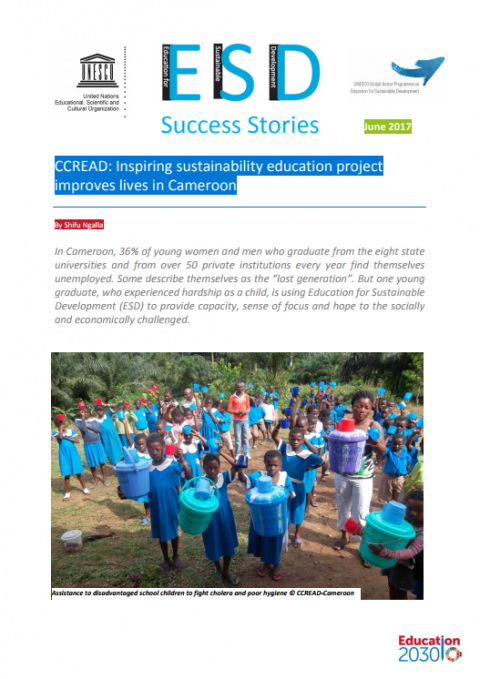 CCREAD: Inspiring sustainability education project improves lives in Cameroon (CAMEROON) Year of publication: 2017 Author: Shifu Ngalla Corporate author: UNESCO In Cameroon, 36% of young women and men who graduate from the eight state universities and from over 50 private institutions every year find themselves unemployed. Some describe themselves as the “lost generation”. But one young graduate, who experienced hardship as a child, is using Education for Sustainable Development (ESD) to provide capacity, sense of focus and hope to the socially and economically challenged.
  Lifelong learning from a social justice perspective Year of publication: 2017 Author: Carlos Vargas Corporate author: UNESCO Over the past two decades, a set of globally converging discourses on lifelong learning (LLL) has emerged around the world. Driven mostly by inter-governmental organizations, these discourses have been largely embraced by national and local education systems seeking to reflect local traditions and priorities. This paper argues that these discourses tend to look remarkably alike, converging into a homogeneous rationale in which the economic dimension of education predominates over other dimensions of learning, and in which adaptation takes pre-eminence over social transformation as a goal of LLL. It also shows how these converging discourses are embedded in the logic of the knowledge economy, driven by concern for human capital formation as dictated by the changing demands of the global labour market, and can neglect the learning needs and interests of local communities. The paper concludes that the globally converging discourse of LLL tends to serve the interests of the market ahead of those of the community, and argues that an alternative characterization of LLL, anchored in social justice, is necessary in the light of the 2030 Agenda for Sustainable Development, and especially Sustainable Development Goal 4, which aims to ensure inclusive and equitable quality education and to promote lifelong learning opportunities for all.
 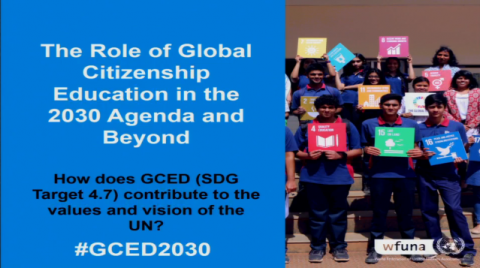 2017 UN Global Citizenship Education Seminar Year of publication: 2017 Corporate author: United Nations (UN) 2017 UN GCED SeminarThe Role of Global Citizenship Education in the 2030 Agenda and Beyond: How does global citizenship education (SDG Target 4.7) contribute to the values and vision of the United Nations?
 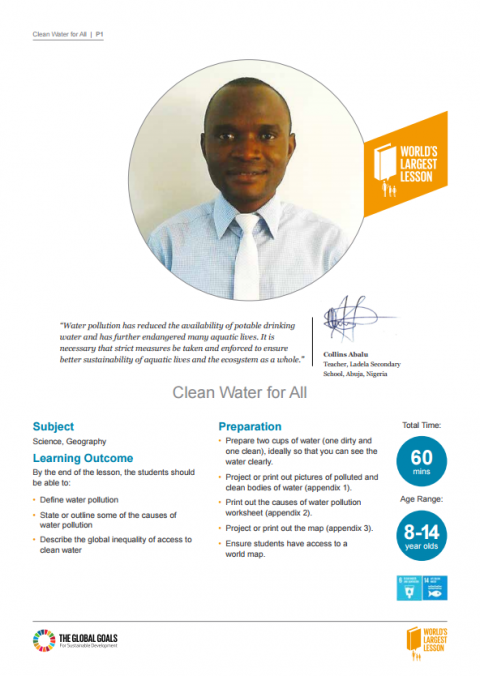 Clean Water for All Corporate author: United Nations Children's Fund (UNICEF) World’s Largest Lesson is a collaborative education project to support the announcement of the United Nations Global Goals for Sustainable Development. Learning outcome of the project: • Define water pollution • State or outline some of the causes of water pollution • Describe the global inequality of access to clean water
 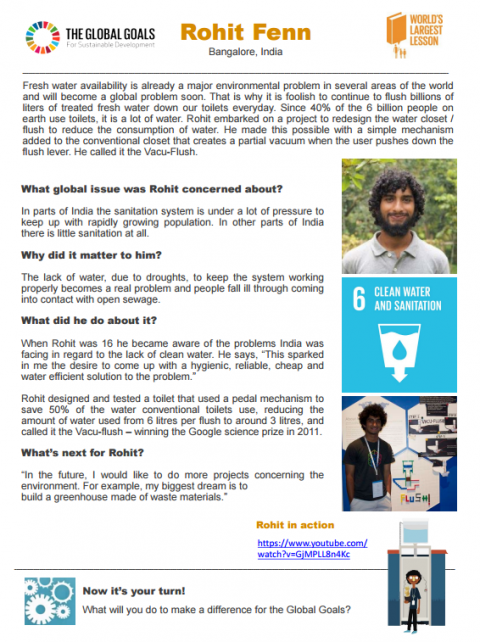 Rohit Fenn Corporate author: United Nations Children's Fund (UNICEF) Fresh water availability is already a major environmental problem in several areas of the world and will become a global problem soon. That is why it is foolish to continue to flush billions of liters of treated fresh water down our toilets everyday. Since 40% of the 6 billion people on earth use toilets, it is a lot of water. Rohit embarked on a project to redesign the water closet / flush to reduce the consumption of water. He made this possible with a simple mechanism added to the conventional closet that creates a partial vacuum when the user pushes down the flush lever. He called it the Vacu-Flush.
  Designing for a Circular Economy: Seeing The Bigger Picture - Lesson 4 Corporate author: United Nations Children's Fund (UNICEF) World’s Largest Lesson is a collaborative education project to support the announcement of the United Nations Global Goals for Sustainable Development. Learning outcomes of the project: • To learn about companies that have adopted the circular economy framework • To design a product or service based on the circular economy
  Understanding the Challenge of Finite Resources: Seeing The Bigger Picture - Lesson 3 Corporate author: United Nations Children's Fund (UNICEF) World’s Largest Lesson is a collaborative education project to support the announcement of the United Nations Global Goals for Sustainable Development. Learning outcomes of the project: • To understand and the urgent challenge that finite resources pose to our current economic system • To explore economic history since the industrial revolution through personal narrative • To critically evaluate our current consumption and production systems and explore better ways of dealing with resources.
 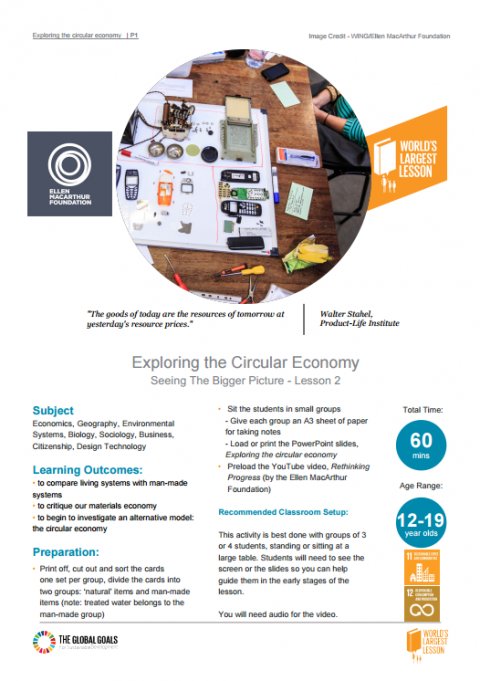 Exploring the Circular Economy: Seeing The Bigger Picture - Lesson 2 Corporate author: United Nations Children's Fund (UNICEF) World’s Largest Lesson is a collaborative education project to support the announcement of the United Nations Global Goals for Sustainable Development. Learning outcomes of the project: • to compare living systems with man-made systems • to critique our materials economy • to begin to investigate an alternative model: the circular economy