
Resources
Explore a wide range of valuable resources on GCED to deepen your understanding and enhance your research, advocacy, teaching, and learning.
8,370 Results found
 Analysis of Determinants of a Measure of Sustainability Literacy Year of publication: 2017 Author: Aurélien Decamps Corporate author: UNESCO This paper highlights the contribution of the Sulitest to analyse the determinants of sustainability literacy in higher education. Sulitest is an open online training and assessment tool designed to assess and improve sustainability literacy. It is a multi-stakeholder initiative supported by several UN agencies and academic networks. Based on collaboration through the volunteer contribution of an international community, this tool aims to be internationally recognized and locally relevant by addressing global as well as local issues. With a growing community of more than 500 higher education institutions and other organizations from more than 50 countries, Sulitest begins to be recognized as a standard to assess and improve sustainability literacy. As the use of the tool is expanding, the data collected provides tangible indicators to map the current level of sustainability literacy and to monitor progress over time.
  Address by Irina Bokova, Director-General of UNESCO, on the occasion of the conference: Creating Sustainable Society of Peace: A Legacy of King Bhumibol Adulyadej of Thailand Year of publication: 2017 Corporate author: UNESCO. Director-General, 2009-2017 (Bokova, I.G.) This address was delivered by Irina Bokova, Director-General of UNESCO, on the occasion of the conference: Creating Sustainable Society of Peace: A Legacy of King Bhumibol Adulyadej of Thailand; UNESCO, 26 September 2017.
 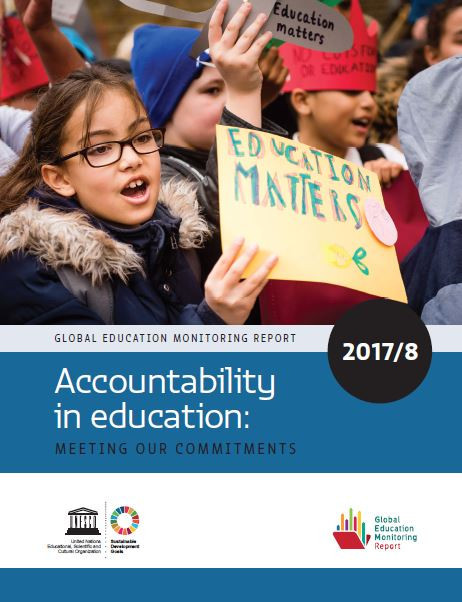 Accountability in Education: Meeting Our Commitments: Global Education Monitoring Report, 2017/8 Year of publication: 2017 Corporate author: UNESCO The second edition of the Global Education Monitoring Report (GEM Report) presents the latest evidence on global progress towards the education targets of the UN Sustainable Development Goals.With hundreds of millions of people still not going to school, and many not achieving minimum skills at school, it is clear education systems are off track to achieve global goals. The marginalized currently bear the most consequences but also stand to benefit the most if policy-makers pay sufficient attention to their needs. Faced with these challenges, along with tight budgets and increased emphasis on results-oriented value for money, countries are searching for solutions. Increased accountability often tops the list.The 2017/8 GEM Report shows the entire array of approaches to accountability in education. It ranges from countries unused to the concept, where violations of the right to education go unchallenged, to countries where accountability has become an end in itself instead of a means to inclusive, equitable and high-quality education and lifelong learning for all.The report emphasizes that education is a shared responsibility. While governments have primary responsibility, all actors – schools, teachers, parents, students, international organizations, private sector providers, civil society and the media – have a role in improving education systems.The report emphasizes the importance of transparency and availability of information but urges caution in how data are used. It makes the case for avoiding accountability systems with a disproportionate focus on narrowly defined results and punitive sanctions. In an era of multiple accountability tools, the report provides clear evidence on those that are working and those that are not.
  [Summary] Accountability in Education: Meeting Our Commitments: Global Education Monitoring Report Summary, 2017/8 Year of publication: 2017 Corporate author: UNESCO This summary of the 2017/8 GEM Report shows the entire array of approaches to accountability in education. It ranges from countries unused to the concept, where violations of the right to education go unchallenged, to countries where accountability has become an end in itself instead of a means to inclusive, equitable and high-quality education and lifelong learning for all.The report emphasizes that education is a shared responsibility. While governments have primary responsibility, all actors – schools, teachers, parents, students, international organizations, private sector providers, civil society and the media – have a role in improving education systems. The report emphasizes the importance of transparency and availability of information but urges caution in how data are used. It makes the case for avoiding accountability systems with a disproportionate focus on narrowly defined results and punitive sanctions. In an era of multiple accountability tools, the report provides clear evidence on those that are working and those that are not.
 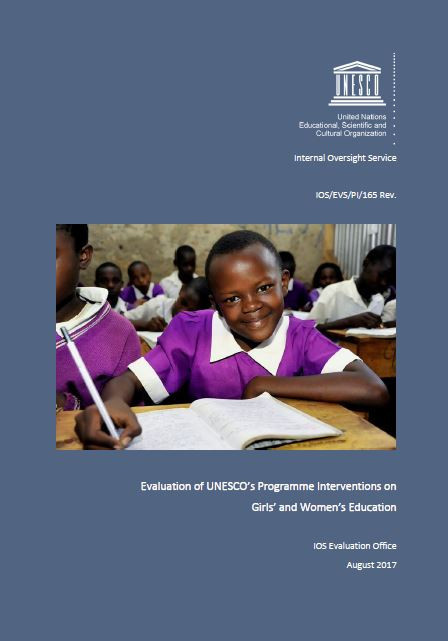 Evaluation of UNESCO's Programme Interventions on Girls' and Women's Education Year of publication: 2017 Author: Michael Reynolds, Martina Rathner, Estelle Loiseau Corporate author: UNESCO Internal Oversight Service (IOS) Since 2008, Gender Equality has been one of two global priorities for UNESCO. In May 2011, UNESCO launched the Global Partnership for Girls’ and Women’s Education, also known as “Better Life, Better Future”, which aims to increase learning opportunities for adolescent girls and women and to find solutions to some of the biggest obstacles to their education. To further advance the global priority of Gender Equality, since 2015 a dedicated Section of Education for Inclusion and Gender Equality specifically addresses the gender dimensions in education that contribute to differential access, participation, completion, and learning outcomes by boys and girls, and men and women. The evaluation examines UNESCO’s programme interventions in girls’ and women’s education during the period 2015 to 2017, in particular to ascertain the relevance, effectiveness, efficiency and sustainability of initiatives, and to clarify the strategic role and positioning of the Organization in supporting girls’ and women’s education at regional and country levels.The evaluation found that although UNESCO’s efforts for enhancing girls’ and women’s education are clearly aligned to SDG 4 and SDG 5 and also broadly in line with the overall principle of leaving no one behind, there is at times a trade-off between targeting the hardest to reach and other donor priorities, and UNESCO needs to more clearly position its efforts in support of girls’ and women’s education and its niche in the 2030 Agenda. Furthermore, continued efforts are required to scale up and/or replicate small-scale interventions, to better ensure sustainability and to consolidate mechanisms for coordination and information sharing among different interventions to seize synergies and enhance organizational learning.
 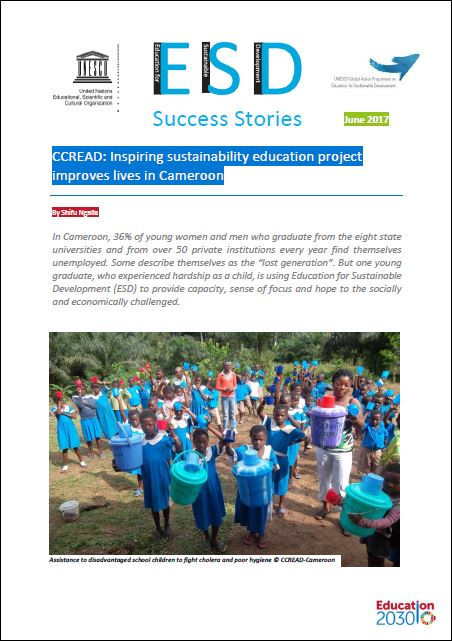 CCREAD: Inspiring Sustainability Education Project Improves Lives in Cameroon Year of publication: 2017 Author: Shifu Ngalla Corporate author: UNESCO This article is about sustainability education project in Cameroon. In Cameroon, 36% of young women and men who graduate from the eight state universities and from over 50 private institutions every year find themselves unemployed. Some describe themselves as the “lost generation”. But one young graduate, who experienced hardship as a child, is using Education for Sustainable Development (ESD) to provide capacity, sense of focus and hope to the socially and economically challenged.
  Safeguarding Heritage to Build Peace (SangSaeng no. 49 Winter 2017) Year of publication: 2017 Corporate author: APCEIU The 49h issue of SangSaeng, “Safeguarding Heritage to Build Peace,” has been published. All ancient civilizations have contributed in some way to the development of modern society. Therefore, all are equally deserving of study. This edition of SangSaeng aims to examine heritage in its different contexts and to help identify our responsibilities as a global community to understand and tolerate other people’s heritages. 3 Director’s Message4 Special Column4 Taking Stewardship of Our Planet8 Focus: Heritage8 Heritage for Peace and Prosperity12 Heritage Education: Opportunity to Enhance Cultural Literacy17 Photo Essay: World Heritage Sites of 2017 21 Special ReportUNAI Impacts Scholarship, Research for Greater Good24 Best Practices24 Frontier Education on the Frontier for Life29 Encouraging the Heart of the Matter33 InterviewGCED Challenge Issued36 Youth NetworkYouth Building Peace 40 LetterJourney to the Heart of Peace42 Peace in My MemoryPeace in a World of Violence46 Understanding the Asia-Pacific RegionEgg, Tambourine and Commemoration49 APCEIU in Action
  UNESCO and Gender Equality in Sub-Saharan Africa: Innovative Programmes, Visible Results Corporate author: UNESCO For over twenty years, UNESCO’s work in Africa has been undertaken in a specific framework with a range of institutional mechanisms designed to help translate into action its priorities: Africa and gender equality. During this period, UNESCO achieved important results in the areas covered by its mandate to promote gender equality.This publication highlights UNESCO’s contribution to the implementation of the African Union’s Agenda 2063 and the 2030 Agenda for Sustainable Development of the United Nations, in the field of gender equality in Africa, through examples of good practice, lessons learnt as well as suggestions and recommendations for the future.
  Interculturalism at the Crossroads: Comparative Perspectives on Concepts, Policies and Practices Year of publication: 2017 Author: Fethi Mansouri Corporate author: UNESCO Today most societies across the world are witnessing rising levels of social and cultural diversity brought about by globalisation and in particular increased human mobility and significant advances in information and communications technologies. The dilemma, therefore, has been how best to manage the resultant diversity and what optimal social policy paradigms to adopt towards this end.Assimilation, multiculturalism and presently interculturalism have all been proposed as possible policy conduits for managing socio-cultural diversity.This book, in focusing on the latter concept, and in particular in its intercultural dialogue manifestation, offers at once theoretical examinations, policy discussion and practical explorations of its uptake across the world. The core argument connecting the book’s three distinct sections is that whilst assimilation in its racist manifestation is no longer a viable option in today’s world, intercultural dialogue within existing multicultural settings has much to offer.
  [Video] The Ten Targets of the Sustainable Development Goal 4...with Elyx Year of publication: 2017 Corporate author: UNESCO This new UNESCO animation explaining the ten targets of the Sustainable Development Goal 4.Together with Elyx, the UN's first digital ambassador, discover how to ensure inclusive and quality education for all and promote lifelong learning.