
Resources
Explore a wide range of valuable resources on GCED to deepen your understanding and enhance your research, advocacy, teaching, and learning.
8,370 Results found
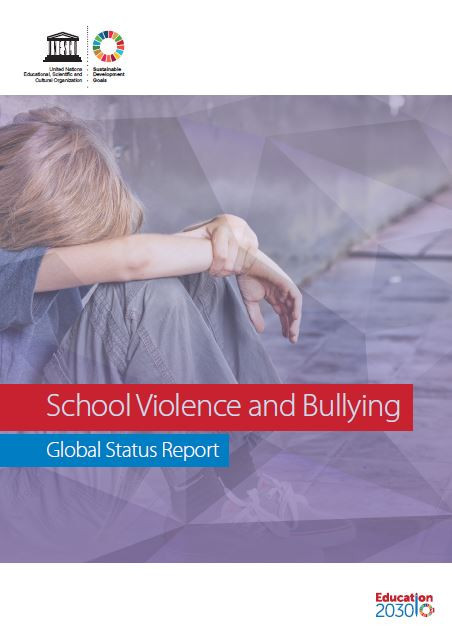 School Violence and Bullying: Global Status Report Year of publication: 2017 Corporate author: UNESCO School violence and bullying occurs throughout the world and affects a significant proportion of children and adolescents. It not only negatively impacts their educational outcomes, but harms their physical health and emotional well-being.This report aims to provide an overview of the most up-to-date available data on the nature, extent and impact of school violence and bullying and efforts to address the problem. It was prepared by UNESCO and the Institute of School Violence and Prevention at Ewha Womans University for the International Symposium on School Violence and Bullying: From Evidence to Action, Seoul, Republic of Korea, 17 – 19 January, 2017.
  Becoming Citizens in a Changing World: IEA International Civic and Citizenship Education Study 2016 International Report Year of publication: 2017 Author: Wolfram Schulz, John Ainley, Julian Fraillon, Bruno Losito, Gabriella Agrusti, Tim Friedman Corporate author: International Association for the Evaluation of Educational Achievement (IEA) The International Civic and Citizenship Education Study 2016 (ICCS 2016) investigated the ways in which young people are prepared to undertake their roles as citizens in a range of countries in the second decade of the 21st century. It studied students’ knowledge and understanding of civics and citizenship as well as students’ attitudes, perceptions, and activities related to civics and citizenship. Based on nationally representative samples of students, the study also examined differences among countries in relation to these outcomes of civic and citizenship education, and explored how cross-national differences relate to student characteristics, school and community contexts, and national characteristics. As the second cycle of this study, ICCS 2016 is a continuation and an extension of ICCS 2009.
 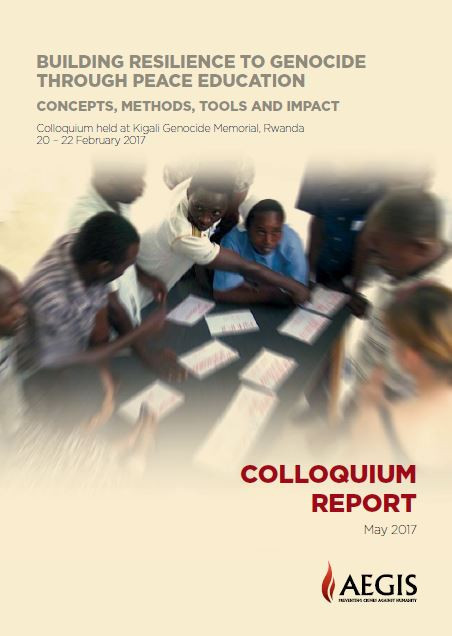 Colloquium Report: Building Resilience to Genocide through Peace Education: Concepts, Methods, Tools and Impact Year of publication: 2017 Author: Jonathan Bower, Mariana Goetz Corporate author: Aegis Trust A three-day Colloquium in Kigali in February brought together academics and practitioners in and around the field of peace education to share concepts, methods and means of measuring impact, contributing to a stronger evidence base for the effectiveness of peace education. Three interesting takeaways from the Colloquium: 1. Building resilience against genocide requires critical thinking about the process of identity-based violence and its reversal.2. The content of peace education programmes matters: interactive role-play type activities have been shown to have a longer lasting impact.3. Unhealed wounds need to be addressed to prevent a repeat of violence; psychosocial support must accompany peace education to reduce anxiety, which can be an obstacle when accessing empathy. A major achievement resulting from the consortium’s advocacy has been that the Government of Rwanda through the Ministry of Education has integrated Peace and Values education into the school curriculum. In a new phase of work Aegis is now supporting the implementation of the revised national curriculum that has integrated peace and values education (2016-19).
  Conceptualizing Intercultural Understanding within International Contexts: Challenges and Possibilities for Education Year of publication: 2017 Author: Fethi Mansouri, Ruth Arber Corporate author: UNESCO This chapter interrogates the ways in which intercultural conception has been defined in diverse contexts, providing the framing context for policy and curriculum measures to work with the manifestations of global population movement, diversity and change. It asks questions the ways in which conversations about intercultural understanding can be broadened to consider how entrenched systemic inequalities, the underlying notional and institutional frameworks that support them, and the mono-cultural and specific privileges and oppression, which are so often their enduring outcome, can be dismantled. To that end, it examines how policy and notional and practical work, in relation to intercultural understanding, can better encompass structural and cultural change regarding the ways in which cross cultural encounters and intercultural relations are shaped and take place.
  Backtalk: The Participatory Film and Its Residency in the Space of Cultural Violence and Creative Education towards a Conceptual Understanding of Peace Year of publication: 2017 Author: Ruchika Gurung Corporate author: Mahatma Gandhi Institute of Education for Peace and Sustainable Development (MGIEP) Cultural violence is defined as the beliefs, attitudes and values that justify structural and direct violence (Galtung 1990). It dulls us into seeing exploitation and repression as normal or in not actively witnessing it, and the media plays a vital role in its dissemination. Media and in particular film studies occupies a space through which notions of culture, ideology, peace and violence are negotiated.While the observational approach to film is well established in education, participatory filmmaking as an educational tool is what this paper addresses, with reference to concepts of cultural violence and peace education.This paper uses Brantmeier’s (2011) five stage model, that encourages social and cultural change towards a future that is nonviolent, sustainable and renewable, and Bery’s (2003) conceptualisation of empowerment to propose that participatory film functions as a transformative creative process and challenges notions of identity and culture while helping learners describe the world around them (Zembylas & Bekerman 2013).Through analysing existing cases in the field of participatory video (Schwab-Cartas & Mitchell 2014), the author argue that participatory film functions as a tool for creative education practices that promotes a more hands-on approach to raising awareness about cultural violence and engaging with identity formation, and as a creative tool for knowledge creation and dissemination.
  Empathy, Perspective and Complicity: How Digital Games can Support Peace Education and Conflict Resolution Year of publication: 2016 Author: Paul Darvasi Corporate author: Mahatma Gandhi Institute of Education for Peace and Sustainable Development (MGIEP) This paper will address how digital games may be uniquely suited to further the work of peace education and conflict resolution. There is a scarcity of research that specifically studies how digital games, as dynamic and interreactive learning tools, can be leveraged to support and enhance the closely related fields of peace education or conflict resolution; however, research in a number relevant sectors will be recruited to better understand the topic and expose gaps for further work. After defining basic terms, the first section will briefly discuss the aims of peace education and interactive conflict resolution and how digital games can assist in facilitating intergroup contact and collaboration. The heart of the paper will examine several serious games for their potential to cultivate perspective-taking and empathy, explore ethical dilemmas, promote intercultural understanding and encourage a sense of complicity, all crucial components in the work of peace education and conflict resolution. The final section will discuss the importance of context and reflection when implementing digital games and consider whether they can produce long-term, sustainable changes to behaviors and attitudes.
  MGIEP Annual Report 2015-2016 Year of publication: 2017 Corporate author: Mahatma Gandhi Institute of Education for Peace and Sustainable Development (MGIEP) The Mahatma Gandhi Institute of Education for Peace and Sustainable Development (MGIEP) is UNESCO’s first Category I institute in the Asia-Pacific region, established with the generous support of the Government of India.UNESCO MGIEP focuses on transforming current education policies and practices by developing innovative teaching and learning methods. Their objective is to build generations of young people equipped to create peaceful and sustainable societies.This annual report describes MGIEP’s main works and various educational programmes for peace and sustainable development.
  Survey on Privacy in Media and Information Literacy with Youth Perspectives Year of publication: 2017 Author: Sherri Hope Culver | Alton Grizzle Corporate author: UNESCO Media and information literate individuals are more empowered to make informed decisions about their privacy online and offline, among other things. Accordingly, governments and policy-makers who are committed to ensuring that the privacy of citizens is respected should also be committed to media and information literacy (MIL) for all. If they are not, then their efforts will be less sustainable. Equally, private and public enterprises that genuinely want to respect the privacy of citizens should purposefully contribute to MIL awareness among users qua citizens. Two research surveys are referenced in this report. The first investigated youth attitudes towards MIL and social and democratic discourses. One of the seven themes addressed in the context of social and democratic discourses was privacy. The research was carried out by UNESCO. The second survey studied privacy in MIL courses globally and was conducted for UNESCO by the UNESCO-UNAOC University Network on Media and Information Literacy and Intercultural dialogue (MILID Network), and members of the Global Alliance for Partnerships in Media and Information Literacy (GAPMIL). The report responds to UNESCO’s efforts to stimulate global research into privacy in MIL. Ultimately, this report aims to provide conceptual, development and policy recommendations to foster privacy in MIL, while enabling the critical engagement of people, including young women and men, in an environment conducive to sustainable development and to freedom of expression online and offline. It seeks to provide clarity on the complex issue of how MIL and privacy intersect.
  The Elusive and Exclusive Global Citizen Year of publication: 2015 Author: Jill Koyama Corporate author: Mahatma Gandhi Institute of Education for Peace and Sustainable Development (MGIEP) In this paper, the author interrogate the notion of global citizenship, both as an aspiration and an improbable practice, by situating it within contemporary understandings of citizenship and globalization.It is a conceptualization that suffers from the dangers inherent in the term “citizenship” and misconceptions of the terms “global,” and it is rooted in the West’s long engagement in normative undertakings in non-Western countries. The writer refute ideas of the autonomous and agentic global citizen. he encourage a rethinking of global citizenship and global citizenship education (GCE) and offer recommendations for redirecting attention to contemporary global stratifications and issues of human rights to address the issues of social justice and inequality that, due to the problematic definition of global citizenship, are currently inadequately covered in existing GCE curricula.
  UNESCO at COP23: Climate Change Education Year of publication: 2017 Corporate author: UNESCO This brochure contains information about UNESCO's role of education in climate change through ESD(Education for Sustainable Development). Education for Sustainable Development (ESD) is increasingly recognized around the world as an effective enabler for a more sustainable future. Building climate change awareness and building capacities for adaptation and mitigation are critical dimensions of ESD. The critical role of education in climate change responses was clearly recognized at the Paris Climate Conference (COP21) in December 2015. COP22 in Marrakesh and COP23 in Bonn reiterate the importance of climate change education in achieving the global agendas.